
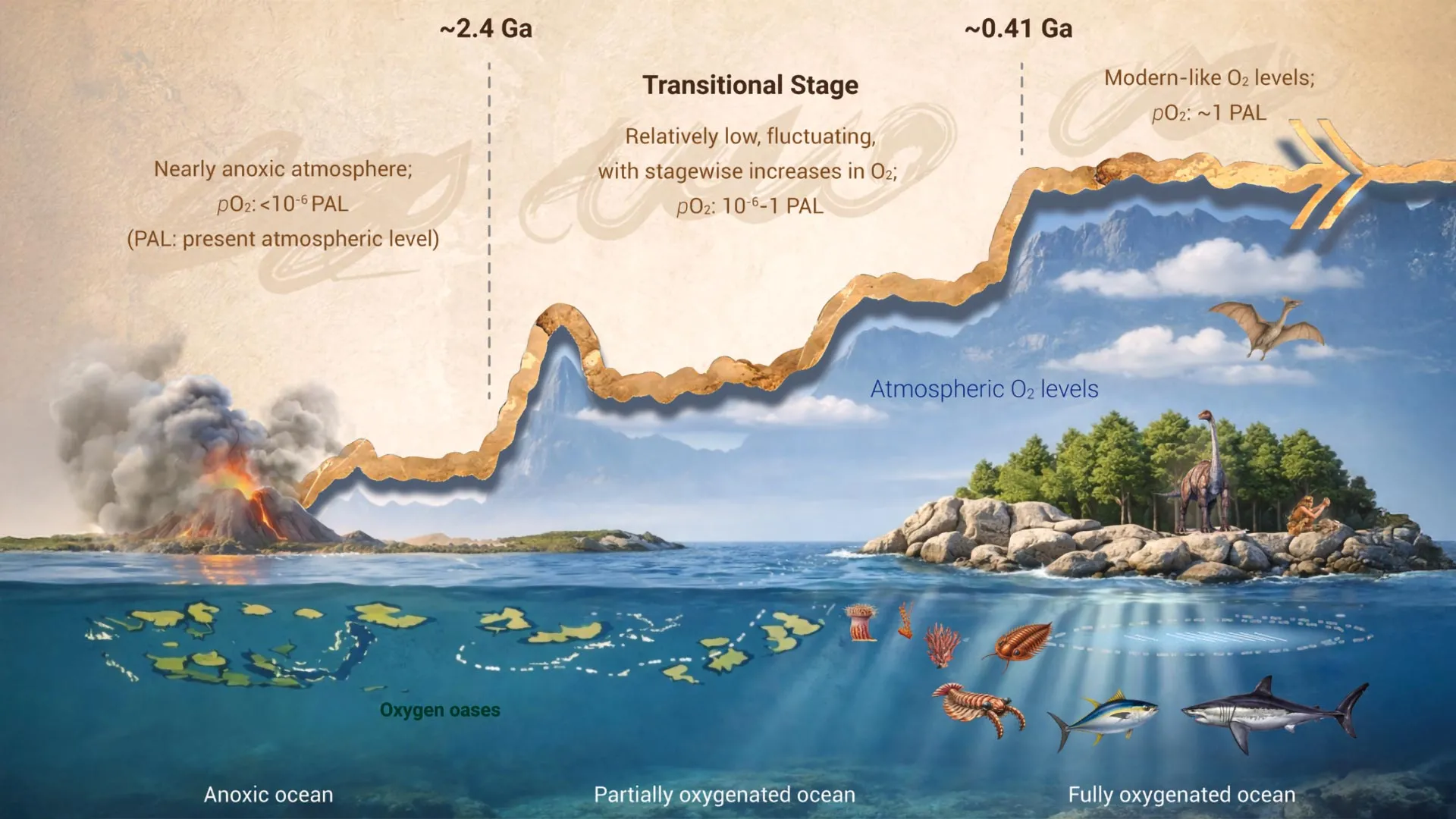
Two geochemists from Chengdu University of Technology said Earth’s oxygen history looks different than we thought. They used chemical signals in rocks instead of ocean data to track atmospheric changes. Their work showed that oxygen levels rose much earlier than old timelines suggested, proving oceans often lagged behind the air.
Two geochemists from Chengdu University of Technology have presented this revised timeline in The Innovation. Their findings challenge the traditional understanding of Earth's oxygen history by examining chemical evidence that reflects conditions in the ancient atmosphere rather than relying primarily on measurements of ocean chemistry.
Ancient Rocks Reveal a Different Oxygen Timeline
Scientists have traditionally reconstructed Earth's atmospheric oxygen levels using chemical clues preserved in ancient ocean sediments. However, the amount of oxygen in seawater is influenced by many factors besides the atmosphere, including nutrient availability, biological productivity, ocean circulation, and the shapes of ocean basins. This makes ocean chemistry an imperfect guide to conditions in the air.
The researchers instead focused on sulfate, a chemical compound that can preserve a distinctive signal from atmospheric oxygen. Reactions involving oxygen, ozone, and carbon dioxide in the atmosphere produce an unusual shortage of the oxygen isotope oxygen-17. When sulfide minerals undergo weathering, this chemical fingerprint is transferred into sulfate, which can eventually become preserved in sedimentary rocks. By examining these signatures, scientists can gain a more direct picture of how atmospheric oxygen changed over time.
According to this evidence, Earth's first major increase in oxygen occurred during the Great Oxidation Event, between 2.4 billion and 2.1 billion years ago. Atmospheric oxygen rose from less than one-millionth of today's concentration to somewhere between 0.1% and 10% of modern levels.
The second major increase took place approximately 1.3 billion to 1.0 billion years ago, followed by a third between 440 million and 410 million years ago. Both occurred earlier than conventional timelines suggest.
Under this interpretation, the well-known Neoproterozoic and Paleozoic oxygenation events, traditionally dated to 800 million to 500 million years ago and 420 million to 360 million years ago, mainly reflect delayed changes in ocean oxygen levels. The oceans responded roughly 200 million and 30 million years after the corresponding atmospheric increases.
Earth's Atmosphere and Oceans Did Not Always Change Together
Despite these major increases, oxygen remained relatively scarce throughout much of Earth's history. Models based on the isotope evidence suggest that atmospheric oxygen during the middle Proterozoic reached only about 0.1% to 1% of present-day levels.
Another clue comes from the fossil record of charcoal. Because charcoal formation requires atmospheric oxygen concentrations of approximately three-quarters of modern levels, its absence from older rocks suggests that oxygen remained too scarce to support widespread burning. Charcoal first appears in the geological record around 420 million years ago.
The researchers also highlight a surprising relationship between oxygen in the atmosphere and oxygen in the oceans. Over extremely long periods, the two generally increased together. However, on timescales of around a million years, they could move in opposite directions.
When additional oxygen entered the oceans, it could react with accumulated organic carbon and sulfide, consuming oxygen in the process. These reactions could reduce the amount of oxygen remaining in the atmosphere.
As a result, some chemical signals previously interpreted as evidence of rising oxygen may actually record periods when atmospheric oxygen was declining. This possibility could change how scientists interpret major fluctuations in Earth's ancient oxygen record.
Oxygen-Rich Oases Existed Billions of Years Ago
The spread of oxygen through Earth's oceans was also far from uniform. The researchers describe two major sources of oxygen in seawater: oxygen produced locally by photosynthetic microorganisms and oxygen absorbed from the atmosphere.
The first process created isolated pockets of oxygen-rich water as early as 3 billion years ago, possibly even earlier. These small oxygenated environments existed during the Archean, when the atmosphere and most of the oceans still contained very little free oxygen.
As atmospheric oxygen levels gradually increased, oxygen entering seawater from the air became more important. Eventually, this atmospheric supply overtook local biological production as the dominant mechanism driving widespread ocean oxygenation.
Even then, the transformation was remarkably slow. According to the proposed timeline, the deep ocean did not become fully oxygenated until approximately 410 million years ago, long after oxygen had begun accumulating in the atmosphere.
How Rising Oxygen Changed the Evolution of Life
These findings also offer a new perspective on the relationship between oxygen and the evolution of complex organisms.
When Earth's atmosphere contained virtually no oxygen, its absence placed a major restriction on oxygen-dependent life. During the Proterozoic, increasing oxygen availability gradually made new environments accessible, although concentrations continued to fluctuate as early animals evolved.
Rather than acting as a single trigger for complex life, oxygen initially provided opportunities for biological innovation. Only after the third major atmospheric increase did higher oxygen levels become a powerful force supporting greater biological complexity.
This later transformation helped create conditions favorable for larger animals, more active predators, and organisms capable of occupying deeper marine environments.
The researchers acknowledge that important uncertainties remain. The available isotope record does not capture every change in detail, and absolute atmospheric oxygen concentrations after 1 billion years ago remain difficult to establish. Additional increases or decreases may have occurred without leaving sufficiently clear chemical evidence to identify them.
Nevertheless, the analysis proposes a major revision to the sequence of events that transformed Earth into an oxygen-rich planet. Rather than the oceans becoming oxygenated first and the atmosphere following, the evidence suggests that atmospheric oxygen increased well before the deep oceans responded.
That prolonged delay may have played an important role in shaping the environments where complex life emerged and evolved.