
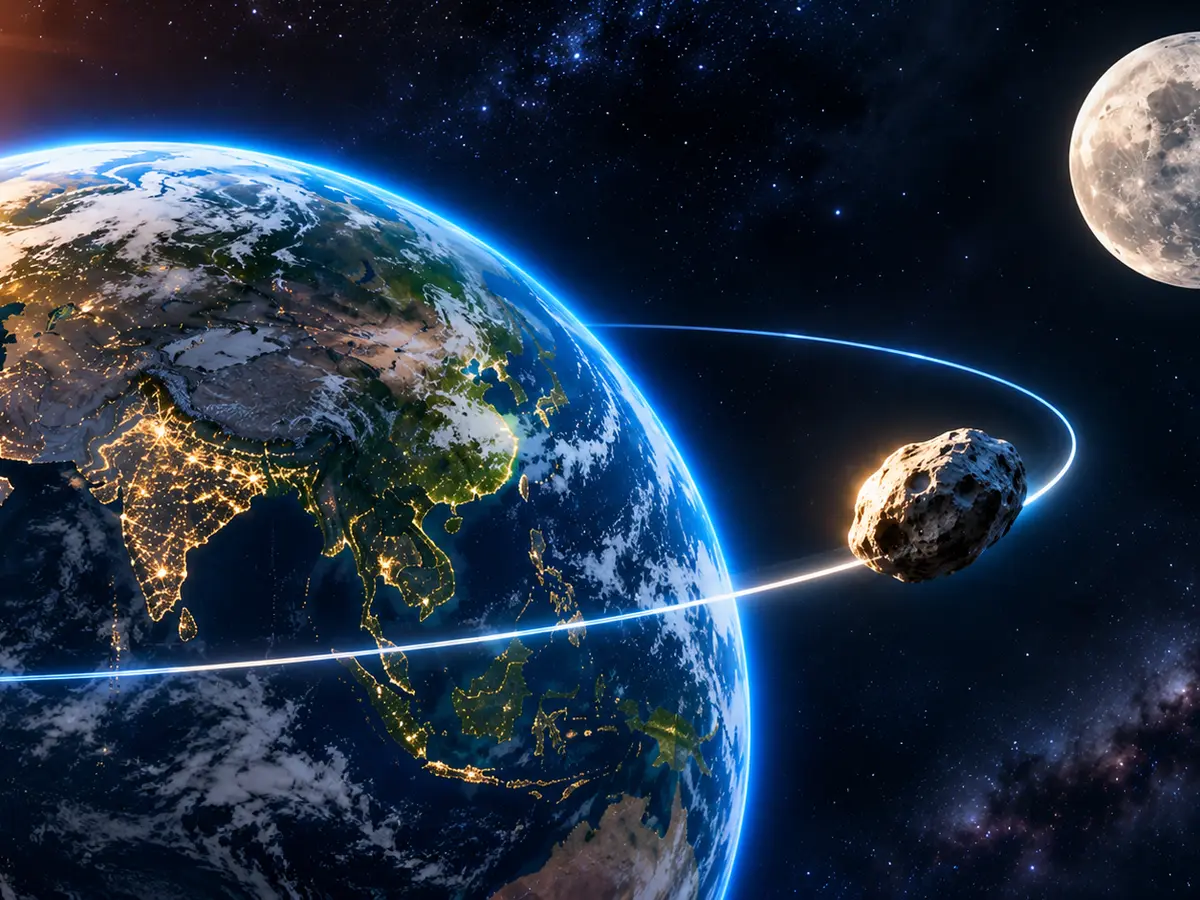
A two-metre asteroid named 2026 QQ8 has been caught in Earth's gravity since April. Astronomers confirmed it is a natural rock, not a defunct satellite. It will drift away in early December. Matthew Payne said, "There is no concern that 2026 QQ8 will hit Earth." It is just a visitor.
A two-metre asteroid named 2026 QQ8 has been caught in Earth's gravity since April and will drift away in early December. Weeks of telescope observations confirmed it is a natural rock, not a defunct satellite. Can it crash into our planet? Read more.
Earth has a small, temporary companion, a new "mini moon". The object is actually an asteroid, about two metres across, and has been caught in our planet's gravitational pull since April. It is expected to break free in early December and resume its journey around the Sun. Astronomers have named the Earth's new mini-moon '2026 QQ8'.
Interestingly, the object is so faint that it took weeks of observations to establish that it was a natural asteroid, rather than a defunct satellite or a piece of one. The Minor Planet Center, which tracks small bodies in the solar system, recorded the name in late October.
Notably, "mini-moon" is an informal label, not an official astronomical designation. Earth has had other temporary visitors: asteroid 2006 RH120 stayed for about a year, while 2020 CD3 orbited the planet for roughly three years.
Spotted by chance
Krisztián Sárneczky, an astronomer at Hungary's Konkoly Observatory, first spotted the object in August while searching for near-Earth asteroids. "I was searching for Near-Earth asteroids, as I have done on every clear night since 2020," he said. At first, he said, it looked like many other asteroids he had found. Its unusual orbit became clear only after further calculations.
Astronomers were divided over whether the object was natural or human-made. They tracked how solar radiation affected its movement over several weeks, using observations from telescopes in Arizona and Hawaii. Those measurements helped confirm it was a natural object.
The capture itself is not especially unusual. "On average, there's probably one there at any given time," said Matthew Payne, director of the Minor Planet Center. "They hang around for a few weeks or months. Sometimes it's none, sometimes it's a couple."
Can the mini-moon collide with Earth?
There is no concern that 2026 QQ8 will hit Earth. If it entered the atmosphere, Payne said, "At best, you would get a bright meteor in the sky and a bit of a bang."
Small objects like this are often missed because they are dim, distant and moving quickly across the sky. That may change as Chile's Vera C. Rubin Observatory begins its decade-long survey of the solar system. The project is expected to expand the known catalogue from about 1.5 million objects to five million.