
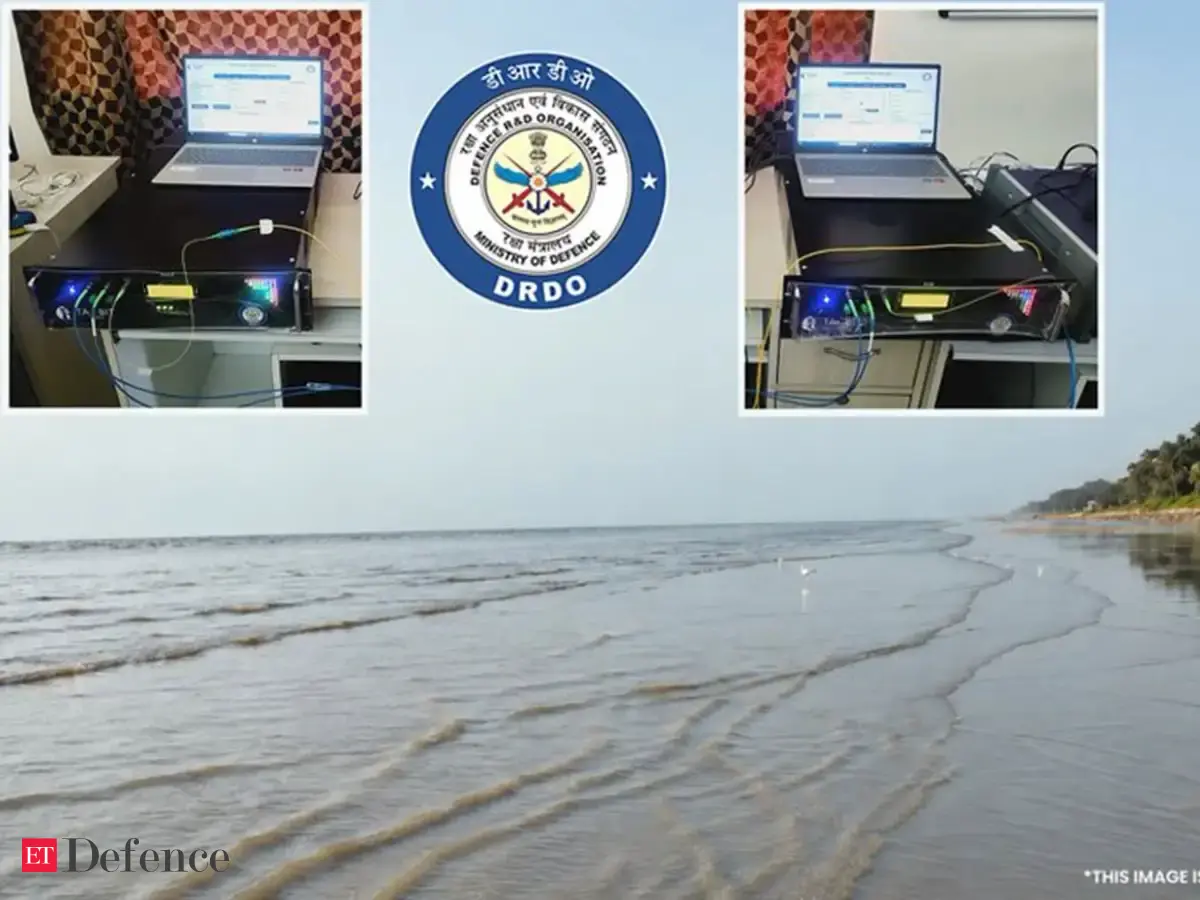
The DRDO successfully tested a Quantum Key Distribution platform in a live network on Wednesday. This new technology secures critical military communications for artillery and armored weapon tests. It provides unbreakable encryption and detects eavesdropping. The system was developed with Taqbit Labs to help protect India’s vital national security data.
The DRDO has successfully tested a Quantum Key Distribution platform in a live network environment. This advancement enhances India's capabilities in quantum-secured communications for critical military applications. The technology ensures secure communication for artillery and armored weapon tests while providing eavesdropping detection capabilities. Additionally, free-space QKD technology is being developed to facilitate communication in challenging terrains without optical fibers.
New Delhi: The DRDO on Wednesday announed that it had successfully configured and tested Quantum Key Distribution(QKD) platform in the live network of the dynamic test ranges at Proof & Experimental Establishment (PXE), Chandipur thereby advancing India's capabilities in quantum-secured communications.
According to the DRDO, this demonstrates the adept use case of QKD to fortify the real-time critical observations & telemetry associated with Artillery and Armoured Weapon tests and evaluation. Quantum Key Distribution (QKD) has been designed and developed under Microelectronic Devices, Computational Systems & Cyber Security (MCC) cluster of DRDO with production partner Taqbit labs and will aptly provide unconditional security added with eavesdropping detection.
Quantum key distribution utilizes the unique properties of quantum mechanical systems to generate and distribute cryptographic keying material using special purpose technology. Quantum cryptography uses the same physics principles and similar technology to communicate over a dedicated communications link. Published theories suggest that physics allows QKD or QC to detect the presence of an eavesdropper, a feature not provided in standard cryptography.
Quantum-resistant algorithms are implemented on existing platforms and derive their security through mathematical complexity. These algorithms used in cryptographic protocols provide the means for assuring the confidentiality, integrity, and authentication of a transmission-even against a potential future quantum computer.
Quantum communication provides fundamentally unbreakable encryption, making it a dual-use technology with applications in securing data in strategic sectors such as defence, finance, and telecommunications, as well as in protecting national security-related communications. Free-space QKD eliminates the need to lay optical fibers, which can be both disruptive and expensive, especially in challenging terrains and dense urban environments.
These technologies are being developed through DRDO-Industry-Academia - Centres of Excellence (DIA-CoEs) - an initiative of DRDO, where 15 Centres of Excellence have been established at premier academic institutes like IITs, IISc & Universities for development of cutting edge defence technologies.