
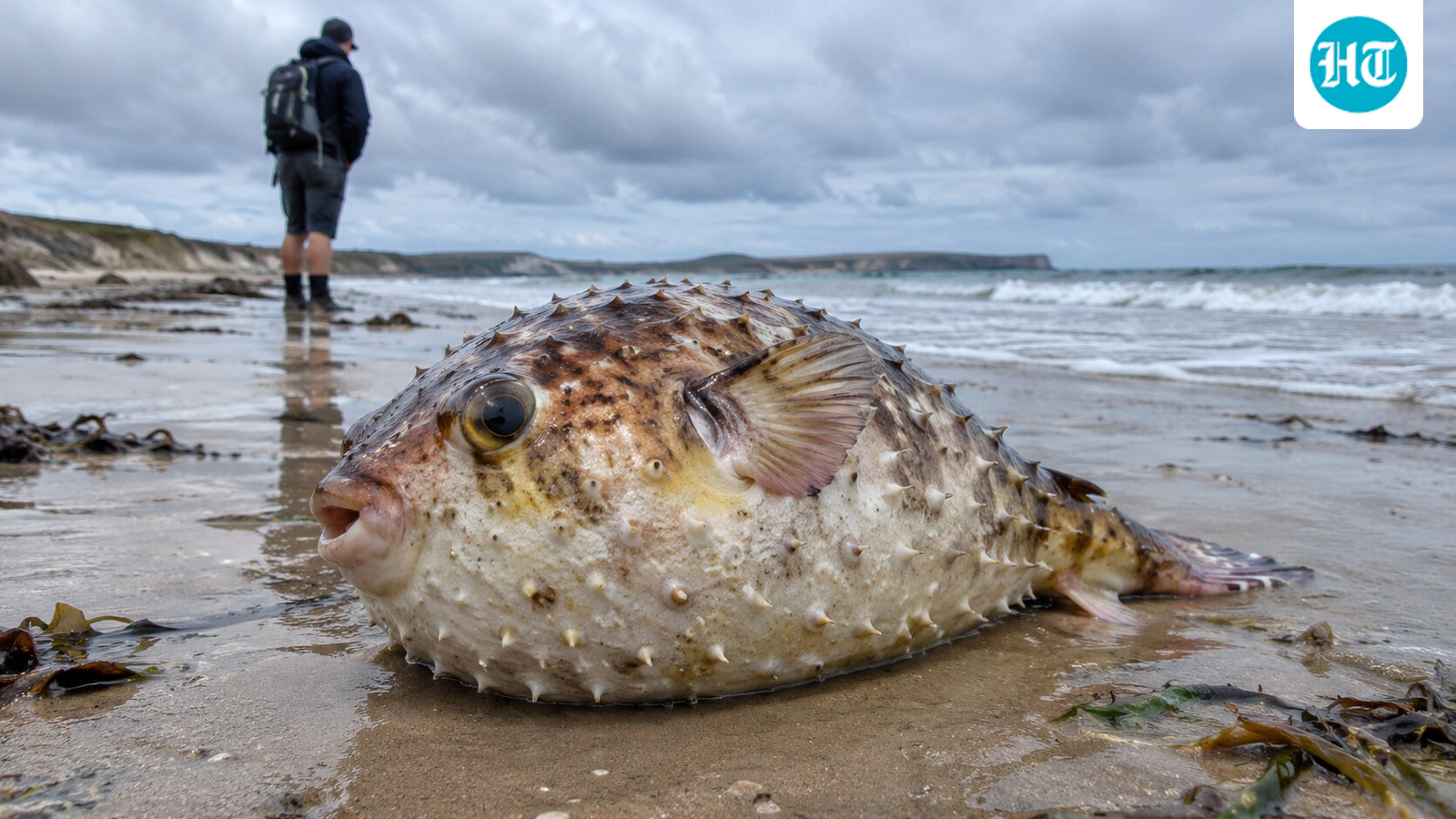
Owen Booty found a highly poisonous pufferfish on Knoll Beach in Studland, Dorset. He said, "I spotted what initially looked like a buoy or plastic bag washed up on the shore." The 17-inch fish likely drifted off course during storms. Experts warn that its skin remains dangerous even after death.
A diver walking along a beach in the UK mistook a mysterious object washed up on the shore for a buoy or plastic bag, only to discover that it was a highly poisonous tropical fish.
The unusual discovery was made by Owen Booty at Knoll Beach in Studland, Dorset. The dead pufferfish, measuring approximately 17 inches (43 cm), was found fully inflated on the sand.
According to a report by The Independent, the fish is believed to have been swept hundreds of miles off course by powerful storms.
Booty, who works with Freedive Life, spotted the strange object while walking along the beach after rough sea conditions prevented him from diving.
"I was out walking along Knoll Beach as the sea was a little too rough to get in the water, when I spotted what initially looked like a buoy or plastic bag washed up on the shore," he said.
He added: "I walked over to investigate and realised it was actually a dead fish. Having encountered pufferfish while diving abroad, I had a good idea what it was, but sent the photographs to Dorset Wildlife Trust and a friend who's a marine biologist for confirmation."
Describing his surprise, Booty said: "I spend a lot of time in the water exploring Dorset's coastline. We're fortunate to have some fantastic marine life right on our doorstep. But despite all the time I've spent diving locally, I certainly wasn't expecting to find a pufferfish washed up on the beach."
Pufferfish are generally found in tropical and subtropical waters of the Atlantic, Indian and Pacific oceans, making their appearance along Britain's coastline unusual.
The fish is believed to have reached Dorset following Storm Austen and Storm Boelo, although its exact journey remains unclear.
Pufferfish are known for their distinctive defence mechanism, which allows them to inflate their bodies into balloon-like shapes, making them difficult for predators to swallow.
Despite being dead, pufferfish can remain dangerous because their organs and skin may contain tetrodotoxin, a powerful neurotoxin.
According to the Natural History Museum, tetrodotoxin is more than 1,000 times as potent as cyanide and can cause paralysis and respiratory failure.
A spokesperson for Dorset Wildlife Trust said: "Usually found in open water in the warmer parts of the Atlantic as well as the Indian and Pacific oceans, these fish are a rare sight in the UK, but they do turn up occasionally."
The charity advised people not to handle pufferfish and urged anyone who spots one to report it.