
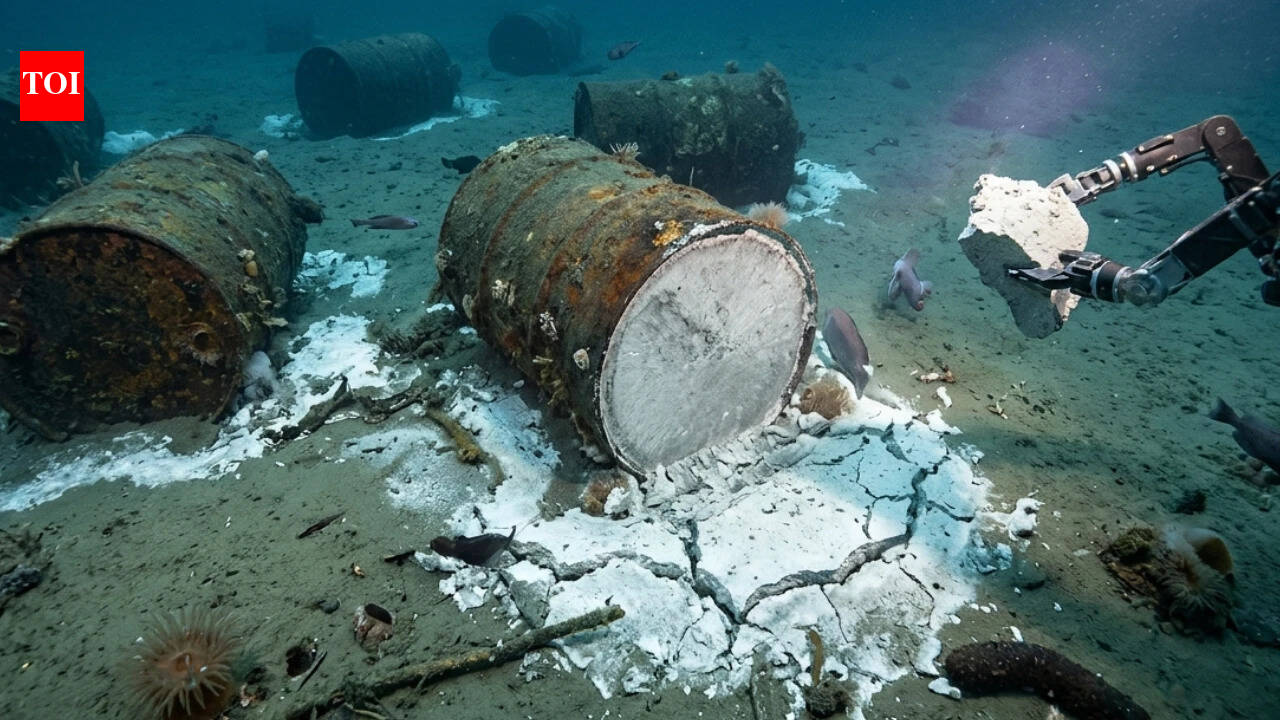
In 2025, scientists sampled white halos around ocean-floor waste barrels off Catalina Island and found pH 12 sediment hardened like concrete. Researchers used a remotely operated vehicle in 2021 to collect these samples. The study showed that alkaline waste leakage created unique conditions that now sustain deep-sea extremophile hotspots.
The ocean floor can preserve the effects of industrial activity long after the original containers begin to corrode. Decades-old waste barrels off Southern California have created unusual deposits in the surrounding sediment, offering scientists clues about how historical dumping continues to affect the deep-sea environment. A 2025 study by researchers at the Scripps Institution of Oceanography found white halos around some of the barrels, with a hard mineral concretion between each barrel and its halo. The researchers measured pH values of 8 to 12 in pore water extracted from thawed halo sediment samples, indicating alkaline conditions in the collected material. They cautioned that these post-collection measurements might not fully represent conditions on the seafloor. The concretion they sampled was mostly brucite, a magnesium hydroxide mineral. The study found evidence that some barrels contained alkaline industrial waste, but the researchers found no evidence linking the sampled barrels to the elevated DDT contamination in the surrounding sediment.
Thawed sediment samples recorded pH readings as high as 12The findings were published on September 9, 2025, in PNAS Nexus in the study titled Extremophile hotspots linked to containerized industrial waste dumping in a deep-sea basin. The paper reports that sediment cores were taken perpendicular to five deep-sea barrels and that halos around three of them contained calcite-rich, high-pH sediments dominated by low-diversity alkalophilic bacteria.
It also notes that a solid concretion sampled beside one barrel was brucite, supporting the idea that alkaline waste leakage created the conditions now sustaining these extremophile hotspots. During two remotely operated vehicle (ROV) dives in 2021, researchers collected sediment push cores around five barrels in San Pedro Basin at an average depth of 901 metres. This mission used the research ship Falkor and its remotely operated vehicle, SuBastian. Of these five barrels, three were accompanied by unique white haloes. The researchers thawed frozen sediment samples and measured the pore-water pH with pH strips. Pore-water samples from sediments surrounding the white halos had pH readings ranging from 8 to 12, indicating highly alkaline conditions. Sediments without halos had a pore-water pH of about 7.
However, the scientists noted that these measurements, taken after thawing samples, might be inaccurate for seafloor conditions. Researchers also discovered a hard concretion between one barrel and the surrounding white-halo sediment. The push core method did not allow penetrating this rock and samples were obtained with the help of a robotic manipulator arm of the remotely operated vehicle, SuBastian. Laboratory analysis identified brucite, a magnesium hydroxide mineral, as the predominant component of the concretion, with calcite, aragonite, mica and quartz also present.Brucite-rich concretions and calcium carbonate formed distinct structuresThe authors proposed that alkaline waste leaking into the sediment pore water supplied hydroxide ions, which reacted with dissolved magnesium ions to produce brucite-rich concretions around the barrels. The resulting hard mineral mass extended about one metre from the barrels. The formation of white halos took place in a slightly different manner. Brucite had the ability to dissolve slowly, releasing hydroxide in the process, thus maintaining alkalinity of the sediment.Alkaline pore water moving upward then caused calcium carbonate to precipitate near the edge of the concretion, forming the white halo. The team also examined the microorganisms living in the affected sediment. This is a possible explanation for how the halos formed and the authors present it as an interpretation of the mineral evidence rather than an observed process.Alkaline conditions were associated with distinctive microbial communitiesThe research further looked into microorganisms residing within the sediment that was impacted. Microbial communities in the halo zones were found to be less diverse, with dominance of alkaliphilic bacteria, meaning microorganisms that thrive in an alkaline environment. The scientists also experienced problems in extracting DNA from the microbes. The high pH readings and the dominance of alkaliphilic bacteria were consistent with alkaline conditions in the halo sediments. However, the microbial findings do not independently establish the exact pH conditions at the time of sampling. The authors noted that the pH readings were taken after the samples were thawed and may not reflect exact seafloor conditions, although a second method, using an electrode, gave consistent results. Extracting DNA from the halo sediments was also difficult, requiring repeated extractions and yielding small amounts of poor-quality DNA.The findings do not establish a link between the barrels and DDT contaminationThe study was initially focused on DDT pollution and the potential microbial degradation of it. DDT and its metabolites, collectively called DDX, were highly elevated compared with control sites outside the dumpsite. Their concentrations did not correlate with distance from the sampled barrels and no evidence was found to connect those barrels to DDT pollution. The paper gives an idea of the scale of industrial waste disposal in the San Pedro Basin. From 1961 until 1964, the Pacific Ocean Disposal Company dumped 1,382,000 gallons of alkaline waste in the basin. While this information helps to understand the origin of the discovery, it does not provide the composition of the sampled barrels. The findings demonstrate how historical waste disposal can leave lasting changes in the chemical and mineral composition of deep-sea sediment. The contents of the sampled barrels remain unknown, but the results showed the lasting effects of historical waste disposal.