
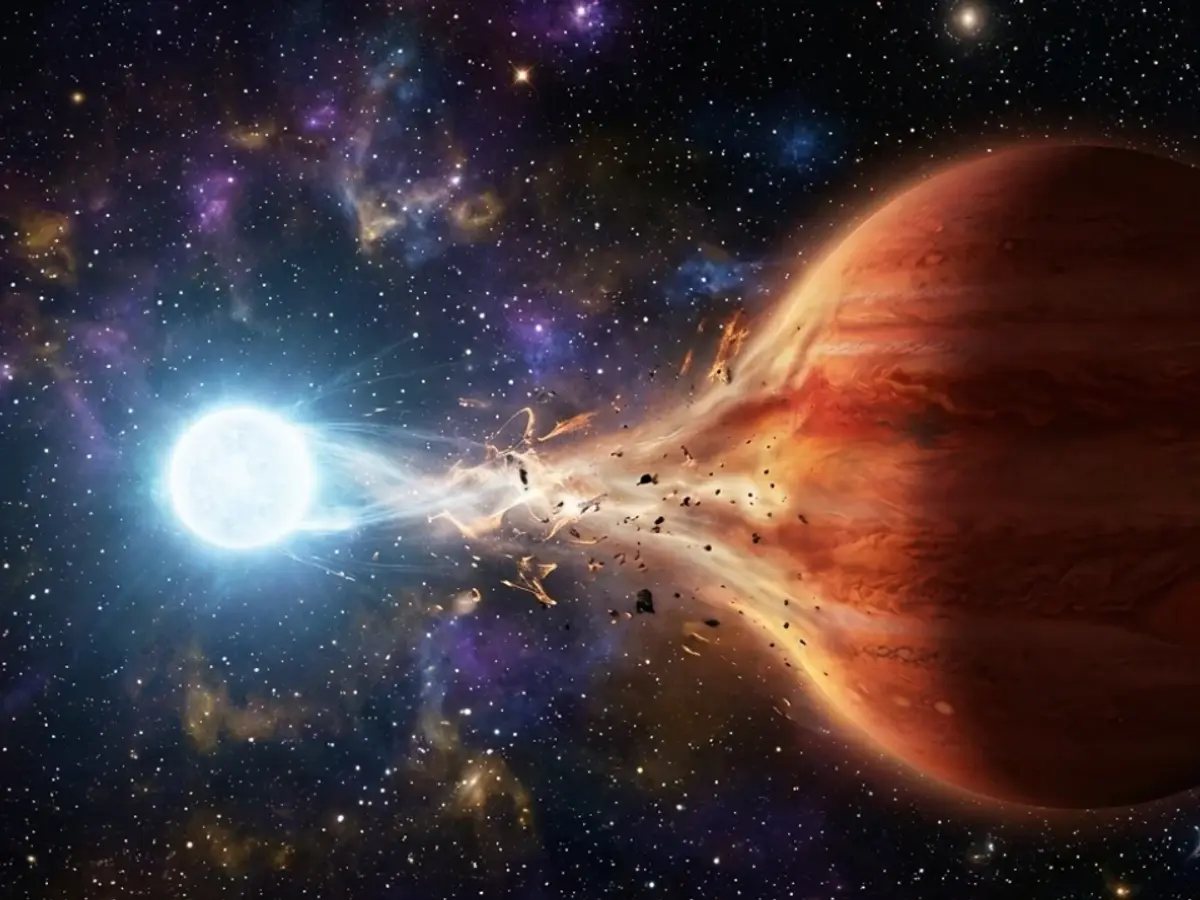
Astronomers found that the white dwarf HS 0209+0832 is destroying a planet that formed after the star died. Researchers at the University of Warwick studied Hubble data from 1999 to identify this rare second-generation world. This discovery shows how dead stars can give planets a strange new life.
A star's death triggered the birth of its planet in an observation that has left astronomers surprised. HS 0209+0832 is a white dwarf and has a large planet orbiting it. The dead star created a new planet and now the star is killing the planet again.
Scientists have discovered a planet that was likely born after its host star died. This is unlike anything that has been theorised till now about the death of a star and what happens to its planets. When the Sun dies, every planet in our solar system will meet its end in some way, as some will be swallowed by the growing Sun and others might turn into rogue planets. But in this case, the death of a star actually led to the birth of a planet.
Researchers at the University of Warwick state in a study published in Nature Astronomy that they may have found what is a "second-generation" planet orbiting a white dwarf. The finding shows that the death of a star might not be the end-all for planets, and they may get a second lease of life using their material.
A star that spawned a planet after its death
The star in question is HS 0209+0832, a white dwarf that is roughly the size of Earth. It is around 36,000 degrees Celsius and has been cooling for about five million years. Scientists studied data gathered by the Hubble Telescope in 1999, which observed roughly 100 unidentified absorption features in its ultraviolet spectrum. Researchers at the time couldn't match these chemical fingerprints to any known elements.
To see them around the dead star created a puzzle since the extreme gravity of a white dwarf pulls in heavy elements, most of which sink under the surface. Their presence in such huge amounts around the star indicated that material was falling onto the star from somewhere else. They were sure that it wasn't from asteroids or planets that had been torn apart.
Revisiting Hubble data
This time, when Jamie Williams, a doctoral researcher, studied the Hubble data, he found that a lot of the unidentified spectral lines were niobium, not seen as commonly in space. Others were copper and zinc, nickel and other elements. There was no iron and only a little silicon. This was very different from what is seen coming from a rocky planet. Observations from NASA's retired Far Ultraviolet Spectroscopic Explorer also revealed niobium.
When stars die, they manufacture elements. Our Sun turns hydrogen into helium during its life, and later helium fusion produces carbon and oxygen. In the final giant phase, the star releases all this material into space, which can contain a lot more than just gas and dust.
Presence of niobium
The slow neutron-capture process, or s-process, acts as a stellar forge where ageing asymptotic giant branch (AGB) stars capture neutrons onto atomic nuclei to synthesise heavier elements. Elements like niobium serve as distinct chemical signatures of this advanced stellar evolution. In the case of white dwarf HS 0209+0832, the accreted material shows a staggering niobium abundance exceeding solar levels by a factor of over 1,000.
Observations of the star's brightness taken by NASA's Transiting Exoplanet Survey Satellite (TESS) revealed a subtle signal repeating every 4.399 days. The star's brightness varied by only about 0.12 per cent. This hinted towards a giant "Phoenix" planet orbiting around six million kilometres from the white dwarf.
The star is still hot, and the radiation is stripping gas from the planet's atmosphere. In other words, it is feeding on the star that was born from its remains. This evaporation explains the bizarre chemical fingerprints observed in the white dwarf's light.