
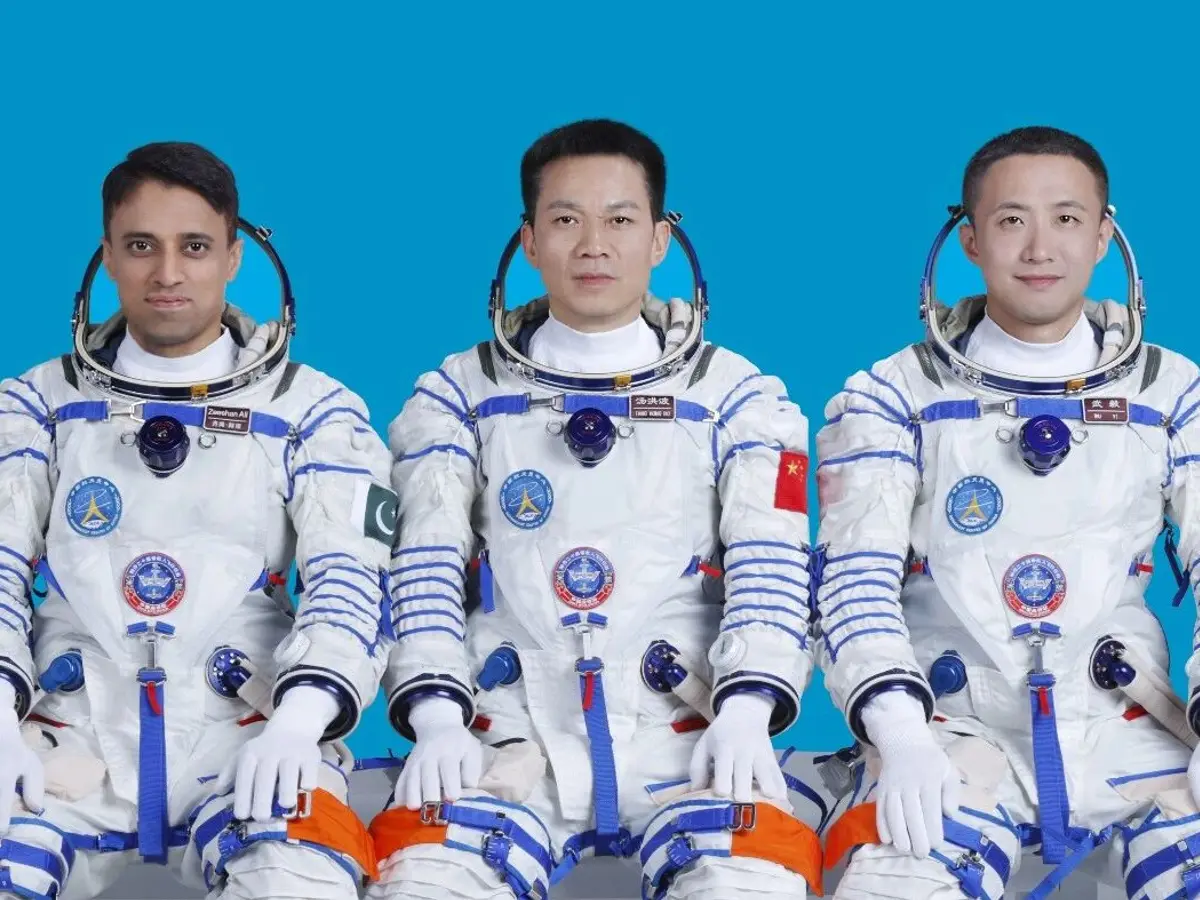
China will send its first foreign astronaut to the Tiangong space station on Wednesday. The Shenzhou-24 spacecraft carries Pakistani national Muhammad Zeeshan Ali and two Chinese astronauts. They will lift off at 8:18 am from the Jiuquan Satellite Launch Centre. The crew will conduct scientific experiments during their space mission.
Pakistani astronaut Muhammad Zeeshan Ali will become the first foreign national to visit China's Tiangong space station as part of the Shenzhou-24 mission.
China will send its first foreign astronaut to the Tiangong space station on Wednesday, when the Shenzhou-24 spacecraft carries Pakistani national Muhammad Zeeshan Ali and two Chinese astronauts.
The three-member crew is scheduled to lift off at 8:18 am local time (0018 GMT) aboard a Long March-2F rocket from the Jiuquan Satellite Launch Centre in northwest China. Ali is set to become the first Pakistani to undertake an orbital space mission.
The China Manned Space Agency (CMSA) said on Tuesday that preparations for the launch had been completed and all three astronauts were in good condition.
The crew comprises commander Tang Hongbo, 51, flight engineer Wu Yi, 39, and Pakistani payload specialist Muhammad Zeeshan Ali, 40.
Ali's participation follows a space cooperation agreement signed between China and Pakistan in February 2025. Earlier this year, Ali and another Pakistani candidate, Khurram Daud, began astronaut training alongside their Chinese counterparts. Ali was subsequently selected for the short-duration mission.
Shenzhou-24 will be the 41st mission of China's crewed space programme. It will also carry out a crew rotation, replacing astronauts currently aboard the Tiangong space station.
Ali is expected to return to Earth alongside outgoing crew members Zhang Zhiyuan and Lai Ka-ying, the first Hong Kong astronaut in space, who are completing their six-month mission. The two Chinese astronauts joining the station will remain in orbit for another six months, while Zhu Yangzhu will continue his stay for an additional six months, completing China's first year-long space mission.
The astronauts will also conduct scientific experiments and research during their stay.
The mission will study how the human body adapts to prolonged exposure to space and collect data for future crewed lunar missions and possible Mars exploration.
China aims to achieve its first crewed lunar landing by 2030 and establish the first phase of a manned scientific base on the Moon by 2035. The United States is also pursuing its lunar ambitions through NASA's Artemis programme.