
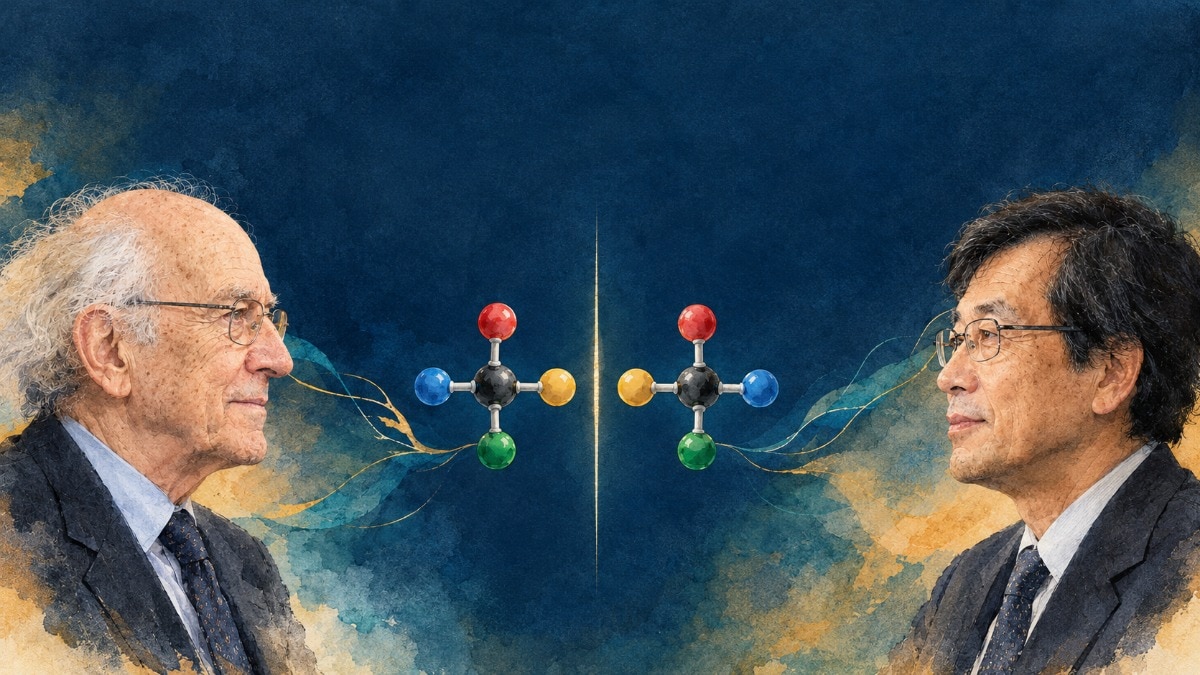
On October 7, the Royal Swedish Academy of Sciences gave the Nobel Prize in Chemistry to Henri B Kagan and Kenso Soai. They discovered how to build molecules that exist as mirror images. This work helps scientists make medicines safer and cheaper, as the body often reacts to only one form.
Think of the last tablet you swallowed. For many medicines, the molecule doing the work has a twin: the same atoms, joined in the same order, but a mirror image. One form heals. The other may do little, or cause side effects nobody wanted.
Your body can tell the twins apart, and so can your nose. One form of a molecule called carvone smells of spearmint. Its mirror image smells of caraway, an aromatic spice. For decades, making only the right twin in a laboratory was a stubborn puzzle.
This year's Nobel Prize in Chemistry honours two scientists who showed how to tip the odds. On October 7, the Royal Swedish Academy of Sciences gave the prize to Henri B Kagan of France and Kenso Soai of Japan for discovering non-linear effects and autocatalysis in asymmetric organic synthesis.
In simple terms, asymmetric organic synthesis means building carbon-based molecules so that one mirror-image form is made in preference to the other; a non-linear effect is when the product can come out purer than the catalyst would suggest; and autocatalysis is when a reaction's product also acts as that helper, speeding up its own making.
Kagan, born in 1930, is professor emeritus at what was then Universite Paris-Sud. Soai, born in Hiroshima in 1950, is professor emeritus at the Tokyo University of Science.
The citation is a mouthful. The idea behind it is simple. Kagan found that a small advantage in a chemical reaction can be made bigger. Soai built a reaction in which that advantage grows by itself until one mirror-image form takes over. Indian chemists say the work matters well beyond the laboratory, from the cost of medicines to the way young researchers are taught to think.
WHY MIRROR-IMAGE MOLECULES MATTER
Many molecules exist in two forms that are mirror images and cannot be laid on top of each other, exactly like hands. Chemists call this property chirality, from the Greek word for hand, and the two forms enantiomers. Life is fussy about them. All amino acids come in two mirrored variants, yet only one is found in the proteins in your cells. The sugars in DNA follow the same rule. This one-handedness is called homochirality.
Think of a handshake. A right hand fits neatly into another right hand, but offer it to a left hand and the grip goes wrong. The body works in a similar way. Its cells are full of structures that can treat the two mirror-image forms of a molecule very differently. One form may do the job it was meant to do. Its twin, built from the same atoms, may do little, or cause unwanted effects. The Nobel Committee recalls thalidomide, the sedative that left thousands of children with birth defects in the early 1960s.
Professor G Sekar, head of the chemistry department at IIT Madras, urges care. Thalidomide's two forms can convert into each other inside the body, so "it would be an oversimplification to describe one form simply as safe and the other as dangerous," he tells India Today Digital.
The answer, he says, is not to treat every drug alike. Whether a medicine needs a single mirror-image form depends on its safety, efficacy and regulatory requirements. Where it does, chemists use asymmetric catalysis, in which a catalyst steers a reaction towards one form. Kagan and Soai's discoveries gave chemists new tools to do that.
The puzzle is old. In the 1850s, Louis Pasteur separated two kinds of tartaric acid crystals with tweezers and found that bacteria ate only one of them. Yet, chemists who made such molecules in test tubes always got an equal mixture. In the early 1900s, Willy Marckwald tilted a reaction towards one form using a catalyst, a substance that speeds up a reaction without being used up. The tilt was tiny. It was the beginning.
THE RULE THAT KAGAN QUESTIONED
Until 1986, chemists believed a simple rule. If a catalyst was an impure mix of right-handed and left-handed forms, the product would carry the same mix. Purity went in, and the same purity came out, a straight line on a graph.
Kagan stopped to ask how the catalyst really works. In many reactions, it is built from a metal atom that holds on to two helper molecules, and each helper is either right-handed or left-handed. In a mixed batch, the helpers pair up by chance, giving three kinds of pair: right with right, left with left, and a mismatched right with left. Kagan found that, in some reactions, the mismatched pair barely works. It sits out, and only the matching pairs do the job.
The Nobel Committee gives a simple example. Suppose a batch is 75 per cent right-handed and 25 per cent left-handed. Most matching pairs will be right with right, and left with left will be rare. The reaction therefore behaves as though the batch were 90 per cent right-handed and 10 per cent left-handed. A mixed batch becomes more one-sided in what it does.
The product can therefore be purer than the catalyst that made it. When Kagan and his colleagues published their results in 1986, the straight line bent into a curve. Chemists call this a non-linear effect.
Professor Kovuru Gopalaiah of Delhi University, who worked in Kagan's laboratory, says such results were at first often dismissed as "experimental error, poor measurement techniques, or sample contamination". Professor Santanu Mukherjee of the Indian Institute of Science, Bengaluru, calls the prize "a well-deserved recognition" and its timing "a pleasant surprise". He adds: "Many experts in the field of asymmetric catalysis felt that Professor Kagan should have been included in the Chemistry Nobel Prize back in 2001."
The discovery also became a clue. Professor Gopalaiah says a non-linear effect acts as "a distinct molecular fingerprint", telling chemists how a catalyst works inside the flask.
THE REACTION THAT MAKES MORE OF ITSELF
In 1953, Charles Frank of the University of Bristol, a theoretical physicist, worked out on paper how a tiny imbalance between mirror-image molecules could grow until one form dominated. He set three conditions: the substance must help make more of itself, favour its own mirror-image form, and hold back the opposite form. He ended with a dry remark: "A laboratory demonstration may not be impossible."
The first condition has a name, autocatalysis. It means the product of a reaction also acts as its catalyst. Professor Mukherjee puts it simply: as the reaction goes on, "more catalyst is produced, and the reaction becomes faster." Earlier asymmetric catalysis supplied the second condition. Kagan's mismatched pairs supplied the third.
Soai put them together. In the early 1990s, he noticed that the catalyst and product of one reaction looked alike, and wondered whether a reaction could make its own catalyst. After trying many molecules, he found one. In a short 1995 paper in Nature, his team showed that a small head start for one form could be built up to about 90 per cent in five consecutive runs, each using the previous product as the catalyst.
Professor Mukherjee suspects the first signs were lucky, saying Soai's initial findings "must have been accidental". The Nobel Committee describes trial and error guided by a clear idea.
By 2003, Soai had a reaction that began with ingredients that had no handedness at all. Both forms appeared at first, chance gave one a slight lead, and that lead was enough. In one version, a head start of 0.00005 per cent, roughly one extra molecule of the favoured form in every two million, grew to more than 99.5 per cent in three runs. That is an amplification of about 630,000 times, according to the committee's scientific background.
Picture a pencil balanced on its tip. Which way it falls depends on a disturbance too small to see, but once it begins to tilt, nothing stops it. In one set of 37 Soai experiments, 18 ended up dominated by one form and 19 by the other, chance deciding each time.
Professor Mukherjee adds a caution. Autocatalysis "is not a general phenomenon," he says, and the Soai reaction "is a very special case."
WHAT THE PRIZE DOES NOT PROVE
It is tempting to read Soai's reaction as the story of how life chose its hand. The Nobel Committee urges restraint. Life's one-handedness took shape about 3.5 to 4 billion years ago, and the committee says we will probably never have a definitive answer. The Soai reaction is a proof of concept, it says, and not relevant to the emergence of homochirality in watery systems.
Indian chemists agree. Professor Gopalaiah calls it "a powerful proof of concept rather than a literal model of prebiotic chemistry." Professor Indresh Kumar of BITS Pilani writes that "it is important not to overstate the conclusion". Professor Sekar says Soai's work "demonstrates a possible mechanism for amplifying chirality, rather than proving exactly how life acquired its molecular handedness."
HOW INDIA'S MEDICINE MAKERS COULD GAIN
The prize hands no Indian company a ready-made product. What it offers is a way of thinking that can lower the cost of making pure medicines, and India makes a great many medicines. An Indian embassy brochure describes the country as the world's largest provider of generic medicines by volume, with about 20 per cent of global supply.
Purity is the heart of the matter. Because of non-linear effects, makers do not always need perfectly pure catalysts to get a pure product. Professor Gopalaiah says industry can work with catalysts that are around 70 per cent pure rather than 99 per cent, which cuts the cost of repeated purification and reduces chemical waste.
The committee's scientific background gives a striking example. Researchers at Merck, making a drug candidate called L-699,392, used a starting material only 70 per cent pure and still obtained a product 95 per cent pure.
There is an Indian thread here too. Professor Sekar says Dr Tummanapalli Satyanarayana, now at Curia India in Hyderabad, worked with Kagan and co-wrote a major review of non-linear effects in asymmetric catalysis. Professor Sekar adds that Indian researchers already work on new chiral catalysts and on methods for making complex mirror-image molecules.
Professor Gopalaiah says his time with Kagan gave him the confidence to use very low-cost iron bromide and copper bromide catalysts in his group at Delhi University. None of the scientists put a rupee figure on possible savings, so the size of the gain remains to be shown.
WHAT ELSE DO INDIAN SCIENTISTS SAY?
Professor Gopalaiah remembers Kagan as a teacher. He says, "The way Professor Henri Kagan mentored his postdocs and students was exceptionally meticulous; he taught us how to think and operate independently." Kagan, he notes, is now 95.
The laureates' ties to India are personal. Professor Sekar says Kagan visited IIT Madras in 2005, gave a guest lecture and spent a day with the organic chemistry faculty. Professor Kumar did his postdoctoral work at the Tokyo University of Science and says he had fruitful discussions with Soai on several occasions.
Soumitra V Athavale, an assistant professor who worked on the Soai reaction's mechanism with Professor Scott Denmark, calls it "among the most beautiful discoveries in chemistry" in a LinkedIn post. "Like a timeless symphony," he writes, "it speaks to both the novice and the master, and leaves each astonished at their own level." He met the reaction at 17 or 18, as an Olympiad problem, and met Soai at the 2018 Solvay Conference on Chirality in Brussels.
None of them claims that India has yet produced a discovery of this size. "Though India has not yet produced a breakthrough comparable to the discoveries of Kagan or Soai," Professor Kumar writes, "several research groups" at IISc Bengaluru, the IITs, TIFR, the IISERs and CSIR laboratories are working at the forefront of asymmetric synthesis. He believes these institutions could contribute by investing in long-term fundamental research, and he adds that "fundamental science often begins with deceptively simple questions."
Professor Sekar says the IITs, NITs and BITS "have the expertise, young scientific talent and research infrastructure to make important contributions to fundamental chemistry." The opportunity, he adds, is to go "beyond applying established methods", so that Indian laboratories "can make discoveries that influence the direction of the field, rather than simply follow existing trends."
Frank wrote in 1953 that a laboratory demonstration of his idea may not be impossible. It took chemists more than four decades to show him right, and it began with a man who doubted a straight line.
Professor Sekar's lesson for young researchers fits the whole story. In chemistry, he says, "a small difference does not always remain small; it can become the starting point for a much larger outcome."