
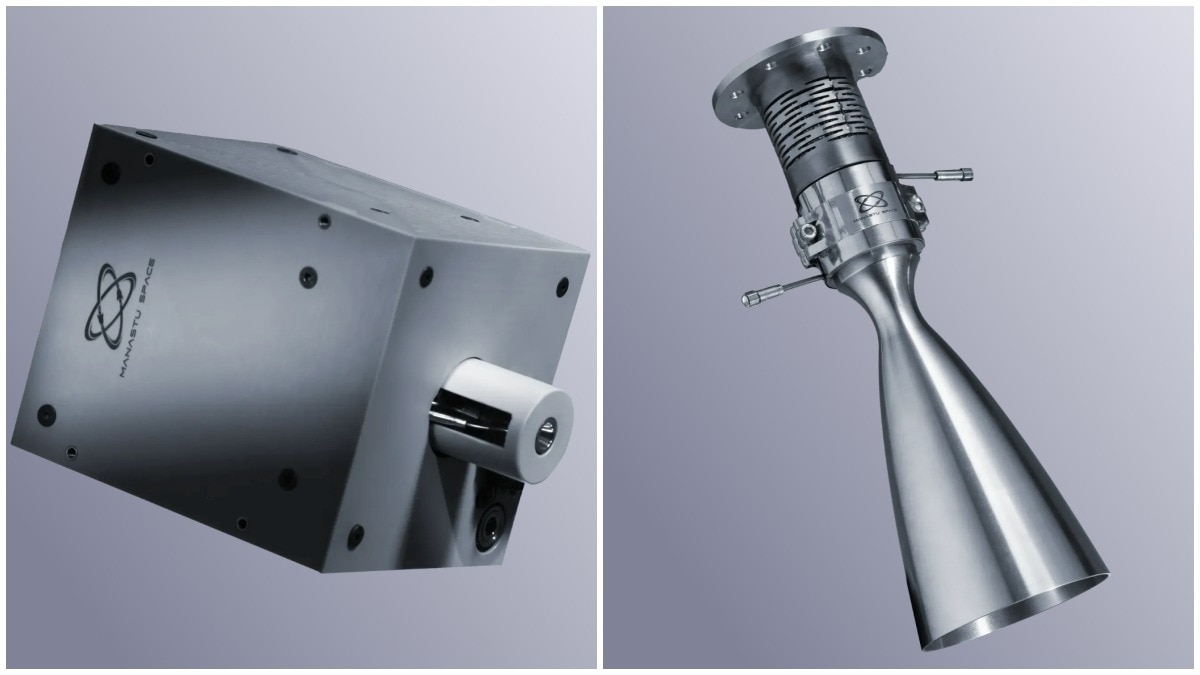
The Centre awarded Mumbai-based startup Manastu Space Rs 116 crore to develop green propulsion technology. This project uses hydrogen peroxide to power satellites and launch vehicles. Rajesh Kumar Pathak said indigenous propulsion technologies were important for strengthening India's capabilities. This funding helps the company move its systems toward full deployment.
The Centre has committed Rs 116 crore to Manastu Space for indigenous green propulsion technology. The support aims to advance deployment readiness and strengthen India's domestic space capabilities.
The Centre has extended financial support of Rs 116 crore to Mumbai-based Manastu Space Technologies to advance its indigenous green propulsion technology for satellites and launch vehicles, in a move aimed at strengthening India's domestic space technology capabilities.
The Technology Development Board (TDB), under the Department of Science and Technology (DST), has signed an agreement with the company under the government's Research Development and Innovation (RDI) Fund.
The project has a total cost of Rs 277.63 crore, with the financial assistance being provided through optionally convertible debt.
Manastu Space is developing a scalable propulsion system using hydrogen peroxide-based green propellant with additives, alongside an integrated engine and catalyst system. The technology is designed to provide propulsion solutions ranging from 5 millinewtons to 300 newtons of thrust, covering applications from small satellites to higher-thrust systems.
The programme aims to advance the technology from Technology Readiness Level (TRL) 6 to TRL 9, the stage at which a system is considered ready for deployment in its intended operational environment.
WHAT MAKES GREEN PROPULSION IMPORTANT?
Conventional spacecraft propulsion systems can rely on hazardous propellants that require specialised handling, storage and ground infrastructure.
Green propulsion technologies seek to reduce some of these operational challenges while maintaining the performance needed for space missions.
Manastu Space's system uses hydrogen peroxide-based propellant supported by a catalyst that enables the chemical reaction required to generate thrust. The project includes developing propulsion engines, propellant feed systems and an ultra-high-temperature ceramic catalyst designed to operate under demanding conditions.
The technology has already been demonstrated in space.
The latest funding will support further engineering, system integration, testing and validation to improve its reliability and readiness for wider deployment.
The system's scalable design is intended to address propulsion requirements across different classes of spacecraft, potentially supporting satellite manoeuvres and other applications where reliable and cost-efficient propulsion is essential.
PUSH FOR INDIGENOUS SPACE TECHNOLOGY
The project falls under the deep technology sector, with space technology identified as its sub-sector. By supporting domestic development of propulsion systems, the initiative aims to reduce reliance on externally sourced technologies and strengthen India's position across the space industry supply chain.
Rajesh Kumar Pathak, secretary of the Technology Development Board, said indigenous propulsion technologies were important for strengthening India's capabilities across the space value chain. He added that the RDI Fund supports technology-intensive projects requiring sustained investment to progress from advanced development towards deployment.
Manastu Space's co-founder and chief technology officer said the funding would help advance the company's propulsion technology through further development, integration and validation, with the objective of reaching TRL 9.
The Rs 116-crore commitment marks a significant investment in India's emerging private space ecosystem, where indigenous propulsion technologies could help expand satellite capabilities and support more sustainable access to space.