
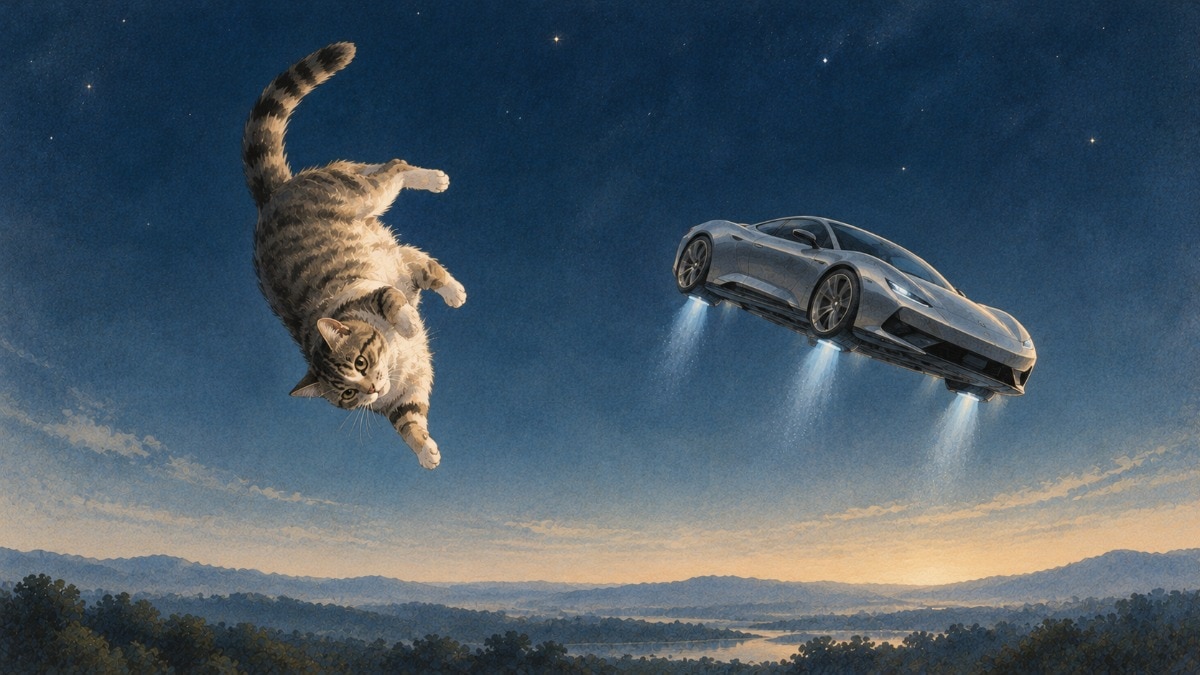
Tesla’s new Roadster recently lifted off the ground, spun mid-air, and landed safely using rocket-style thrusters developed with SpaceX. This feat mimics the natural righting reflex of cats, which turn mid-air by changing their body shape. While physics puzzles scientists, both the cat and the car successfully mastered the landing.
A cat has never read Newton. The feline obeys Newton's laws of motion anyway, and it does so with such unbothered elegance that you almost suspect it wrote a physics book.
Watch a cat slip off a sofa arm. There is the slow, liquid twist, the little flick of the head, and a soft landing. And then the look of attitude. "Nobody saw me fall," says the cat, and if they did, the fall was on purpose.
Now, a very different machine has tried the same trick. Tesla's new Roadster, fitted with rocket-style thrusters developed with SpaceX, lifted off the ground, spun mid-air and came down in one piece. But how does anything, a cat or a car, turn itself around in the air and land the right way up?
The answer needs some maths. We will do it slowly, one step at a time, and nobody has to drop a cat.
WHY DO CATS LAND ON THEIR FEET, AND WHY IS A FLYING TESLA TRYING THE SAME TRICK?
The special skill that lets a cat land on its feet is called the righting reflex, an automatic movement that turns a falling cat the right way up. French scientist tienne-Jules Marey photographed a falling cat in 1894, and scientists have been arguing about the details ever since.
The puzzle is that physics says this should not work. Anything that starts with no spin keeps having no spin unless something pushes it. A cat dropped upside down starts with almost none, and nothing in mid-air gives it a shove. In theory, it should stay upside down all the way to the floor.
A flying Tesla has the mirror-image problem. It leaves the ground, must turn in mid-air, and must come back down the right way up, with no road to push against. The cat solves it for free. The car solves it with a tank. Physics has made its position clear on both. The cat has not read it.
HOW DOES A CAT TURN MID-AIR, AND HOW DOES A TESLA DO IT WITH ROCKET GAS?
The cat turns by changing its shape. That sounds too simple, so here is why it works.
Step 1: some things are harder to turn than others. Sit on an office chair, hold your arms out and get someone to spin you. You turn slowly. Pull your arms in and you spin faster. Nothing about you changed except where your weight is. The further your weight sits from your middle, the harder you are to turn. Scientists call this the moment of inertia, which just means how stubborn something is about turning.
Step 2: the rule behind it. Here is the only rule of this story. Take every bit of weight, multiply it by its distance from the middle, then multiply by that distance again. Add up the results for all the bits, and that is the moment of inertia. (Physicists say mass, but weight will do here.) The distance counts twice, which is why moving weight outwards makes such a big difference.
Take a cat's hind leg of 0.1 kg. Tucked in, 5 centimetres from the spine, it gives 0.1 multiplied by 0.05 multiplied by 0.05, which is 0.00025 units. Stretched out, 15 centimetres from the spine, it gives 0.1 multiplied by 0.15 multiplied by 0.15, which is 0.00225 units. The stretched leg sits three times further out, so it is three times three, or nine times harder to turn. The numbers are invented, but the nine-fold jump is genuine physics.
Step 3: the cat twists its two halves, one easy and one stubborn. Picture wringing out a wet towel. When you twist one hand one way, the other hand twists the other way, and the towel stays in one piece. A falling cat does the same with its body. One half twists one way, so the other half must twist the opposite way.
Now the cat makes the halves unequal. In the classic picture, a cat tucks its front legs in close, so the front half is easy to turn. It sticks its hind legs out, so the back half is hard to turn. The easy half does most of the twisting. Say the back half is three times harder to turn than the front half. Then the front swings 90 degrees one way, and the back swings only 30 degrees the other way.
Let us keep score, like a compass. The cat starts facing zero degrees. Call one direction plus and the other minus. After the twist, the front half is at plus 90 degrees and the back half is at minus 30 degrees. The body is twisted like the towel, and the front has clearly turned further.
Step 4: why does the cat swap its legs? This is the clever part, so let us go slowly.
The cat is now twisted, and it must untwist before it lands. Suppose it just untwists without changing anything. The front half is still the easy half, so it does most of the moving, and it swings 90 degrees straight back to where it started. The back half swings 30 degrees forward, also back to where it started. The score is back to zero and zero. All that twisting, for nothing.
So the cat swaps. It stretches its front legs out, which turns the front half into the stubborn half. It tucks its hind legs in, which turns the back half into the easy half. The legs move without turning the body, so the score does not change: the front is still at plus 90 and the back is still at minus 30.
A ratchet spanner works the same way. You click it forward with a firm grip and the nut turns. On the way back you loosen the grip and the spanner slides without moving the nut. The cat does the same thing, in reverse: on the way out, one half moved a lot. On the way back, the cat makes that same half stubborn, so it barely moves.
Step 5: untwist, and add up the score. Now the cat untwists. The back half is the easy one, so it swings 90 degrees forward. The front half is the stubborn one, so it only swings 30 degrees back.
The front went from plus 90 to plus 60. The back went from minus 30 to plus 60. Both halves are now at plus 60 degrees. The body is straight again, and the whole cat has turned 60 degrees without pushing against anything. It is like climbing a staircase, one 60-degree step at a time. Three steps make a half turn.
Real cats do not climb in neat steps. They bend at the waist and twist in one smooth motion, and none of them is doing sums, or if they are, they have the grace to look busy with something else.
In 1969, T. R. Kane and M. P. Scher modelled a falling cat as two bodies bending back and forth. A 1998 study by Arabyan and Tsai later built a model of how the nervous system controls it.
Now the Tesla. A car has no towel to wring and no legs to tuck. It cannot reshape itself, so it does something else: it throws air out.
Think of a balloon. Blow it up, let go, and it shoots across the room as the air rushes out the back. The air goes one way, so the balloon goes the other. That is Newton's third law: every action has an equal and opposite reaction.
Reports from the unveiling describe a car carrying about 250 to 260 kg of compressed air, which means air squeezed into strong tanks, with 10 nozzles around the body. When a valve opens, the air shoots out, and the car is pushed the opposite way. These are called cold-gas thrusters because nothing burns. It is only stored air, escaping.
To spin the car, the engineers place the push away from its middle. Think of a door. Push on the handle and it swings open easily. Push near the hinges and it barely moves. A push far from the centre has a bigger turning effect, and that turning effect is called torque. It is simply the push multiplied by the distance from the middle.
So the cat turns by reshaping itself, and the Tesla turns by throwing air. Same result, very different bills.
HOW LONG CAN A FALLING CAT AND A HOVERING TESLA STAY IN THE AIR?
Turning is only half the job. The other half is time, because both of them are racing the ground.
The cat. A falling thing covers a distance equal to half of gravity, multiplied by the time, multiplied by the time again. Gravity adds about 9.8 metres per second of speed every second. Dropped from about 90 centimetres, a height often quoted as the minimum for the cat's reflex to work safely, a cat is in the air for about 0.43 seconds. Check it: half of 9.8, multiplied by 0.43, multiplied by 0.43, comes to about 0.9 metres. From 30 centimetres, it is only about 0.25 seconds.
That is less than half a second to spot the drop, turn the head, twist the body and get the legs under it. You could not finish saying "oh no" in that time.
The Tesla. Tesla has not published this, so here is our own rough estimate, using assumed numbers. Say the car weighs about 2,000 kg.
To stay up, the air pushing down must be as strong as gravity pulling down. Push is measured in newtons, and one newton is roughly the weight of a small apple. Gravity pulls a 2,000 kg car down with 2,000 multiplied by 9.81, which is about 19,620 newtons. So the thrusters must push up with 19,620 newtons, every second.
How much air does that take? The rule is simple: push equals the kilograms of air per second, multiplied by the speed it shoots out. Engineers score how well a thruster uses its gas with a number called specific impulse, measured in seconds. For nitrogen, the main gas in air, a published table lists about 73 seconds, and the thrusters NASA has reviewed run from about 35 to 110 seconds. Tesla has not published its figure, so I have used a cautious 60 seconds.
A score of 60 seconds means that 1 kg of the gas could hold up 1 kg of weight for 60 seconds, so a higher number means the gas goes further.
Multiply 60 by 9.81 and the air leaves the nozzle at about 589 metres per second, more than twice the speed of a passenger jet. Now turn the rule around: air needed each second equals 19,620 divided by 589, which is about 33 kg per second.
With 250 kg on board, that is 250 divided by 33, or roughly 7.5 seconds of hover.
With a more efficient thruster, the hover could stretch to about nine seconds. With a less efficient one, about six.
Seven and a half seconds is about as long as it takes to say, are we really doing this? So the numbers suggest a hop, not a flight, which fits what the demonstration showed: brief, controlled manoeuvres.
So the cat has under half a second, and the car has about seven. Which of them turns faster?
HOW LONG DOES A HALF TURN TAKE FOR A CAT'S SPINE AND A TESLA’S THRUSTERS?
Start with the cat. In February 2026, researchers at Yamaguchi University in Japan published a study in The Anatomical Record comparing two parts of the cat's backbone. The thoracic spine is the upper back, where the ribs are attached. The lumbar spine is the lower back.
They twisted the spines of five cat cadavers. The upper back gave way easily and had a neutral zone of about 50 degrees, a range where twisting meets almost no resistance. The lower back was much stiffer and had none. They also dropped two live cats onto a soft cushion and filmed them. One turned right side up eight times out of eight, the other six times out of eight, and in the video the upper body finished twisting before the lower body.
A loose, twisty front and a firm, steady rear: that slack in the upper back is probably what gives a cat its liquid look, as if the front half is thinking about something else while the back half catches up. The stiff lower back adds poise. And because the reflex runs automatically, the cat is already landing before it has had time to form an opinion.
Now the car. Its half turn takes five small steps, and we will do them one at a time. This is our own illustration, with assumed numbers, not Tesla data.
Step 1: how stubborn is the car? A car resists turning too, and far more than a cat. Its stubbornness is its moment of inertia, found with the same rule as the cat's leg: weight multiplied by distance multiplied by distance, added up for every bit. For a whole car that is a very long sum, so engineers use a shortcut for a slab-shaped car. Our slab weighs 2,000 kg, is four metres long and two metres wide. Do it in order:
Multiply the length by itself: 4 multiplied by 4 is 16.
Multiply the width by itself: 2 multiplied by 2 is 4.
Multiply by the weight: 20 multiplied by 2,000 is 40,000.
Divide by 12: 40,000 divided by 12 is about 3,333.
The 12 is a fixed number, like the half in the area of a triangle. It is what engineers get when they add up every bit of a block's weight and its distance from the middle. You only need to put in the car's numbers.
So what is 3,333? It is the car's score for how hard it is to spin. The scale is the same as for the cat: a 1 kg weight sitting 1 metre from the middle scores 1, because 1 multiplied by 1 multiplied by 1 is 1. The car resists spinning as much as 3,333 kg parked 1 metre from its middle. The unit is kilogram metres squared, which simply means weight multiplied by distance multiplied by distance. We will round it to 3,000 to keep things friendly. It is an estimate, since a real car packs its battery and motors in particular places.
Step 2: how hard can a thruster twist? That twist is the torque we met earlier: the push multiplied by its distance from the middle. Say a thruster pushes with 3,000 newtons (roughly what it takes to hold up a 300 kg weight) from 1.5 metres out. The torque is 3,000 multiplied by 1.5, which is 4,500 newton metres.
Step 3: how fast does the spin build? This is Newton's second law, in its spinning form: torque divided by the moment of inertia gives the angular acceleration. Angular acceleration is the spinning version of a car's acceleration. It does not tell you how fast the car is turning, only how quickly its turning speed keeps growing. Here, 4,500 divided by 3,000 is 1.5 radians per second, every second. A radian is a unit of turning, about 57 degrees, so the angular acceleration in the case of the car is about 86 degrees per second, every second.
Step 4: how long does a half turn take? A half turn is 180 degrees, so we split it in two. For the first 90 degrees, the car keeps speeding up its spin. For the last 90, a thruster on the other side fires to slow it down, so it stops facing the other way.
To find the time, we use the same rule as for the falling cat, with turning in place of falling: the angle turned equals half of the angular acceleration, multiplied by the time, multiplied by the time again. Here is how it works out:
We want the angle to be 90 degrees.
Half of our angular acceleration, 86, is 43.
So 43, multiplied by the time, multiplied by the time again, must equal 90.
Divide 90 by 43 and you get about 2.1. That is the time multiplied by itself.
The square root of 2.1 is 1.45.
So the first 90 degrees take about 1.45 seconds. Braking takes the same time again, which makes the half turn about 2.9 seconds.
Step 5: how much air does it cost? A thruster pushes by hurling air backwards, so we use the rule from the hover: push equals the air per second, multiplied by the speed of the air. A 3,000 newton push, with air leaving at 589 metres per second, needs 3,000 divided by 589, or about 5 kg of air every second. Firing for 2.9 seconds, that is roughly 15 kg, a small sip from a tank said to hold about 250 kg.
Turning, it seems, is cheap. Staying up is what costs.
So the cat's flip fits in under half a second and burns no fuel. The car's takes nearly three seconds and 15 kg of air. The spine wins on speed. The thrusters win on not needing a spine.
HOW DOES A CAT LAND SOFTLY, AND HOW MUCH AIR DOES A TESLA NEED TO DO THE SAME?
A cat brings its own landing gear: four legs that bend like springs, and no paperwork. It lands, absorbs the shock in its joints and walks off as though the floor had been rude.
The car must buy its softness with air. To see how much, we will follow four small steps. The numbers are our own estimates, built on figures we have already used, and nothing here is published by Tesla.
Step 1: how fast does the car hit the ground? Say the car drops from 2 metres, about the height of a tall man. That height is our assumption. To find the time it falls, we use the falling rule from earlier: distance equals half of gravity, multiplied by the time, multiplied by the time again.
Half of 9.8 (gravity) is 4.9.
Divide the 2 metres by 4.9 and you get about 0.41. That is the time multiplied by itself.
The number that does that is about 0.64. So the fall takes about 0.64 seconds.
Gravity adds 9.8 metres per second of speed every second. After 0.64 seconds, the speed is 9.8 multiplied by 0.64, which is about 6.3 metres per second, or roughly 23 km/h. That is a brisk cycle ride, straight into the ground.
Step 2: how much punch must the thrusters cancel? A heavy thing moving fast carries a punch. Scientists call it momentum, and it is simply weight multiplied by speed. For the car, that is 2,000 kg multiplied by 6.3 metres per second, which is about 12,600. To land softly, the thrusters must take away all of it.
Step 3: how much air does that take? Air carries momentum too, by the same rule. Each kilogram of air shot out at 589 metres per second carries 1 multiplied by 589, which is 589. (The 589 is the exit speed we worked out for the hover, from the 60-second specific impulse.) By Newton’s third law, the car gets the same punch back, in the opposite direction. So the air needed is 12,600 divided by 589, or about 21 kg. A real landing needs a little more, because gravity keeps pulling during the burn.
Step 4: add up the whole tank. Reports from the unveiling suggest about 250 kg of air on board. Let us spend it:
The half turn took about 15 kg (from the flip calculation above).
The landing takes about 21 kg.
That leaves 250 minus 15 minus 21, or 214 kg.
Hovering burns about 33 kg a second (from the hover calculation). So 214 divided by 33 is about 6.5 seconds in the air.
So the flip is cheap, and the landing is cheaper than you would think. The hover is what eats the tank. Even the cat would find that funny.
COULD A CAT OR A TESLA SURVIVE A BAD LANDING?
Not always, in either case. Nine lives is a myth, and a generous one. A study of 119 cats treated for high-rise syndrome between 1998 and 2001 found an average fall of four storeys, and reviews of such cases report that roughly 90 per cent of cats who reached a vet survived.
Be careful with that number. It counts only cats who made it to a clinic. Those that did not are missing, a trap called survivorship bias, so the true odds are worse than they look.
The Tesla has a worse problem. If a thruster fails mid-flip, there is no reflex to fall back on, and the car cannot land on four legs. Noise, stability and safety under ordinary conditions are also still unproven.
SO WHO LANDS BETTER, THE CAT OR THE FLYING TESLA?
The cat, for now, and by a distance. The Roadster is targeted for production in 2028, but its real capabilities are still unproven, and Tesla has yet to show otherwise.
The cat's answer is elegant: no fuel, no valves, a spine that twists at exactly the right place. The car's answer is brute force with 250 kg of air. One of them has had a very long time to practise. The other has been practising since the unveiling, and has yet to learn how to look unbothered afterwards.