
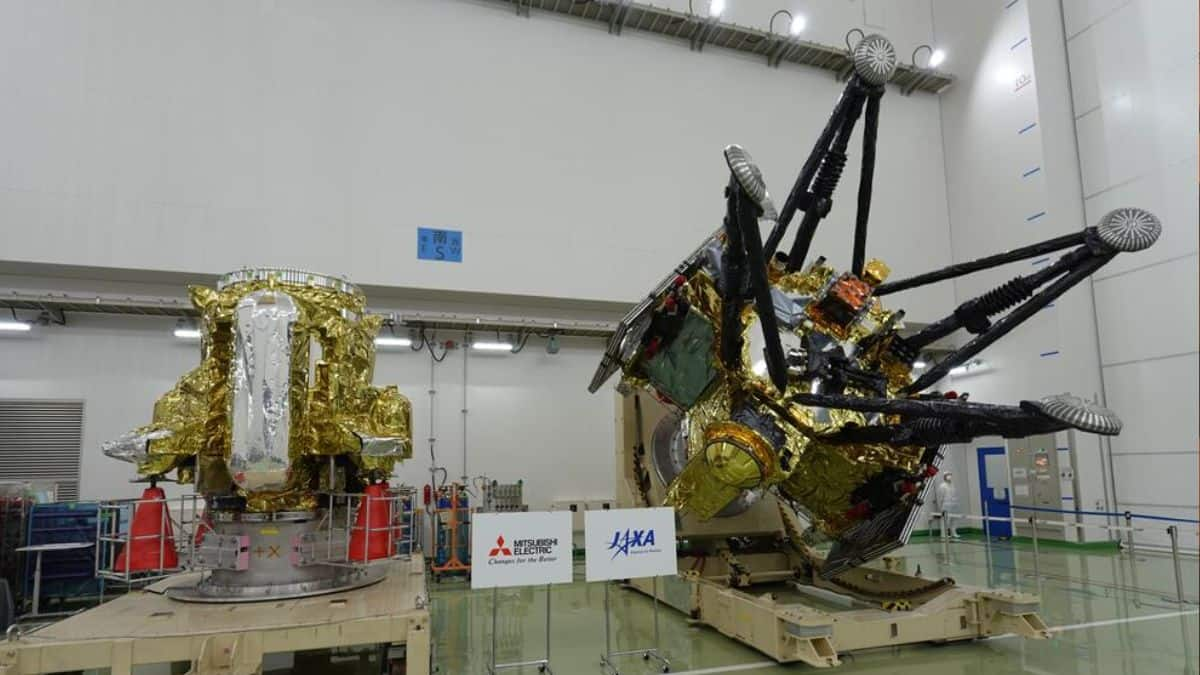
Japan’s MMX mission will launch on Tuesday to collect samples from Phobos, a moon of Mars. The spacecraft will travel for ten months before reaching Mars in August 2027. Prof Sara Russell said, "I think this is an incredibly ambitious and fun mission." It aims to return material by 2031.
Japan's MMX mission is scheduled to launch on Tuesday, aiming to bring back the first-ever samples from Phobos, one of Mars' moons, to Earth
A spacecraft due to lift off from Japan on Tuesday will attempt to collect material from Phobos, a moon of Mars, and carry it back to Earth. Should it succeed, it will be the first time a sample from Mars or either of its moons has been delivered to laboratories on Earth for analysis.
Japan's Mars Moons Exploration (MMX) spacecraft is scheduled to launch aboard an H3 rocket from the Tanegashima Space Center. After a journey of around 10 months, it is expected to reach Mars in August 2027. The spacecraft is expected to remain in Mars orbit for around three years, studying Phobos, before conducting flybys of Deimos, Mars' smaller moon, on its journey home.
Prof Sara Russell, of the Natural History Museum, who serves as the mission's deputy for sample analysis, noted that no previous mission has managed to visit Phobos and return material from it. "I think this is an incredibly aTuesday mbitious and fun mission," she said.
The inner Solar System contains just three moons, Earth's own, and the two that orbit Mars, Phobos and Deimos. Both are tiny and irregular in shape, resembling what might be described as space potatoes. Phobos measures roughly 20km (12 miles) across, while Deimos is about 10km (six miles) wide.
A difficult landing
The mission intends to deploy a small rover to explore Phobos's terrain, a task that will be far from straightforward. According to Prof Russell, no one has previously landed a rover on a moon so small.
"The moon itself doesn't have very much of its own gravity," she explained. "But it's next to an enormous planet that's got a much higher gravity, and that makes it much harder to get a rover onto the surface."
Once on the surface, the spacecraft will use a robotic arm and two samplers to gather moon dust. The material will be sealed in a small capsule, which is due to return to Earth in 2031 and land in the Woomera desert of South Australia.
A three-year study of Mars' moons
Once it reaches the Martian system, MMX will enter a quasi-satellite orbit around Phobos, allowing it to travel alongside the moon as both orbit Mars. During the initial phase, the spacecraft will use cameras, a laser altimeter and other scientific instruments to map Phobos' surface, examine its composition and identify potential landing sites.
The spacecraft will carry a small rover named IDEFIX, developed jointly by the French space agency CNES and the German aerospace centre DLR. Built to explore Phobos' terrain, the rover will carry cameras and instruments to analyse the moon's surface composition and temperature.
The rover is expected to be deployed in late 2028 or early 2029 from an altitude of around 40 metres. Given Phobos' extremely weak gravity, IDEFIX is designed to free-fall onto the surface, recover its orientation after bouncing and begin examining the terrain.
Two theories behind Mars' moons
Scientists are investigating two leading explanations for the origins of Phobos and Deimos. One theory suggests that the moons are asteroids that were captured by Mars' gravity. Their resemblance to primitive asteroids supports this possibility, as such objects could preserve material dating back to the formation of the Solar System around 4.6 billion years ago.
The competing theory proposes that a massive collision involving ancient Mars blasted material into orbit, eventually forming a debris disc from which the two moons developed. This would be similar to the proposed formation of Earth's Moon.
However, observations of the moons' composition and orbits have so far failed to establish which explanation is correct. MMX aims to resolve this puzzle by examining their surface materials and chemical composition.
What scientists hope to discover
The mission will use a range of instruments to study Phobos in detail. These include spectrometers designed to identify minerals and measure elemental composition, along with cameras and sensors to map its geological features. NASA's MEGANE instrument will use gamma rays and neutrons to examine the moon's elemental composition, including material beneath its surface.
The findings could help scientists determine whether Phobos formed elsewhere in the Solar System before being captured by Mars, or emerged from debris following a major collision. The results could also provide new insights into the early history and evolution of Mars and other terrestrial planets.
MMX aims to collect at least 10 grams of material from Phobos using two sampling mechanisms. The spacecraft is expected to make two collection attempts at different sites, returning to orbit between them before storing the samples in its return capsule.
After completing its observations of Phobos and conducting flybys of Deimos, the spacecraft will begin its journey home. The sample-return capsule is due to land in the Woomera Prohibited Area in Australia in 2031, where the material will be recovered for laboratory analysis by Japan and its mission partners.