
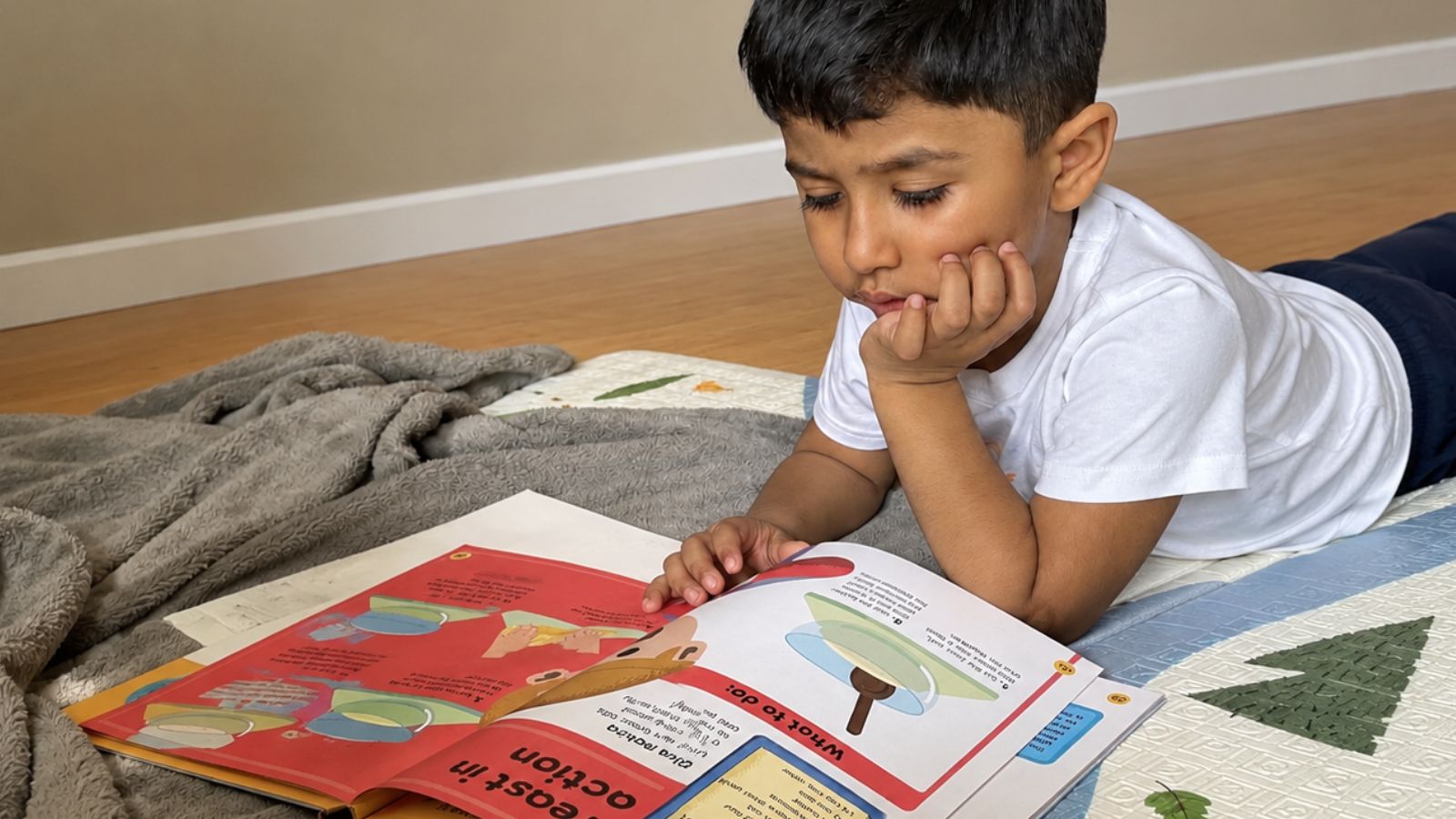
Arjun Prajapati, an Indian-origin child, recorded a 141 IQ at age four. He started reading at 18 months and explored over 3,000 books. Arjun got into Mensa and Intertel after his assessment. His mother said, "We have always tried never to dismiss Arjun's questions, no matter how unusual."
An age when most of his peers would be fascinated by Harry Potter and Sherlock Holmes, Arjun could easily tell that its fiction and would get back to reading his science-backed theories.
An IQ score of 141 at the age of four placed Arjun Prajapati in the 99.7th percentile on a standardised cognitive assessment. The Indian-origin child, who began reading at just 18 months, has since developed a keen interest in human physiology, mathematics, astronomy and ancient civilisations, and qualified for membership in two internationally recognised high-IQ societies, Mensa and Intertel.
Born into a Gujarati family from Vadodara whose parents are settled in Canada, Arjun has explored more than 3,000 books, his parents say. His interests range from science, technology, engineering and mathematics (STEM) to microbiology and immunology. While many children his age might gravitate towards fictional characters such as Harry Potter and Sherlock Holmes, Arjun prefers non-fiction books and science-based explanations.
When Arjun was nearly four years old, he underwent a standardised cognitive assessment using the Stanford-Binet Intelligence Scales, Fifth Edition (SB5).
According to the assessment results shared by his family, he recorded a full-scale IQ (FSIQ) of 141, placing him at the 99.7th percentile. His non-verbal IQ was 149 (99.99th percentile), while his fluid reasoning score was 144 (99.8th percentile) and working memory score was 146 (99.9th percentile).
Following the assessment, Arjun qualified for membership in Mensa, which generally requires a score within the top 2 per cent of the population on an accepted intelligence test, and Intertel, which generally requires a score within the top 1 per cent.
Arjun's mother, Mahitha Prajapati, said his interest in learning was evident early on. His reading journey began with picture books featuring illustrations alongside their corresponding initial letters.
Recognising his enthusiasm, she helped him learn phonetics and numbers while patiently answering his questions.
His parents regularly took him to the nearest library, where he would read an average of nine to 10 books during a visit. He would also pick up books left behind by other readers on tables and begin reading them.
"We have always tried never to dismiss Arjun's questions, no matter how unusual or complicated they may seem. Even when we don't know the answer, instead of simply saying, 'I don't know,' we say, 'That's a wonderful question. I don't know the answer yet, but let's find out together.' Sometimes, his questions become learning opportunities for us as parents, too," his parents said.
At a time when digital devices and online videos are a regular part of many children's lives, books remain Arjun's primary source of knowledge. Google, YouTube and children's video channels are not his first choices when he wants to learn something new.
Whether at breakfast, before bedtime, during school holidays or while travelling by car, he is rarely far from a book. He even sleeps with one beneath his pillow and wakes up to it.
His mother attributes his limited screen time to habits the family has consciously cultivated at home.
"On weekends, I would rather get him bored to tears than give him a screen to watch irrelevant content," she said, explaining that boredom can encourage children to explore their interests and discover new things.
Arjun's preference for books, she said, was reinforced through small but consistent practices. He regularly saw his mother reading a physical book rather than using a tablet. When he asked about unfamiliar words, she would reach for a dictionary and look up their meanings with him.
Arjun's reading has introduced him to concepts in genetics and human biology. He has explained to his parents that humans have 23 pairs of chromosomes, telling his father, "Dad, you have XY chromosomes, and Mom has XX."
Arjun is now looking forward to attending a session at the Canadian legislative assembly on October 28, where he has been invited for recognition of his abilities and curiosity.