
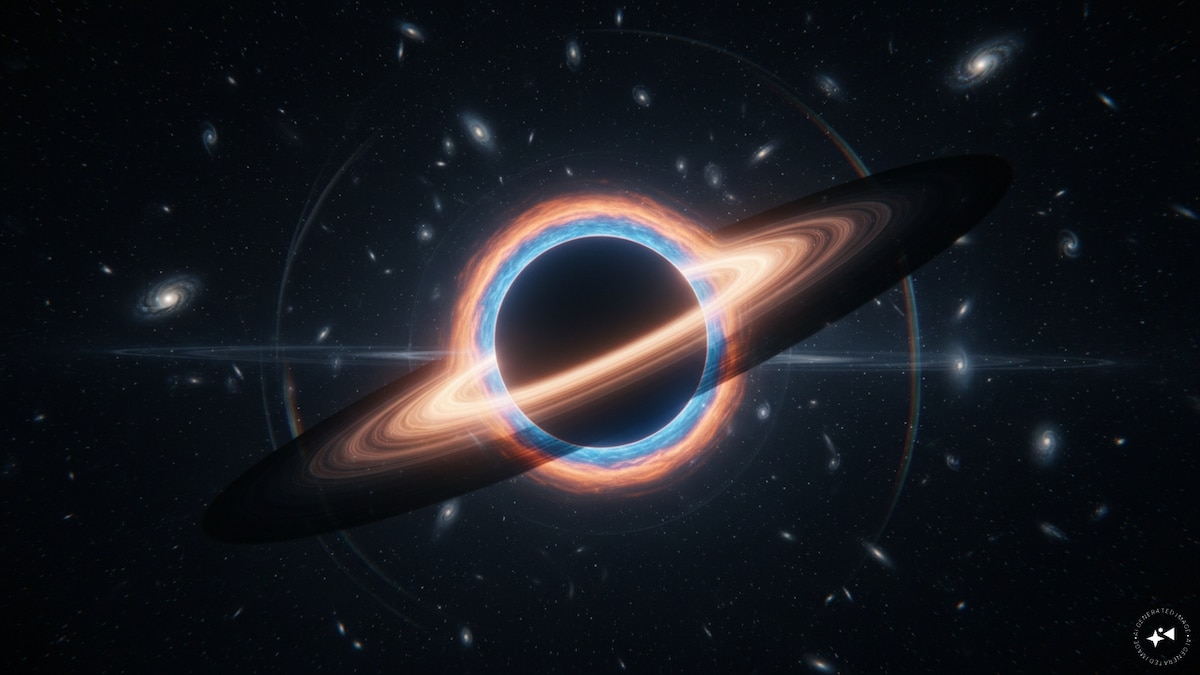
Physicist Jay Armas published a new study on November 16 exploring a bizarre five-dimensional Black Saturn. This theoretical model features a spherical black hole sitting inside a giant ring-shaped one. The research showed how both objects could rotate independently in two different planes, expanding our understanding of cosmic space geometry.
Physicists have advanced a theoretical model exploring a ring-shaped black hole encompassing a spherical counterpart within five-dimensional spacetime. The framework demonstrates how both objects can sustain independent dual-plane rotations while reaching maximum spin limits. Find out how this mathematical model bridges distinct cosmic configurations under general relativity.
Black holes are generally imagined as massive, spherical objects with gravity so strong that nothing, not even light, can escape them. What if a black hole could take the shape of a giant ring, with another black hole sitting inside it? This structure, called a 'Black Saturn', is a theoretical possibility under Einstein's theory of general relativity when an extra dimension of space is added.
A new study has now expanded the theoretical model, showing how the two black holes could rotate independently in two different planes. The research, titled Doubly-spinning Black Saturns, was published on arXiv on November 16 by physicist Jay Armas.
It presents a mathematical solution describing a spherical black hole surrounded by a ring-shaped black hole in five-dimensional spacetime. The model also explores how both objects could reach an extreme state while retaining their separate event horizons.
What exactly is a Black Saturn?
A Black Saturn is a theoretical arrangement involving two black holes of different shapes. At its centre is a spherical black hole, while a much larger, ring-shaped black hole surrounds it.
Both objects have their own event horizons. These are boundaries beyond which nothing, including light, can escape the gravitational pull of a black hole.
How does this bizarre cosmic structure work?
This arrangement is possible in the mathematics of five-dimensional spacetime. Our observable Universe has three dimensions of space and one dimension of time. Adding another spatial dimension allows Einstein's equations to accommodate geometries that are not possible in the familiar four-dimensional setting.
As a result, black holes in five-dimensional spacetime do not necessarily have to follow the spherical shape commonly associated with them.
How does the new model change the earlier understanding?
The original Black Saturn model was proposed in 2007, but it allowed both the central black hole and the surrounding ring to spin in just one plane.
In five-dimensional spacetime, objects can rotate in two independent planes. Accounting for both forms of rotation make the mathematical equations more complicated, but it also allows researchers to explore a wider range of possibilities.
Armas's latest work removes the earlier restriction. It presents a six-parameter family of solutions in which both the central black hole and the surrounding ring can rotate in two independent directions. This means the two objects do not have to share the same rotational behaviour.
Both Black Holes can reach an extreme state
Another important finding in the study concerns a condition known as extremality. A black hole is described as extremal when it reaches the maximum allowed angular momentum for its mass under the relevant conditions.
At this limit, its Hawking temperature, the temperature associated with radiation from a black hole, falls to absolute zero. In five-dimensional spacetime, reaching this state while keeping the event horizon intact requires rotation in both independent planes.
Armas found that both black holes can reach their maximum spin limit at the same time while keeping their own event horizons. This is the first mathematical model to show two separate black holes reaching this state together in five-dimensional space.
Three types of Black Hole solutions
The new mathematical model also connects Black Saturns with other known black hole solutions. Under specific conditions, the equations can reproduce a doubly spinning Myers-Perry Black Hole, a Pomeransky-Sen'kov black ring and the earlier singly spinning Black Saturn. This allows researchers to study different types of black hole configurations within a single mathematical framework.
Can Black Saturns really exist in our universe?
For now, Black Saturns remain theoretical objects. There is no observational evidence that such structures exist in nature and no evidence that our Universe contains the additional spatial dimension required for this particular mathematical configuration.
But solutions like this are useful for physicists because they help explore how Einstein's equations behave under unusual conditions. They also provide a way to study the relationship between gravity, rotation and the geometry of spacetime.
The new model could offer a starting point for further research into how light and matter behave around these objects and how spacetime is structured near their event horizons.