
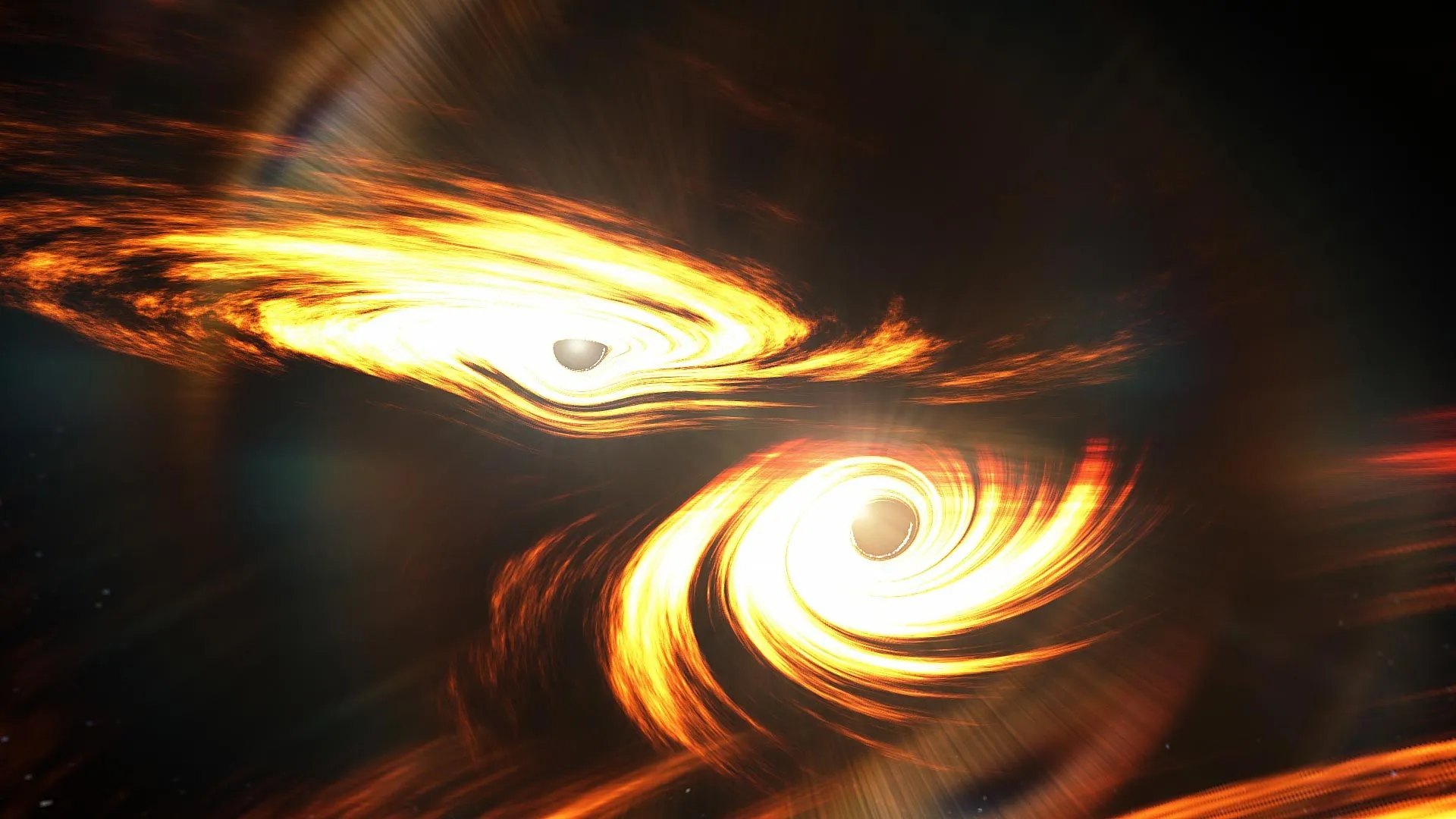
Black hole collisions may follow a simple law of nature, according to new research in Physical Review Letters. Scientists found that a merger settles into a stable state using thermodynamics. "The final black hole after a merger is ringing like a struck bell," said researcher Monica Rincon-Ramirez about the process.
As two orbiting black holes gradually spiral toward each other, they eventually collide and combine into a single, larger black hole. The immense energy released during the merger distorts spacetime, generating ripples known as gravitational waves. Sensitive instruments on Earth can detect these waves even when the collision occurs billions of light-years away.