
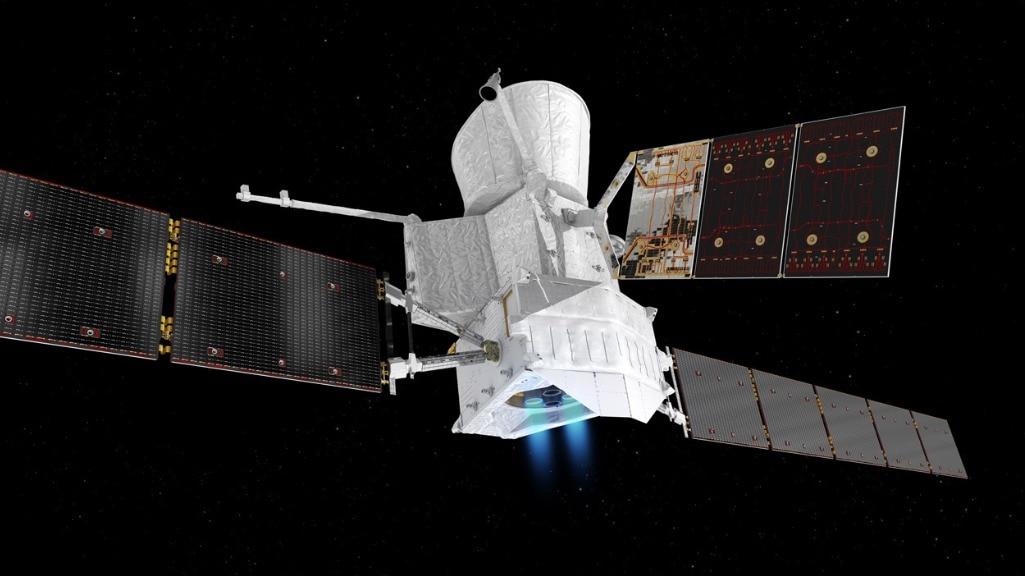
BepiColombo reached Mercury on November 21 after an eight-year journey. Although a software glitch interrupted its engine burn, the spacecraft is safe in a stable orbit. ESA confirmed it remains on track for its mission. Controllers plan more engine burns to adjust the orbit before the two orbiters separate soon.
After an eight-year journey, BepiColombo has reached Mercury. Its arrival manoeuvre was interrupted by a software problem, but the spacecraft is safe in a stable orbit.
Europe's BepiColombo spacecraft has successfully entered orbit around Mercury despite a software glitch that interrupted a crucial engine burn, raising concerns about its arrival at the solar system's innermost planet.
The European Space Agency (ESA) has confirmed that the spacecraft is safe and remains on track for its next major mission milestone.
The development was announced by ESA on November 23, after mission controllers identified a software problem that caused the spacecraft's engines to stop firing earlier than planned during its arrival at Mercury.
WHAT WENT WRONG WITH BEPICOLOMBO?
BepiColombo entered orbit around Mercury on November 21, after travelling through space for eight years.
As the spacecraft passed about 635 km above the planet's surface, its four main engines began firing to slow it down and help it settle into orbit.
The engine burn was supposed to last 37 minutes. However, the spacecraft automatically interrupted the manoeuvre and entered what is known as safe mode, a protective setting that switches off non-essential activities when something unexpected happens.
An investigation by ESA and spacecraft manufacturer Airbus traced the problem to a software glitch involving the system that controls the spacecraft's direction and engines.
The shortened engine burn delivered around 77% of the planned change in speed.
Despite this, mission controllers confirmed that BepiColombo had successfully entered a stable orbit around Mercury.
ESA said additional engine burns are planned in the coming months to adjust its orbit.
EXPLORING MERCURY
Launched in October 2018, aboard an Ariane 5 rocket, BepiColombo is a joint mission between ESA and the Japan Aerospace Exploration Agency (JAXA).
It consists of two scientific spacecraft travelling together -- ESA's Mercury Planetary Orbiter that will study the planet's surface and internal structure, and Japan's Mercury Magnetospheric Orbiter that will study its magnetic field and the space environment around it.
Mercury is one of the least explored planets because its proximity to the Sun makes it difficult for spacecraft to reach and operate around it.
Scientists are now hoping to understand how the planet formed, why it has a magnetic field and how water ice can survive inside permanently shadowed craters despite the planet's scorching daytime temperatures.
WHAT'S NEXT FOR BEPICOLOMBO?
The two scientific orbiters are scheduled to separate on December 9, allowing each to move into its designated orbit.
After that happens, routine scientific observations are expected to begin in April 2027.
BepiColombo is only the third spacecraft to visit Mercury and the second to orbit it.
Its findings could bring to light important clues about how rocky planets, including Earth, formed and evolved.