
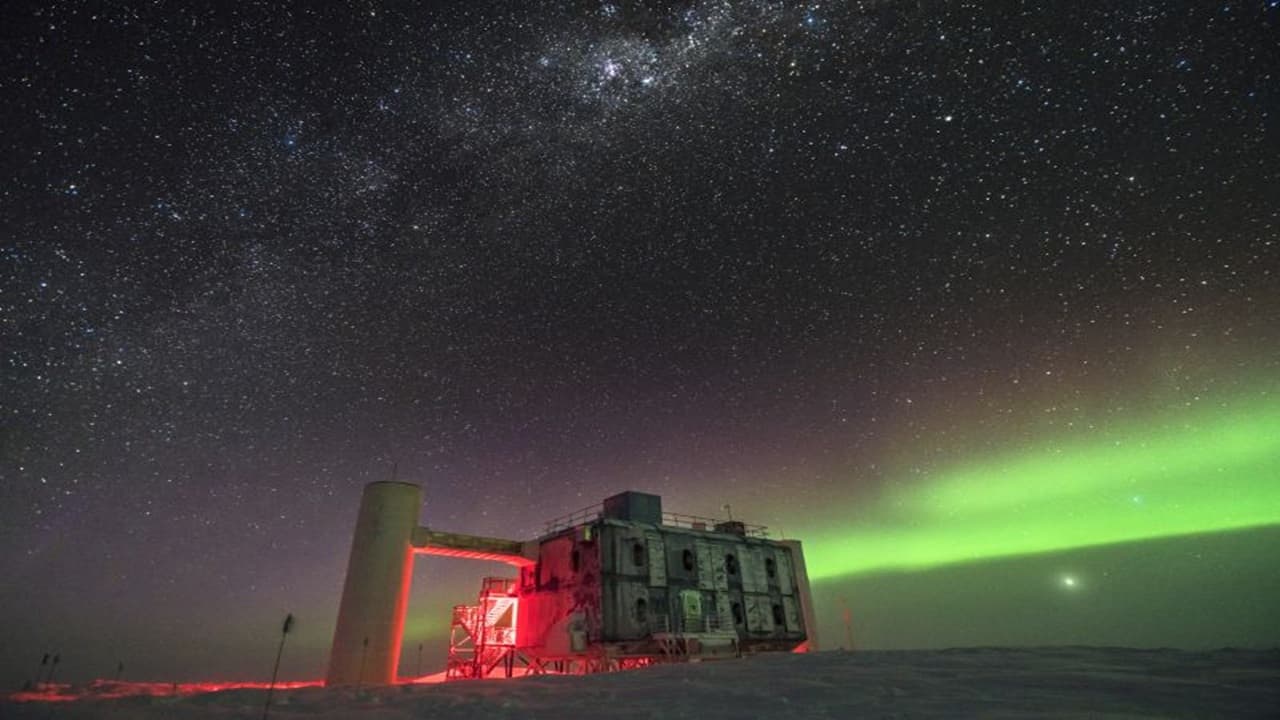
Scientists built a giant telescope two kilometres beneath the Antarctic surface to track elusive neutrinos. Francis Halzen won the 2026 Nobel Prize in Physics for this work. The observatory uses 5,160 sensors buried in clear ice to capture faint light flashes, helping researchers study violent events across the deep universe.
At the bottom of the world, more than two kilometres beneath the Antarctic surface, thousands of light sensors are waiting for something that usually passes straight through the Earth. That unlikely setup has turned a vast block of ice into one of humanity's strangest telescopes - one capable of tracing elusive particles back to some of the most violent places in the universe. The idea belongs to Francis Halzen, the University of Wisconsin-Madison physicist who won the 2026 Nobel Prize in Physics for his "decisive contributions to the IceCube Neutrino Observatory and the discovery of high-energy neutrinos of astrophysical origin". According to the Royal Swedish Academy of Sciences, Halzen laid the foundation for an entirely new type of astronomy by recognising that the clear glacial ice at the South Pole could be used to capture neutrinos - particles so elusive that they can pass through Earth and human bodies almost unnoticed. A telescope with no lenses IceCube does not look anything like a conventional telescope. There is no giant mirror, lens, or radio dish. Instead, its main detector occupies about one cubic kilometre of Antarctic ice, with 5,160 digital optical modules attached to 86 vertical strings buried between about 1,450 and 2,450 metres below the surface. The sensors are essentially looking for flashes of light. Neutrinos themselves cannot be seen directly. They have no electric charge and almost no mass, and they interact with matter extraordinarily rarely. But when one does collide with an atomic nucleus in the ice, it can produce a charged particle. That particle travels through the ice and generates a faint blue flash known as Cherenkov light. IceCube's optical sensors capture those flashes, record when and where they occurred, and send the information to computers at the IceCube Lab on the surface. From those tiny bursts of light, scientists can work backwards to determine the direction and energy of the incoming particle. In other words, the ice is not merely surrounding the telescope. The ice is the telescope. Why put it at the South Pole? The choice of Antarctica may sound extreme, but the location solves several problems. At sufficient depth, the ice is extremely dark and remarkably clear. It contains little biological activity and low levels of radioactive interference. It is also solid and geologically stable. The Royal Swedish Academy of Sciences said the ice below about 1,400 metres proved particularly suitable because light generated by particle interactions can travel hundreds of metres before being absorbed. There was another advantage: the South Pole already had a research station and an established system for transporting equipment and personnel. The drawback was equally obvious. The extreme Antarctic winter makes travel and fieldwork impossible for much of the year. Construction teams therefore had only the short Antarctic summer, roughly November to February, to do their work. The idea began in 1988 Halzen first presented the concept of a neutrino observatory in Antarctic ice in 1988. The basic idea was not entirely unprecedented. Scientists had already considered using large volumes of water to detect neutrinos. Halzen's insight was that naturally occurring Antarctic ice could provide an enormous, transparent detection medium without requiring researchers to construct a gigantic tank. Before IceCube came AMANDA, an experimental neutrino detector that helped establish whether the Antarctic ice was suitable. The first attempts were not straightforward. The upper layers of the ice contained bubbles that scattered light and blurred the signals. But deeper down, researchers found remarkably clear ice. That discovery helped turn a theoretical proposal into an engineering project. To install the sensors, teams drilled holes roughly 60 centimetres wide and up to 2,450 metres deep using hot water. The drill could melt through the ice at roughly 2 metres a minute. The sensors were then lowered into the water-filled holes. The water eventually froze around them, permanently locking the detector into the Antarctic glacier. The operation was repeated across 86 holes over seven Antarctic summers. IceCube was completed in 2011. The problem was finding one particle among millions Building the detector was only half the challenge. Earth is constantly being bombarded by cosmic rays. When these particles hit the atmosphere, they create showers of secondary particles, including neutrinos. Many of these signals reach IceCube. More than 100 million atmospheric particles from above Antarctica are registered by IceCube every day, while a few hundred atmospheric neutrinos can reach the detector after travelling through Earth, stated the Royal Swedish Academy of Sciences. The high-energy neutrinos scientists are interested in are much rarer. Researchers, therefore, have to sift through huge amounts of data and distinguish potentially cosmic signals from the much larger background produced by Earth's atmosphere. IceCube's data operation is enormous - the observatory collects roughly 1 terabyte of unfiltered data every day, according to IceCube. Then came the breakthrough In 2013, IceCube researchers reported the first evidence that they had detected high-energy neutrinos originating beyond the solar system. The US National Science Foundation said the neutrinos had more than a million times the energy of previously detected neutrinos. That changed what scientists could do with neutrinos. Ordinary astronomical observations rely heavily on electromagnetic radiation such as visible light, radio waves and gamma rays. But these signals can be absorbed, scattered or otherwise altered as they travel through space. Neutrinos behave differently. Because they have no electric charge, magnetic fields do not bend their paths. They can also travel enormous distances while interacting only very weakly with matter. That makes them unusually valuable messengers. A high-energy neutrino detected on Earth can, therefore, carry clues about the extreme environment in which it was produced. A new map of the Milky Way IceCube's discoveries have since moved beyond simply proving that cosmic neutrinos exist. In 2018, researchers obtained evidence linking high-energy neutrinos to a supermassive black hole in another galaxy. Then, in 2023, IceCube produced the first neutrino-based image of the Milky Way, giving scientists a view of our galaxy through particles rather than conventional light. One of the potential sources identified by IceCube is the active galaxy NGC 1068, also known as M77. The Royal Swedish Academy of Sciences says 79 detected neutrinos appear to come from the direction of the galaxy, although that evidence is not yet strong enough to conclusively establish it as a neutrino source. That distinction matters: neutrino astronomy is still in its early stages. The next telescope is already being planned IceCube is not the end of the experiment. Scientists are planning IceCube-Gen2, an expanded detector that would cover about eight cubic kilometres of Antarctic ice. The aim is to capture more neutrinos and improve scientists' ability to identify where they originate. The significance of IceCube goes beyond one detector or one particle for Halzen. The Royal Swedish Academy of Sciences said his scientific vision had paved the way for "a new kind of astronomy". The achievement is, perhaps, easiest to understand by looking at what the telescope actually is: not a machine pointed towards the stars, but an enormous volume of ancient Antarctic ice, buried in darkness, waiting for an almost weightless particle from the distant universe to leave behind a tiny flash of blue light. That flash can be enough to tell scientists where the particle came from and, potentially, what was happening there billions of years ago.