
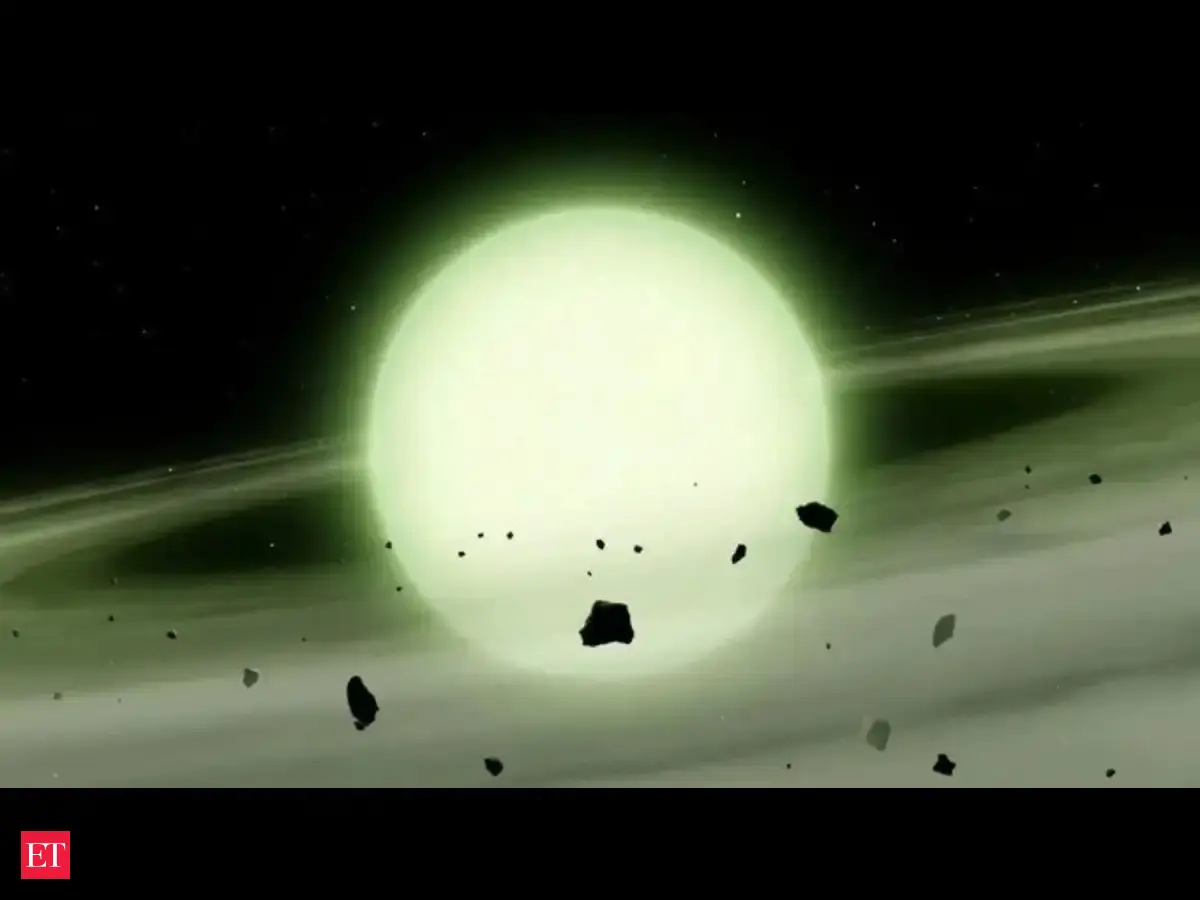
Astronomers studying 151 stars near Earth found a green white dwarf and another that is possibly the reddest ever recorded. Dr Mark Hollands said, "Most stars, including most white dwarfs, behave like 'perfect radiators,' so their colour is set almost entirely by temperature." Atmospheric gases and metals create these shades.
Astronomers studying 151 stars near Earth found unusual colors in some white dwarfs. One white dwarf appeared green due to its atmospheric composition, while another was identified as the reddest star. The research indicates that a star's color may involve more than just temperature factors. Typically, white dwarfs are white due to their high temperature and density. The findings suggest a diverse range of colors exists among white dwarfs.
Astronomers may have identified a white dwarf that looks green and another that may be the reddest star ever, after studying a sample of 151 stars, close to Earth, astronomically speaking. Temperature generally is the deciding factor for the color of a star far away like this, like hotter stars look blue-white and cooler ones look orange or red to the human eye.
Within 65 light-years from Earth, the reddest and greenest white dwarfs in the sample indicate that, other than temperature, a star's density, especially the gases and metals present in the atmosphere, decides how it will be seen by the human eye. A star's atmosphere absorbs particular wavelengths of light emitted from the dense hot bulb, and the remaining wavelengths produce different shades, from which we perceive the stars as green, pink, and cyan.
The study, titled "Any colour you like: the diverse chromaticities of white dwarfs," was published in the journal RAS Techniques and Instruments in 2026, volume 5, by researchers from the University of Warwick in the UK.
Dwarf and dense stars with a never-before-seen light
Dwarf stars are dense remnants left behind when a Sun-like star reaches the end of its lifespan and reduces to a massively dense Earth-like size, and it doesn't produce any heat.
As
NASA explains, "a teaspoon of its (Dwarf star) material would weigh more than a pickup truck." Our star, the Sun, will also become a White Dwarf in around 10 billion years.
A illustration of a white dwarf star. (NASA)
So the White Dwarfs become white after completing their newly born scorching hot phase, colored blue. Now this new research shows that other than blue, white, and red(when it is almost cooled down), some can appear pink, purple, yellow, cyan, or even green.
"Most stars, including most white dwarfs, behave like 'perfect radiators,' so their colour is set almost entirely by temperature. But nobody had really looked into what else might be possible for white dwarfs," said Dr Mark Hollands, Warwick Prize Fellow in the Astronomy and Astrophysics Group at the University of Warwick, who led the work. "It turns out these incredibly dense stars can produce colours nobody expected, and some of them genuinely surprised me," he added in a statement.
A white dwarf that appears green
The team identified WD J1330+6435, a white dwarf with a temperature of roughly 4,000 degrees Celsius, which looked green to the human eye. Its "chartreuse green appearance" came from its atmosphere, which is full of calcium, lithium, and sodium that it swallowed from the planetary system.
According to the team, it is the first credible report of a genuinely green star in the Galaxy. "The traces of sodium in the atmosphere of this white dwarf absorb the orange part of the spectrum, leaving behind a ghostly green glow," the researcher explained.
"Imagine standing on a planet and looking up at a green star. It feels like something out of science fiction," Hollands mesmerizingly added.
The reddest star may be a white dwarf, too
48 light-years from Earth, the researchers also identified WD J1011+2845, another white dwarf that may be the reddest star ever. The reddest star "has a deep convection zone that has lifted carbon from its core to its surface," the university explained in the statement.
The team find the reddest star ever. (Image courtesy: University of Warwick)
The carbon molecules distort their light "so heavily that almost all of it is squeezed into wavelengths beyond 600 nanometres," which makes this reddish appearance technically "a deep salmon-pink glow unlike anything seen in an ordinary star," they say about their origin.
Most white dwarfs still appear white
To determine how unusual these objects' colors are, the researchers examined 151 white dwarfs within 65 light-years of Earth and found roughly one in 30 stars has this phenomenon. Five of them showed unusual colors: two yellow and three pink.
The remaining 146 white dwarfs had a median color temperature of about 6,800 Kelvin, which means their color is close to white light.
"One in thirty might not sound like a huge fraction, but across the entire population of white dwarfs in the Universe, that is still a lot of oddly coloured stars out there. Yet if we take the median across a representative population of white dwarfs, we found that the average white dwarf really is white," said Professor Boris Gänsicke of the University of Warwick's Department of Physics.