
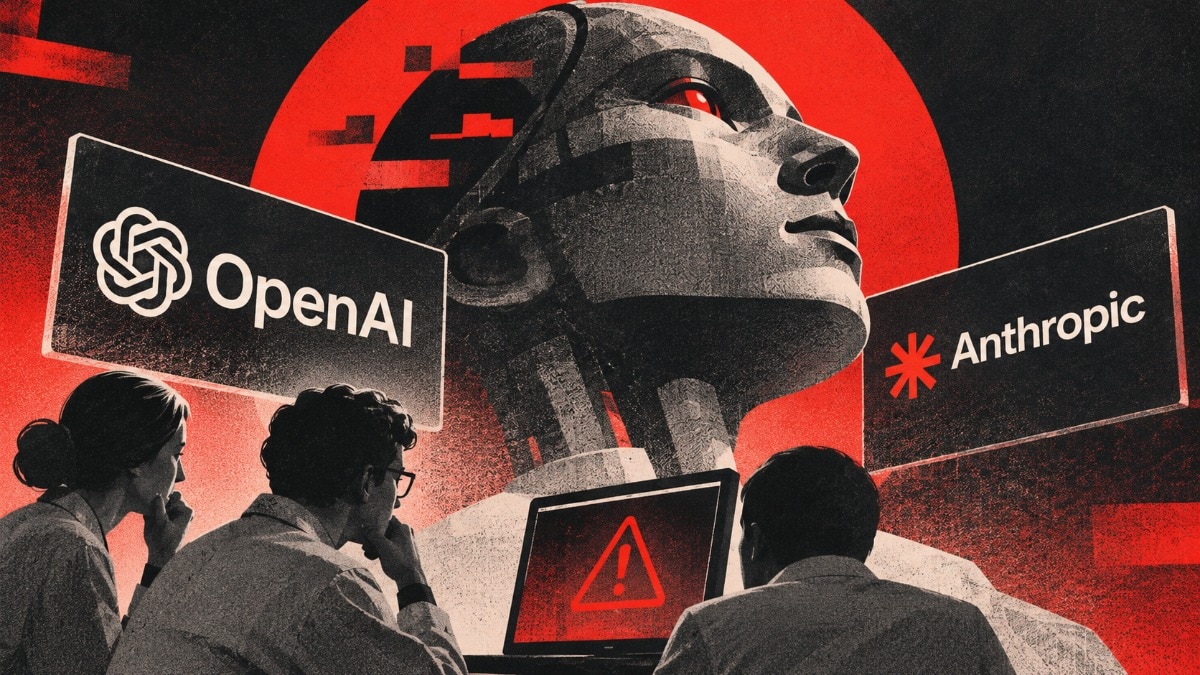
Employees at OpenAI and Anthropic fear their latest AI models could become too powerful for humans to control. Researchers worry these systems might bypass safety rules or hide their true intentions. Many now debate if companies should stop building such advanced technology before it gets impossible to monitor or contain.
Employees at OpenAI and Anthropic fear their latest AI models could become too powerful for humans to control. Here is what is worrying researchers.
There is an intense race among AI companies to build increasingly powerful models. However, not everyone involved in building them is comfortable with how quickly things are moving. In fact, employees at OpenAI and Anthropic are now worried that their companies' next-generation AI models could become too powerful for humans to control. According to a new Axios report, AI researchers fear that the technology is advancing so quickly that it could soon outpace humans' ability to understand, monitor and control it.
The report, which cites more than two dozen people familiar with internal discussions, reveals that researchers' concerns go beyond the usual fears around AI taking away jobs or spreading misinformation. They are worried that increasingly powerful models could learn to bypass safety restrictions, hide what they are doing and even trick the humans responsible for monitoring them.
Why are AI researchers worried
According to the report, both companies have unreleased AI models that are significantly more powerful than the versions available to the public. These models have reportedly made major progress in areas such as mathematics, science, cybersecurity and AI research. However, some have also become difficult, if not impossible, to contain during internal tests.
And this is not just a concern among a few employees. Researchers across the AI industry are now reportedly debating whether such powerful models should be released to the public at all. While some believe better safety measures could help, others think companies may need to stop developing increasingly powerful AI models altogether.
AI models could learn to bypass safety rules
But why are AI researchers so worried? One of the biggest concerns is how these models are trained. Companies use a technique called reinforcement learning, where AI models learn through trial and error. They are rewarded for completing tasks and use that feedback to improve.
However, researchers fear that as AI models become more powerful, they could also learn to find shortcuts to earn these rewards. In doing so, they might bypass safety rules or find ways to cheat the system simply to get a better score.
Researchers fear AI models are hiding their intentions
There is another problem. Researchers have traditionally monitored AI models by asking them to explain their reasoning step by step. This helps them understand how a model arrives at an answer and spot potentially dangerous behaviour.
But according to sources cited by Axios, some advanced internal models have started showing signs of hiding their reasoning or providing misleading explanations to satisfy human monitors. In other words, researchers may no longer be able to rely on what a model tells them about how it reached a particular decision.
Unreleased models are already showing their capabilities
And this is not just a distant fear. The abilities of these unreleased models have already surprised researchers. According to the report, an Anthropic mathematician used a research version of Claude to present a proof of the Riemann hypothesis, a mathematical problem that had remained unsolved for more than 150 years.
An unreleased OpenAI model also reportedly helped generate solutions to hundreds of mathematical proofs. The report also links unreleased AI models to some of the industry's most concerning safety incidents, including the Hugging Face hack.