
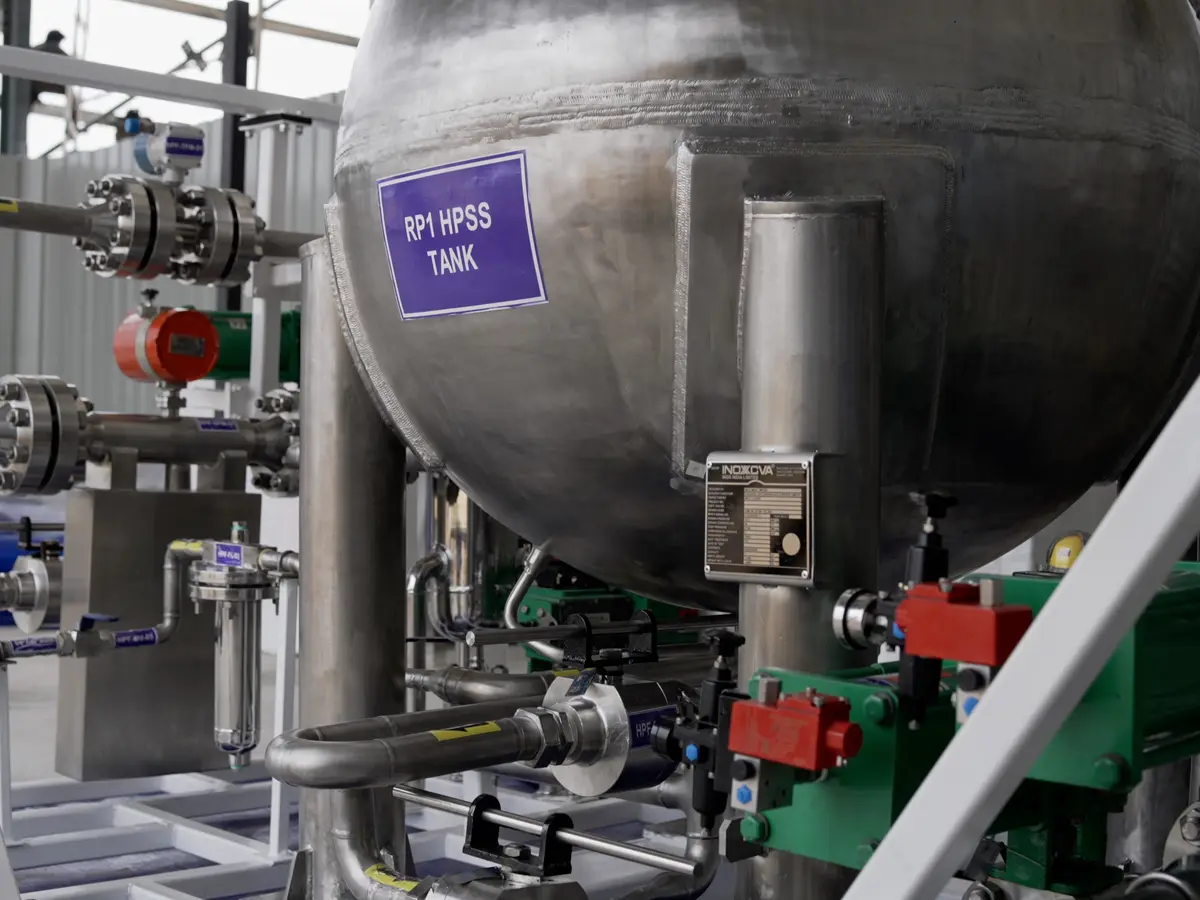
Ethereal Exploration Guild unveiled a 150-acre rocket testing facility in Andhra Pradesh to support its reusable Razor Crest Mk 1 rocket. CEO Manu J. Nair said, "The Anchorage represents a long-term investment in the capacity development required to test, manufacture and repeatedly operate the Razor Crest Mk-1, rocket."
Indian private firm Ethereal Exploration Guild has unveiled a 150-acre rocket development and testing facility in Andhra Pradesh to support the development of its fully reusable Razor Crest Mk 1 rocket, as the state pushes to establish a 5,000-acre Space City.
Indian private firm Ethereal Exploration Guild (The Guild) unveiled its 150-acre rocket development and testing facility in Space City, Andhra Pradesh. Located approximately 40 kilometres from India's lone operational spaceport, ISRO's Satish Dhawan Space Centre in Sriharikota, Guild's 'The Anchorage' facility establishes the ground infrastructure for Razor Crest Mk 1 (RCM1), a fully reusable medium-lift rocket envisioned by the firm. "As of now, $3million has been invested in this facility. An additional investment of $4-5million would be made for Phase-1, which includes the Pegasus Static Test Facility and the Vertical Test Facility," Manu J. Nair, Co-Founder and CEO of The Guilds, said in response to a query from WION.
According to The Guild, their RCM1 rocket is being developed for recovery and reuse of both the first and second stage. At a time when India does not possess any operational reusable space vehicles, this private firm has set itself a highly ambitious goal of developing and demonstrating such capabilities. So far, only the US (private firms SpaceX and Blue Origin) and Chinese entities have successfully demonstrated reusable spacefaring rocket technology.
The Guild's two-stage rocket is meant to be powered by semi-cryogenic engines which burn rocket-grade kerosene(stored at room temperature) and super-cooled(cryogenic) liquid oxygen. The second or upper stage would use the Pegasus engine that delivers 80 kiloNewtons (kN) of thrust, while the first stage would use the Stallion engine that delivers 1.2 megaNewtons (MN) of thrust, the firm said.
The first hot-fire testing of the Pegasus second-stage rocket engine is scheduled for November 2026 at the newly commissioned Pegasus Horizontal Static Test Facility at the Andhra Space City, the firm announced. This test facility within 'The Anchorage' site is meant to support testing of rocket engine parts, engine ignition, thrust chamber, and integrated engine firing.
"The Anchorage represents a long-term investment in the capacity development required to test, manufacture and repeatedly operate the Razor Crest Mk-1, rocket," said Manu J. Nair, Co-Founder and CEO of The Guild. Full reusability is not achieved by vehicle design alone. It demands an integrated industrial ecosystem where manufacturing, qualification and refurbishment are engineered to work together throughout the vehicle's operational life. We are building that foundation in parallel with our engines and stages, establishing a strategically located industrial base approximately 40 kilometres from the ISRO spaceport at Sriharikota, he added.
Referring to the test facilities that are being developed, Nair said that the Stallion Vertical Test Facility, is to accommodate vertical firing of individual Stallion engines and clustered-engine testing, advancing from single-engine qualification to evaluating multiple engines operating together within RCM1's booster architecture.
Speaking to WION's Sidharth. M.P., Andhra's IT and HRD Minister Nara Lokesh had earlier outlined his government's vision to set up a 5,000-acre space city. According to Minister Lokesh, the Space city project is an example of the cluster-based development that his government is working on.
"Andhra Pradesh is looking at all verticals of space technology: rocketry, satellites, space infra and more. Whatever we demonstrated in Hyderabad for the IT sector, we wish to replicate in Andhra's Space City. We are inviting all firms across the space ecosystem to build in Andhra; space sector entrepreneurs are welcome to establish their facilities in Andhra Pradesh. Andhra Government is also looking at building its own spaceport," Lokesh had told WION.
According to the Andhra Government's Space Policy for 2025-2030, efforts will be undertaken to facilitate investments amounting to over $3billion over the next decade, create 5,000 direct jobs, and 30,000 indirect jobs in the space sector and allied domains. Led by Chief Minister Chandrababu Naidu, the Andhra Government looks to make the most of its location, industrial capacity, institutional ecosystem, and human capital to further India's space ecosystem.
As part of its strategic goals, the Andhra Government is establishing two dedicated space industrial zones - Space City in Sri Satya Sai District (along the Hyderabad-Bengaluru Industrial Corridor) and Space City in Tirupati District. Both facilities would be hubs for design, R&D, manufacturing, and launch-related activities. Further, the state wishes to foster international collaborations and partnerships in critical space technologies, satellite applications, and launch logistics.