
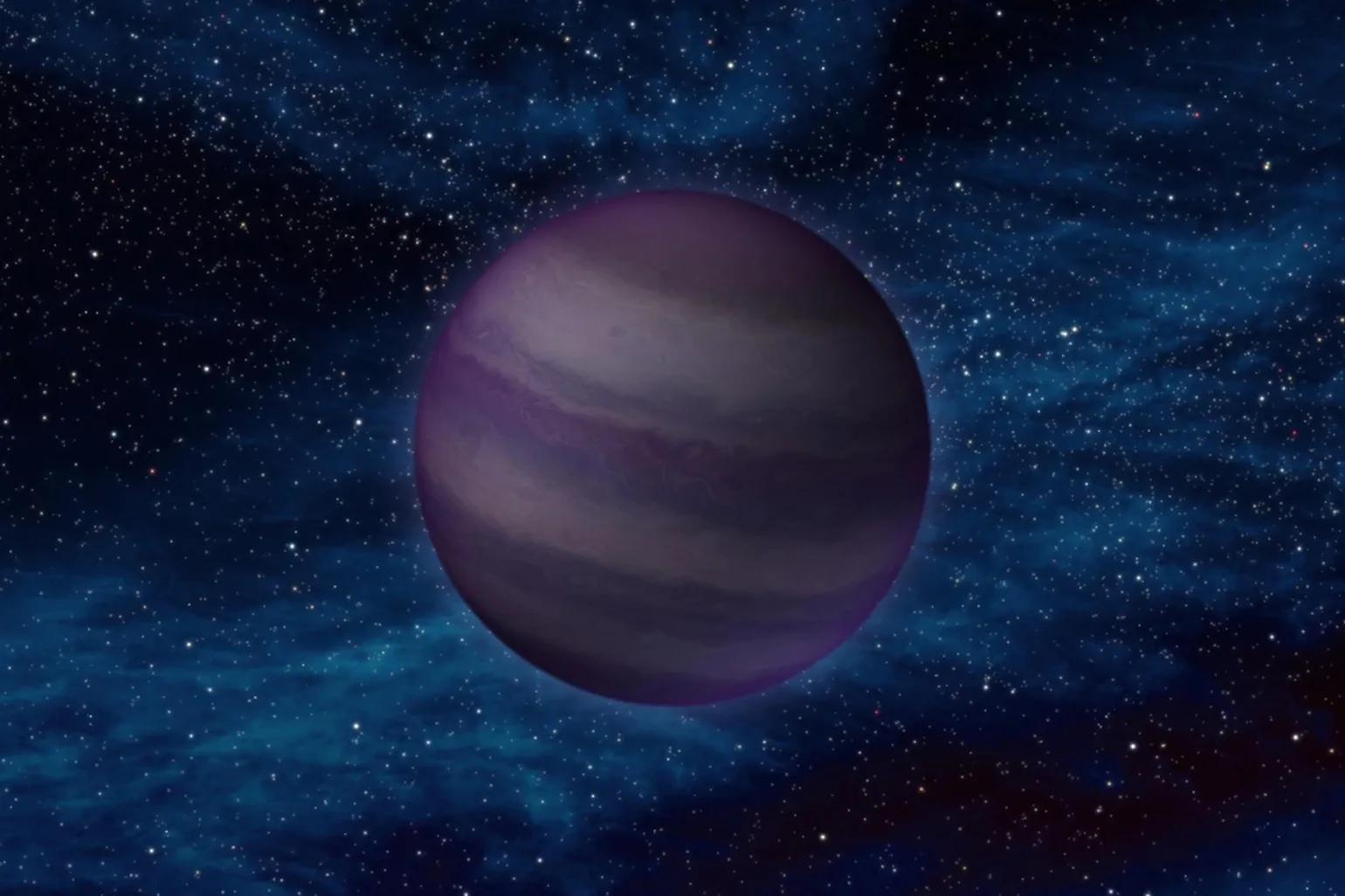
Astronomers used the JWST to study WISE 0855, a brown dwarf 7.5 light-years away. They found that water clouds on this cold world change thickness over time. "This is the first time we've been able to confirm that water clouds are becoming thinner and thicker on a nearby world," said Miles.
WISE 0855, with an approximate temperature of 265 Kelvin (cooler than Earth's surface), is the coolest brown dwarf discovered to date. As intermediate cosmic objects, brown dwarfs have mass greater than planets, but they lack the necessary mass to become stars. WISE 0855 has a mass approximately twice that of Jupiter; therefore, it further blurs the distinction between planet and star.
For 11 hours straight, Brittany Miles, an assistant astronomer at the University of Arizona's Steward Observatory, and her team aimed JWST at the object and captured a spectrum every 15 minutes. The result? The most detailed time-series portrait ever taken of a world this cold.
And the headline discovery: direct confirmation that water clouds on another body change thickness over time. In other words, weather, real, dynamic weather, happens there.
"This is the first time we've been able to confirm that water clouds are becoming thinner and thicker on a nearby world," said Miles. "Before JWST, we only had photometry, which mixed up the effects of clouds, chemistry, and temperature all together. Now we can actually distinguish them."
While WISE 0855 was rotating, JWST saw areas of cloud cover come into and go out of focus. It looked like a patchwork quilt with warmer and colder areas. The telescope also found signals at the base level that are rhythmic, from gases including carbon monoxide and phosphine.
These gases do not stay in one place. Convection pushes them up into the atmosphere, much like how the atmosphere of Jupiter is mixed. Disequilibrium chemistry is the term used to describe this type of chemical activity. Observing this occurring for the first time was an incredible experience.
NASA says Hii to our neighbor in space
Mark Marley, director of the Lunar and Planetary Laboratory at U of A, likens the process to peering through a filter:
"The photons go through the atmosphere and escape to space. It's like looking at the world through a screen door, where the screen is filtering out some of the light. We're learning about the world on either side of the screen, but we also have to understand the screen itself."
And this "screen" keeps changing.
Sure, WISE 0855 isn't a planet we could visit. But the physics at play- clouds thickening, gases rising- is the same physics shaping Jupiter's atmosphere, and, by extension, the atmospheres of gas-giant exoplanets orbiting other stars.
Miles emphasizes that this discovery is bigger than one brown dwarf:
"Even though brown dwarfs are not true planets, they exhibit planet-like behavior. There is a spectrum of behaviors, not a hard line between brown dwarfs and planets. Jupiter and this object look distinctly different, but they have similar weather patterns. There are basic physics and chemistry that can be applied across all of these worlds."
Astronomers discovered a widely separated pair of brown dwarf
That universality is the real prize. If the same rules apply everywhere, JWST can help decode the skies of distant exoplanets, worlds that might one day be candidates for habitability.
For Miles, the project is also personal. Her models build on decades of work by theorists like Marley, whose atmospheric models were benchmarked against Jupiter.
"A lot of my physical intuition on what is missing from the models is because of Mark's mentorship and hard work," she said. "This is a multi-year project. A lot of people contributed to make sure this could be done right."
The ultimate point is straightforward and very significant: weather is not something that is exclusive to Earth. It's a general process occurring in many different parts of our universe.
WISE 0855 is an isolated, star-free celestial object that travels alone. However, the atmosphere above it is active, with clouds constantly changing, gas rising, and chemical reactions occurring. With the help of the JWST, we are now able to see this celestial "show" take place in real time.
Now that Miles has more baseline observations to get into the details of the planet's rotation and atmospheric dynamics, there is an obvious takeaway from this discovery. Our cosmic neighborhood is a lot stormier, cloudier, and more similar to Earth than we could have ever imagined.