
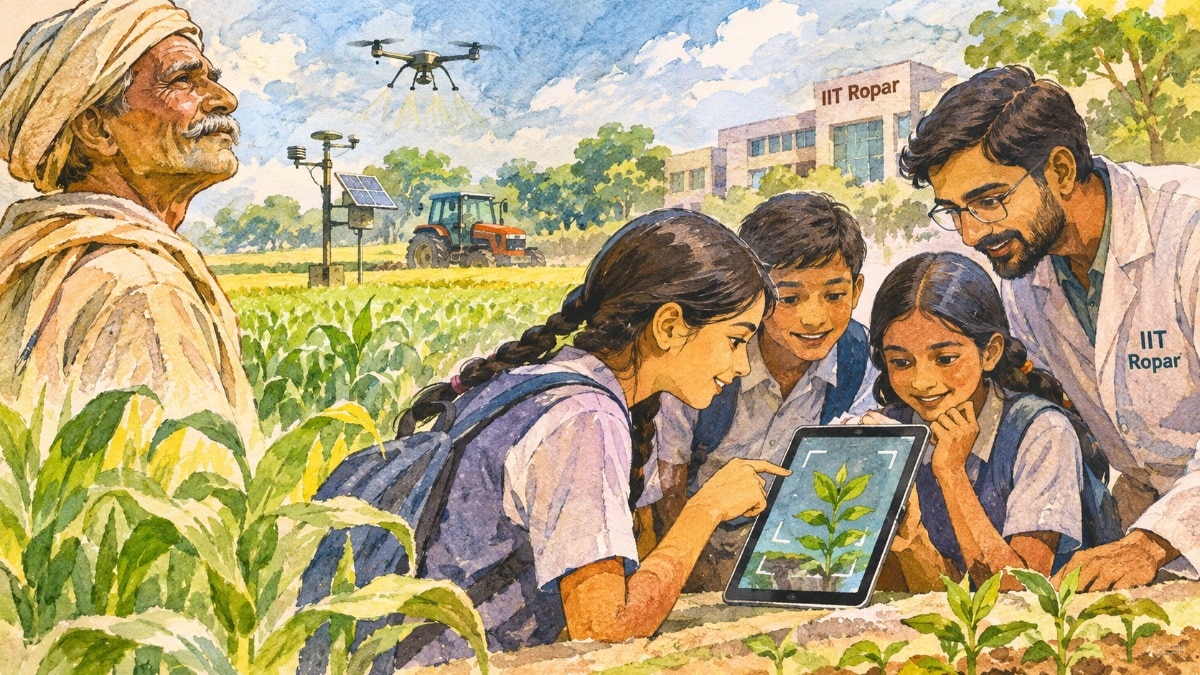
IIT Ropar is bringing agriculture to schools to teach children about farming science. Following PM Narendra Modi’s call for smart farming at the India Today Kisan Summit 2026, which ended on November 12, the institute started the AVNI app. It helps young students understand food systems and modern technology.
India remains an agrarian nation. Agriculture today faces mounting challenges, from climate change and shifting weather patterns to food security, declining soil health and the loss of farmland to urbanisation. At the India Today Kisan Tak Summit, PM Narendra Modi spoke of need to prepare for changing demands. At IIT Ropar, an initiative seeks to address these challenges through AI and a digital platform designed for children aged 5 to 15. It aims to introduce young minds to agricultural education, helping them understand science of farming.
Prime Minister Narendra Modi, at the India Today Kisan Summit 2026, which concluded on November 12, once again drew attention to the importance of farming and the changes taking place in India's agricultural sector. His focus on smart farming definitely talks of something which is unheard of but raises a larger question: how does the next generation view agriculture, and are young people being prepared to understand the challenges that will shape the future of food production?
The answer may lie not only in the fields but also in classrooms.
As farming increasingly draws upon technology where scientific knowledge and new methods of cultivation are playing a major role, there is a growing need to make agriculture a subject of interest among children.
At IIT Ropar, one of India's premier technical institutions, an initiative under the Ministry of Education's Centre of Excellence programme is seeking to address some of the pressing challenges facing Indian agriculture.
ANNAM.AI, the institute's agriculture-focused initiative, is working to bring AI and technology into farming, developing tools that can help farmers make informed decisions, improve crop productivity and use resources more efficiently.
Its efforts, however, extend beyond the fields. The initiative is also exploring ways to bring agricultural education into schools and other institutions through AVNI app, enabling children to understand farming, biodiversity and the food systems on which the country depends.
In an exclusive conversation with India Today, Professor Pushpendra Singh, Project Director of ANNAM.AI at IIT Ropar, spoke about the vision behind the initiative and its plans to connect technology with farming and how the next generation could be involved.
WHY AGRICULTURE NEEDS A NEW APPROACH
Where will India find the food to feed its growing population? How will it produce more when agricultural land is under pressure from the demands of development? And how can farmers increase their output without exhausting the very soil and water upon which cultivation depends?
These, according to Professor Pushpendra Singh, are the three questions that gave rise to ANNAM.AI at IIT Ropar. Through its child-focused AVNI app, students can explore the world of farming by using photographs to identify crops, insects and plant health, making agricultural learning more interactive and engaging.
Singh believes that the challenge before Indian agriculture is greater than it may first appear. The country's population is growing, consumption patterns are changing and agricultural land is being required for roads, houses and other forms of construction.
The burden upon farming, therefore, is not simply to produce more, but to do so with fewer resources.
Explaining the scale of the problem, he says:
"We need something like 65% to 70% more food to feed this ever-growing population. [...] By 2050, we need 70% more food. By 2040, we have less rural population and rural land. So this is a double problem. It's not just if you freeze everything today, that's fine. We are not going to use any agricultural land any further. Still, you need 70% more food to be produced for the same amount of land."
For Singh, increasing production cannot mean simply pouring more fertiliser into the fields or drawing more water from the ground.
He recalled the idea of an Evergreen Revolution associated with agricultural scientist MS Swaminathan, whose vision was to increase production without damaging the soil and biodiversity.
"As I said, we have to work with all these three numbers. One, we need 70% more food. Number two, we have to worry about how to manage the agricultural land. Number three, we have to increase the yield so that we can reach to the level of what the U.S. is able to produce," he says.
The difficulty, he maintained, cannot be addressed by increasing the use of fertilisers and water alone.
The farmer must be assisted in deciding what to use, when to use it and in what quantity. This is where digital agriculture and artificial intelligence enter the discussion.
THE JOURNEY FROM FARM TO KITCHEN
There is another difficulty which receives less attention than the question of production: the food that is lost after it has been grown.
A crop may be harvested, but that does not ensure that it will reach the consumer in good condition. Storage, transport, delayed harvesting and the absence of adequate cold-chain facilities can all contribute to losses.
Singh drew attention to the difference between the problems faced in India and those in countries where post-harvest management is more developed.
"In India, the food waste doesn't happen between the market to kitchen, or kitchen to anywhere. Because in India, our consumption pattern is very clean. We consume almost everything of the food. But our food waste happens between the produce to the market."
He went on to explain how the absence of suitable facilities affects farmers:
"Sometimes the farmers are not able to sell it in time. Sometimes farmers are not able to harvest in time. Even if they want to harvest, and they harvest it, they are not able to transport to the right place to sell it. If it reaches the right place, from that right place to the consumer, it doesn't reach in time."
The remedy, in his view, requires better storage and transportation, supported by appropriate technology. He cited the example of tomatoes, which can be processed close to the place of harvest and sent to markets in a form that preserves their quality.
For ANNAM.AI, these are among the practical difficulties that technology must seek to address. Singh said the intention is to build a body of knowledge and tools that may be used by farmers, companies and start-ups, while bringing digital agriculture into wider public discussion.
WHY SHOULD A CHILD KNOW ABOUT A HONEYBEE?
The institute's ambition, however, does not end with the farmer. Singh believes that children must also learn about agriculture, for the simple reason that their lives depend upon it.
Consider the honeybee, the butterfly and the other insects that are often seen in a garden or a field. To a child, they may appear to be little more than creatures passing through the day. Yet many of them perform a necessary service in the production of food.
Singh believes that a lack of knowledge about biodiversity may have consequences for the future of farming. He pointed to the importance of pollination and the part played by insects in the agricultural system.
"Why do we need them? We need them for the process of pollination. 75 percent plus crops that we grow, they are actually using insects for the purpose of pollination."
He explained the matter through the example of a mustard field:
"Imagine you have mustard field. And your mustard field is not pollinated 100 percent. It is pollinated only 50 percent. Doesn't matter what quality seed you have used. Doesn't matter what kind of fertiliser and land you have used. Your yield will be only 50 percent because the yield is directly related to the pollination. And pollination is directly related to the pollinators."
The lesson, Singh suggests, is that agricultural education should not be confined to the names of crops or the methods of cultivation. Children must also understand the relationships between plants, insects, soil, water and food.
AVNI: MAKING AGRICULTURE A SUBJECT OF DISCOVERY
It was with this purpose that the team developed AVNI, a digital learning application intended for children between the ages of five and 15. Rather than asking children merely to read about agriculture, the application encourages them to observe the world around them.
A child may photograph an insect, a plant or a crop and learn about what has been found. The application provides information about the insect's family, life span and role in agriculture, including whether it is beneficial or harmful. It can also help identify possible problems affecting a plant, such as disease or a shortage of water or nutrients.
Singh explained the thinking behind this approach:
"We realize that kids like to play video games. They are engaging themselves in different things. So why not we engage them in something which is also useful for them."
The application also employs points and badges to encourage children to continue exploring. Singh said:
"In a typical game you earn the points. In fact you play sometime, you know, if you are playing Candy Crush. I am just giving a typical example. What do you get in Candy Crush? You get little bit of dopamine release and you get some points. Those points. You are happy. [...] So those badges and points we included. At the same time we included a lot of knowledge there."
The purpose is to bring learning and observation together. A child who photographs an insect is not merely collecting points; the child is also being introduced to its place in the natural world.
CAN THE SCHOOL GARDEN BECOME A CLASSROOM?
Singh now hopes to take the application into schools and make agricultural learning part of their regular activities. He believes that the existing treatment of the subject in school education does not always provide children with sufficient practical understanding.
His suggestion is simple: take students out of the classroom, give them a mobile phone or tablet and let them explore the school garden.
He said:
"So why not that one hour you take a tablet or a mobile phone and go with the kids in the school garden and just click things and let them see in the real time what is what. So that is what we are also trying to do. We are writing to Ministry of Education."
There is, of course, a distinction between developing an application and making agricultural education a regular part of school life. The latter will require the participation of schools, teachers and education authorities.
ANNAM.AI's and AVNI app proposed school outreach is still an effort in that direction.
Agriculture is not a concern belonging to farmers alone. It begins on the farm, but its consequences reach every household.