
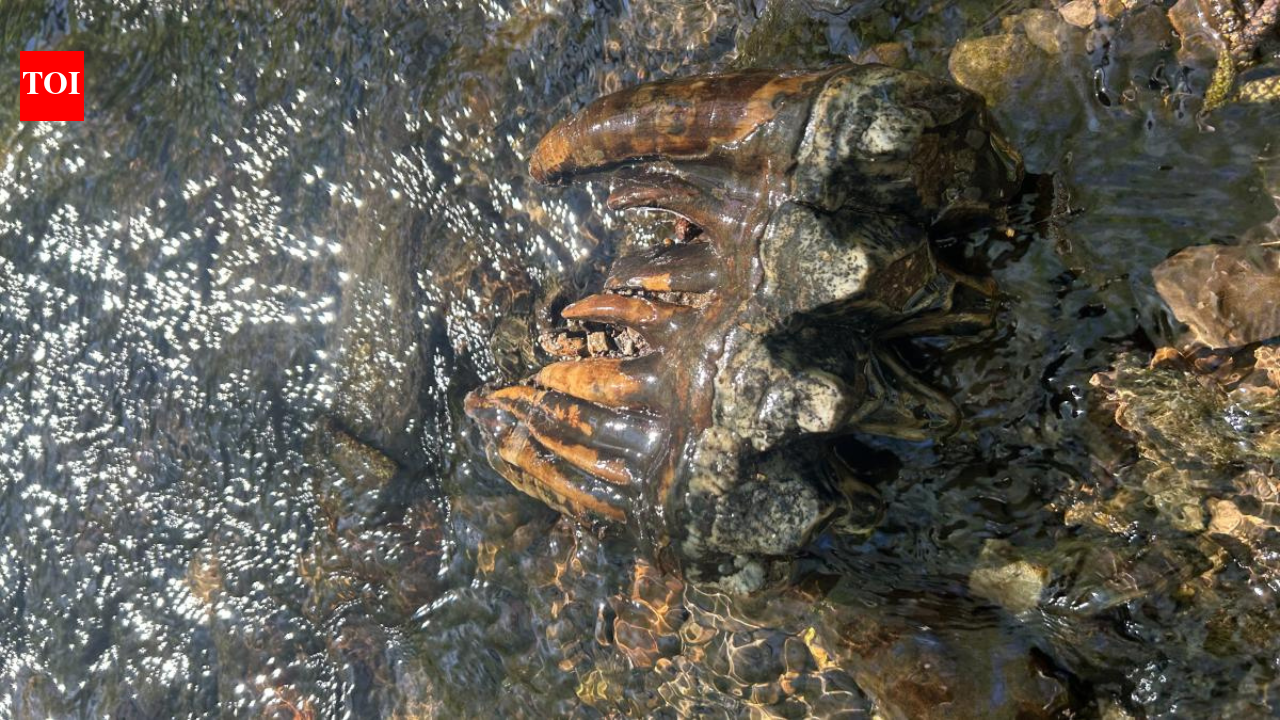
A California geologist found an Ice Age mastodon tooth in a creek while surveying for a habitat project. A Google reverse image search helped identify the fossil, which is at least 10,000 years old. Paleontologist Wayne Thompson said, "the most complete mastodon molar from our area" and truly spectacular.
A California geomorphologist surveying a creek for a habitat restoration project noticed an unusual object lying half in and half out of the water. Unsure what she had found, she turned to Google's reverse image search for clues. The search suggested it might be a molar from an Ice Age mastodon, and a paleontologist later confirmed it. The tooth belonged to an ancient Pacific mastodon, a mammal that roamed North America thousands of years ago. It was found in a Midpeninsula Regional Open Space District (Midpen) preserve in San Mateo County, during work to improve habitat for threatened California red-legged frogs. Researchers are now working to establish its age and significance.
A reverse image search pointed to the identification
Brigid Lynch, a geomorphologist with Balance Hydrologics, found the object while conducting field surveys for the habitat enhancement project. When a reverse image search suggested it could be a mastodon molar, Midpen and her team contacted paleontologists for confirmation.Wayne Thompson, a paleontologist with Pacific Paleontology, confirmed it as an upper left molar from a Pacific mastodon (Mammut pacificus).
The tooth measures about 8.5 inches long, 7 inches deep and 3 inches wide, and it retains both its crown and roots.
Thompson called it "the most complete mastodon molar from our area" and the most spectacular he has ever seen. Mastodon teeth are often found broken, which makes the condition of this one especially significant.
The tooth is at least 10,000 years old, and may be much older
The tooth is estimated to be at least 10,000 years old, but its precise age has not been established. Thompson told Fox News Digital it could be between 50,000 and 100,000 years old. Researchers at Stanford University's Doerr School of Sustainability plan to analyze the tooth to learn more about its age, the animal's diet and its environment.Pacific mastodons were large herbivores that lived in western North America during the Pleistocene epoch, which ended about 11,700 years ago. Although related to modern elephants, they differed from mammoths in several ways, including their teeth and feeding habits. Mastodons primarily browsed on leaves, shoots and other vegetation rather than grazing mainly on grasses.Pacific mastodons were identified as a species distinct from the American mastodon in 2019, following extensive study of mastodon bones found in Southern California.
Stanford will keep and scan the fossil
Midpen donated the fossil to Stanford University to support further scientific study. Stanford will also produce a 3D scan of the tooth for Midpen to use in educational outreach, which allows people to examine the specimen without handling the original.The fossil could help scientists understand the animals that once inhabited the Bay Area and the ecosystems in which they lived. Such discoveries provide clues about past biodiversity and environmental change.
The discovery site will remain undisclosed
Midpen is not revealing the exact location, so that visitors do not go looking for their own fossils. Thompson has said the tooth may have recently separated from a skull that remains buried at the site, though this has not been confirmed.The find also offers an unexpected link between ancient wildlife and modern conservation. Lynch came across the fossil while working on a project to improve habitat for the threatened California red-legged frog. A survey meant to support a species facing present-day pressures instead uncovered evidence of an animal that disappeared thousands of years ago.