
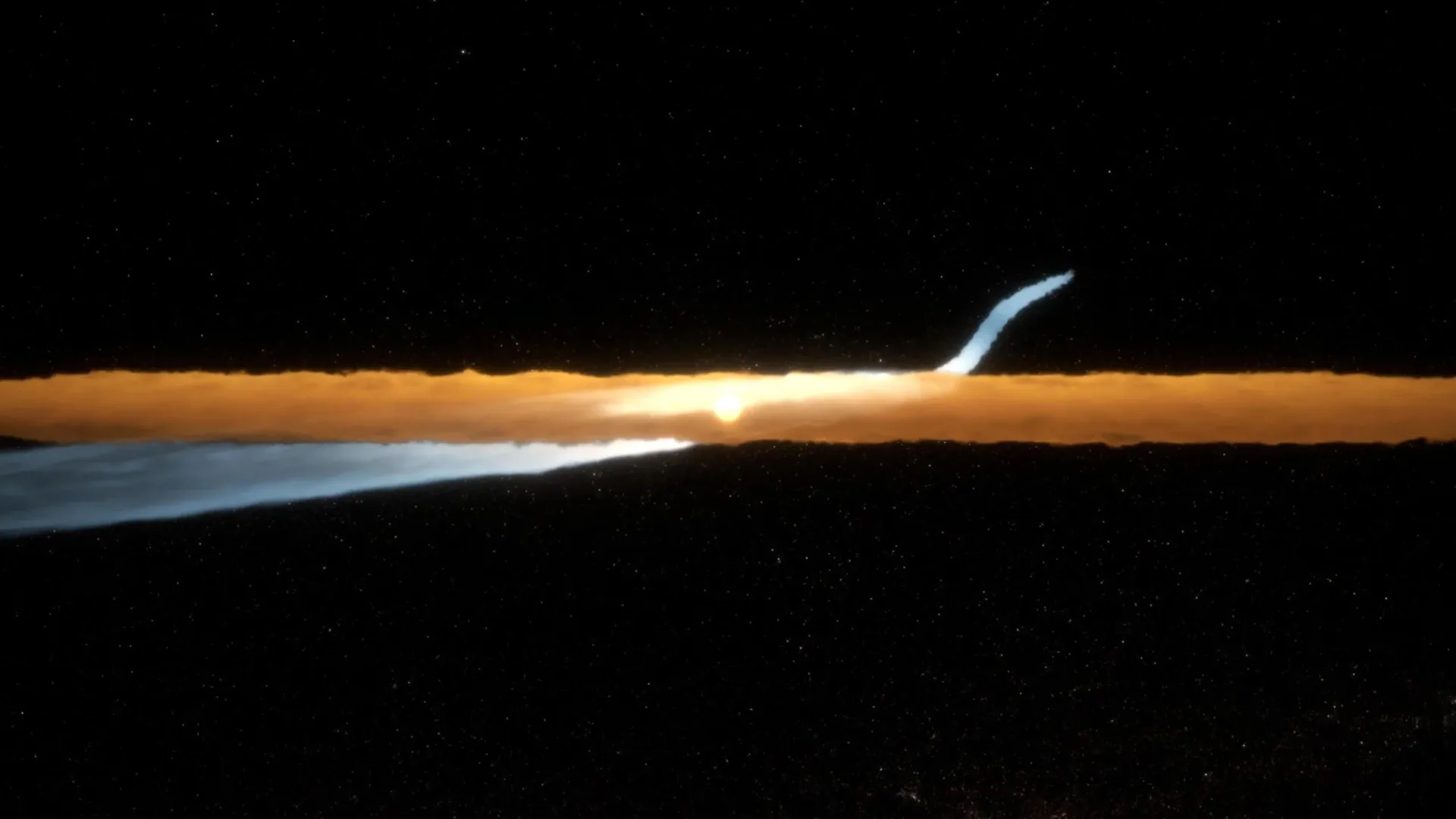
Astronomers used NASA’s Hubble Space Telescope to capture the mysterious Cat’s Tail structure near the star Beta Pictoris. Arin Avsar said, "The Cat's Tail is thought to be the aftermath of a collision between large bodies." This discovery suggests that massive worlds crashed together, leaving behind a vast dust disk.
The structure is part of a vast disk of dust and debris surrounding Beta Pictoris, a young star system that resembles our own solar system during its early development. Now, using NASA's Hubble Space Telescope, astronomers have captured previously hidden details of the Cat's Tail in visible light for the first time.
The discovery is described in a study published in The Astrophysical Journal Letters. Led by University of Arizona planetary scientist Arin Avsar, the research team combined the new Hubble images with observations spanning more than 14 years. Their findings provide a clearer picture of the structure's composition, location, and shape, along with additional evidence that a massive collision may have created it.
A Possible Collision Between Pluto-Sized Worlds
"The Cat's Tail is thought to be the aftermath of a collision between large bodies - think something like Pluto," said Avsar, a doctoral student working with the research groups of Daniel Apai and Kevin Wagner at the University of Arizona's Lunar and Planetary Laboratory and Steward Observatory.
"Oddly, this feature had previously only been seen with the James Webb Space Telescope, which detects infrared light, but remained invisible at shorter wavelengths, which has puzzled the community for a while."
The mystery becomes even more interesting when viewed in the context of how planetary systems form.
Today, our solar system appears relatively orderly. Planets follow established paths around the Sun, while many smaller rocky objects occupy "designated" regions such as the asteroid belt. But 4.6 billion years ago, the situation was dramatically different.
A young sun was surrounded by a swirling disk of gas and dust. Rocky objects repeatedly collided, sometimes breaking apart and sometimes combining into larger bodies. Over time, some accumulated enough material to become planets, while countless others were destroyed or scattered.
Astronomers study younger systems like Beta Pictoris because they offer an opportunity to observe processes that unfolded in our own cosmic neighborhood billions of years ago. Its debris disk, consisting of dust and fragments left behind during planetary development, is believed to be approaching the final stages of planet formation.
Why Hubble Could Finally See the Mysterious Cat's Tail
One of the most intriguing questions about the Cat's Tail is why it was previously detectable in infrared light but so difficult to observe in visible light.
The answer may lie in the unusual material that makes up the enormous structure.
"We think the Cat's Tail has eluded our observations in visible light until now because of what it's made of," Avsar explained. "It consists almost entirely of we call organic refractory material, which is heavily carbon-based. These long chains of carbon atoms absorb visible light, so they're quite black."
Organic refractory material consists of complex carbon compounds that can withstand relatively harsh conditions in space. Because these compounds absorb much of the visible light that strikes them, they can make the surrounding dust appear exceptionally dark.
The Hubble observations also support another unusual finding: the Cat's Tail appears to be composed of extremely small, surprisingly porous dust particles.
Individual grains measure only about a micron across, roughly one millionth of a meter. Yet instead of being compact and solid, they appear remarkably "fluffy," with substantial empty space within their structures.
The scale of the entire cloud is difficult to imagine. It may stretch as far as 1,000 astronomical units, with one astronomical unit (AU) defined as the average distance between Earth and the Sun. That corresponds to approximately 93 billion miles, or the equivalent of lining up around 200 trillion house cats from tail to nose.
"How you can get dust grains that small that are as porous as we see here, no one really understands, and that's part of why we study this feature," Avsar said.
How a Violent Collision Could Create Fluffy Cosmic Dust
If the Cat's Tail really formed when large planetary bodies smashed into each other, researchers still need to explain how that destruction produced such tiny, porous particles.
One possibility is that the collision was powerful enough to vaporize some of the material involved.
"It's possible that the velocities involved in the collisions were so high that the carbon grains vaporized, turned into gas, and then recondensed as they cooled, and that's how they became so porous," said co-author Wagner, a NASA Sagan Postdoctoral Fellow at the University of Arizona's Steward Observatory.
In this scenario, the intense impact would have transformed solid carbon material into gas. As the material cooled, it could have condensed back into solid particles with unusually open, lightweight structures.
However, the precise process remains uncertain, and additional observations will be needed to determine whether this explanation is correct.
A 93-Billion-Mile Structure With an Unexpected Shape
The new research also challenges previous assumptions about where the Cat's Tail extends in space.
By combining visible light observations from Hubble with infrared measurements from the James Webb Space Telescope, the researchers used computer modeling to reconstruct the structure's possible three-dimensional arrangement.
Earlier observations suggested that the Cat's Tail extended outward from Beta Pictoris and far behind the star from Earth's perspective. Because the surrounding debris disk is viewed nearly edge-on, it was difficult to determine how much of the structure extended away from us rather than across our field of view.
The new analysis points to a different explanation.
"We find that instead of extending for 1,000 astronomical units behind the star, the Cat's Tail may extend straight sideways relative to us, and there is no third dimension to it," Avsar said. "It's essentially in the same plane of the sky as the star and possibly extends a little bit behind it."
This suggests the structure may be spread mainly across the sky as seen from Earth, rather than projecting deep into space behind the star.
The revised geometry gives astronomers a better understanding of where the dust is located and could help them reconstruct the event that produced it.
Hubble Discovers a Strange Warp Caused by a Giant Planet
The Cat's Tail was not the only unusual feature revealed by the new observations.
Using Hubble in a different observational configuration, Avsar and his colleagues also identified an unexpected distortion in the broad halo of dust surrounding Beta Pictoris.
The researchers suspect this strange warp may be caused by the gravitational influence of Beta Pic b, one of three planets in the system.
Beta Pic b is a massive gas giant estimated to be about 10 times the mass of Jupiter. Its powerful gravity may be disturbing the surrounding debris, altering the paths of dust particles, comets, and other icy objects across enormous distances.
"This gives us another line of evidence into how giant planets influence comets through their immense gravitational force," Avsar said. "It's a testament of how much these massive planets really influence their surrounding dust and icy bodies out to hundreds of astronomical units."
The finding highlights how giant planets can shape their environments far beyond their immediate orbits.
A Glimpse Into Our Solar System's Violent Past
For researchers, Beta Pictoris offers more than an opportunity to investigate an unusual cosmic structure. It may also provide a window into the early history of our own solar system.
Consider the Kuiper Belt, the distant region beyond Neptune that contains Pluto and numerous other icy bodies.
When the Kuiper Belt was only about 20 million years old, astronomers believe it was much more crowded than it is today. It may have contained hundreds of objects comparable in size to Pluto.
Over billions of years, the gravitational influence of the solar system's outer giant planets likely changed that environment dramatically. By disturbing the orbits of smaller bodies, these planets may have pushed many objects into new regions or expelled them from the solar system entirely, effectively "clearing out" much of the original population.
The strange dust tail and newly identified warp around Beta Pictoris may offer clues to similar processes unfolding in another planetary system.
By studying these distant structures, astronomers hope to better understand how violent collisions, migrating debris, and the immense gravity of giant planets helped transform the chaos of the early solar system into the planetary arrangement we see today.