
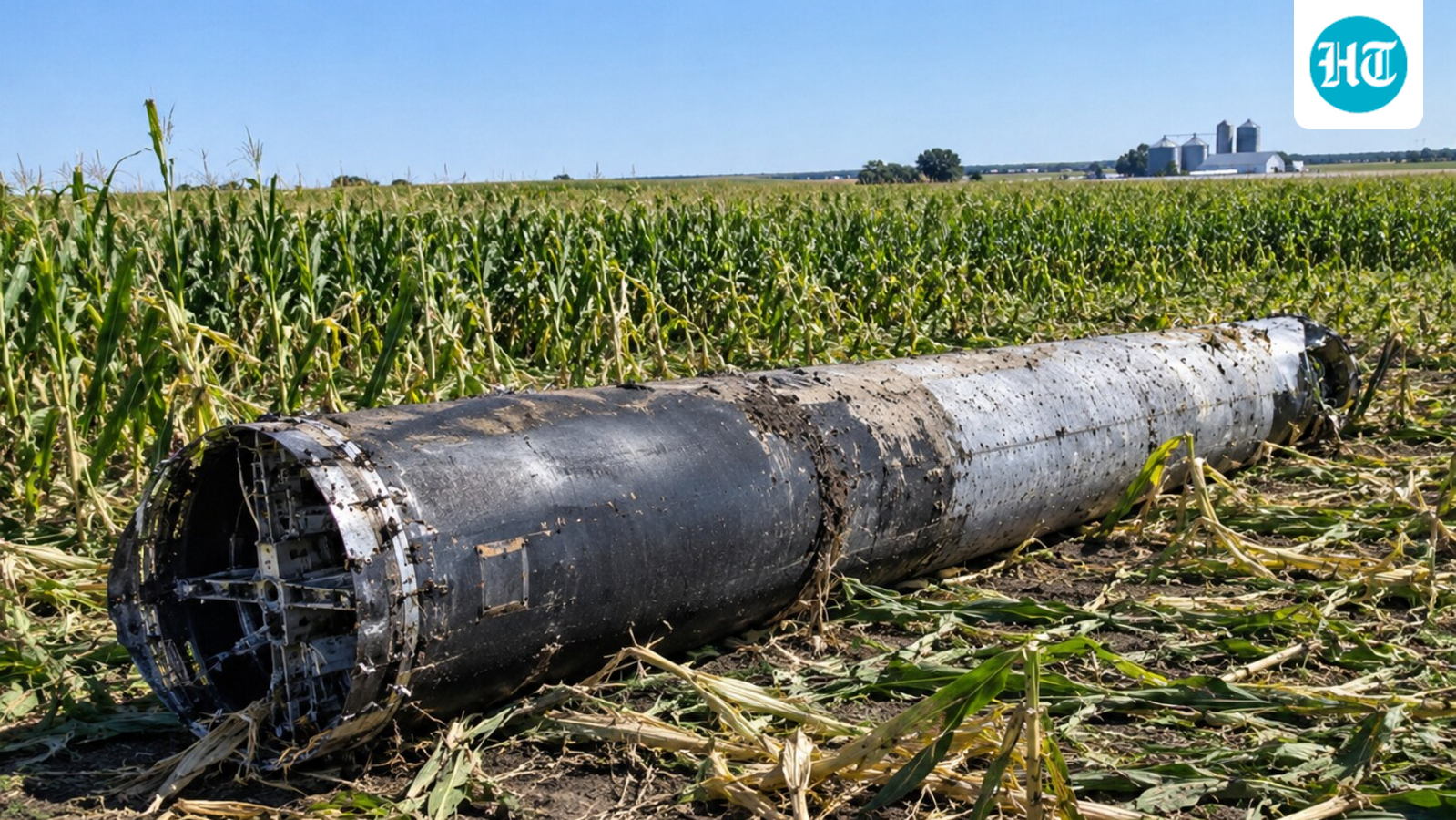
A Minnesota farmer found an 11-foot metal object in his cornfield on October 14. Deputies said the charred, bowl-shaped item is presumably space debris. Officials found serial numbers on the device and started working with federal agencies to find its origin. They said there is no threat to the public.
A cornfield in western Minnesota became the site of a space-debris mystery after a farmer discovered a charred metal object among his crops. The bowl-shaped object, measuring about 11 feet across, was unlike anything he had encountered on the farm, prompting authorities to investigate whether it had fallen from the sky.
As reported by MPR News, the object was discovered on October 14 in Scott Township, Stevens County, while the farmer was harvesting corn. Deputies who arrived at the scene found the unusual structure and described it as presumably a space object. The farmer later estimated that it may have been in the field for about six weeks, based on the condition of the crops growing around and beneath it.
The mystery began after the Stevens County Sheriff's Office was notified of "foreign debris" in a cornfield. Officials responded to the scene and discovered the metallic object, which has been estimated by officials as being approximately 11 feet across and "presumably a space object." Photos released by the sheriff's office reveal a dark metal bowl that has visible evidence of having been scorched. The charred look of the object was one factor in officials' suspicion that it was an object that had re-entered Earth's atmosphere.
The discovery also offered a clue about what the hardware might be. The officials stated that there were serial numbers on the device, which could assist in figuring out where the hardware had come from and who had been its owner. The sheriff's department began working with state and federal agencies to determine the device's origin. Despite the unusual situation, officials said there was no threat to the public.
The investigation took a more intriguing turn when aerospace observers examined the object's apparent size and shape. MPR News, citing evidence from Ars Technica, suggested that the object could be associated with a Chinese rocket launched earlier this year. The suspected vehicle was a Zhuque-2E rocket, developed by Chinese aerospace company LandSpace.
That sequence highlights a basic problem with objects left in orbit. A rocket stage can continue travelling around Earth after completing its primary mission. Eventually, atmospheric drag can cause it to decay from orbit and re-enter the atmosphere. Most materials burn up or break apart, but some dense or heat-resistant components can survive and reach the ground. NASA notes that spacecraft and rocket stages generally break apart during re-entry because of aerodynamic forces and heating, although individual components can survive depending on their material, size, and construction.
The Minnesota discovery is unusual not just because of its size, but because it shows how space activity can leave physical traces far from launch sites. Research published in Science examined how space debris breaks apart during atmospheric re-entry, showing that tracking the final stages of a falling object remains difficult and that predicting where fragments will land can be challenging. The researchers used seismic data to reconstruct the trajectory and fragmentation of debris during a previous re-entry.
For the Minnesota farmer, the issue was much more immediate. What initially appeared to be a mysterious metal object among the crops was later thought to be a piece of space hardware that had travelled into orbit before returning to Earth. The object has since been retrieved, with experts suggesting it may be linked to a Chinese Zhuque-2E rocket launched earlier this year.