
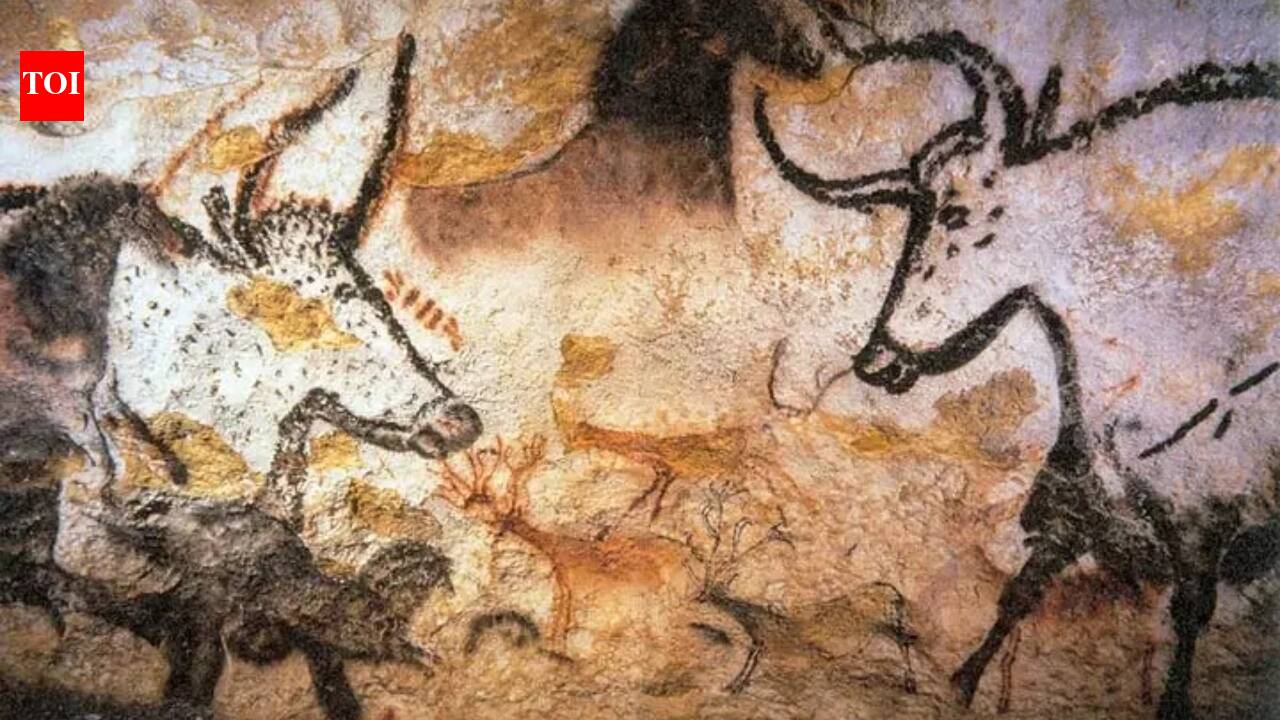
In September 1940, a dog named Robot found a hole by an uprooted tree in France. Four friends explored the opening and discovered a cave filled with nearly 600 prehistoric paintings. These images, over 17,000 years old, showed animals like horses and bison, revealing the deep creativity of ancient humans.
Imagine taking your dog out for a walk, and that dog ends up discovering something that belongs to the prehistoric age!
Turns out, sometimes, history's greatest discoveries begin with the most unexpected detectives! Sometimes, the most remarkable discoveries indeed start in strange ways, like with a dog poking its nose where no one else ever thought to look.Per Futura Sciences, back in September 1940, four friends wandering the hills in southwestern France had no idea their afternoon adventure would lead them to one of history's greatest archaeological treasures. Their dog, Robot, began sniffing at a hole beneath an uprooted tree. At first, it seemed like nothing more than a rabbit's den (Robot might've been hoping for a quick chase). But what they didn't realize was that this opening led to a hidden world.
What happened?
When Marcel Ravidat and his three friends, Jacques Marsal, Georges Agnel, and Simon Coencas, enlarged the entrance and squeezed into the darkness below, they found themselves inside a cave that would soon become legendary. Armed with little more than a homemade lamp, they walked through galleries and chambers painted with nearly 600 images, some dating back over 17,000 years. Animals (think horses, bulls, deer, bison) covered the walls and ceilings, their contours following the cave's natural curves.
It was hard to imagine these pictures had been made so long ago, in an age before the world had even heard of written history.
The Lascaux Cave became famous practically overnight. It was hailed as Europe's 'Sistine Chapel' of prehistoric art and immediately attracted the curiosity of scientists and the public alike. These paintings weren't just doodles or simple records; they revealed that ancient humans cared about creativity, about symbolism, and about storytelling. The skill involved was astonishing; the artists knew their animals, understood movement and anatomy, and managed to create depth and life out of pigments and stone. They didn't just survive; they imagined, observed, and expressed.When the boys told their teacher, Léon Laval, what they'd found, he could see this was no ordinary cave; he reached out to experts, and soon French prehistorian Henri Breuil stepped in to help confirm the site's significance. There was one curious historical twist: France's Ministry of Culture later described the cave's entrance as a foxes' den and mentioned Marcel's initial exploration, but the dog's role became more prominent in popular stories than in official records. Still, in the end, Robot earned a permanent place in the tale.Exploring further, the teens found the Hall of the Bulls, which was the most famous chamber, decorated with massive animals, including a bull stretching over five meters. Other sections, like the Axial Gallery, displayed detailed compositions and mysterious scenes, such as a bird-headed human facing a wounded bison, which was a painting that still inspires debate among archaeologists. Prehistoric artists had no modern brushes or lighting. They used mineral pigments, bits of hair, fingers, even hollow bones to spray color on the stone. Sometimes the paintings overlapped, hinting that generations of people added their own marks over thousands of years. It was a communal canvas, not a single artist's masterpiece.
Why did prehistoric humans paint inside caves?
What drove these ancient people into the darkness, risking safety and working by firelight? Nobody knows for sure. Maybe the artwork was part of hunting rituals or fertility ceremonies. Perhaps the caves were sacred spaces, places where communities gathered to share memories and myths. They weren't the usual places people lived; Lascaux feels more like a sanctuary than a home. What's clear is the talent and sophistication on display: the artistic eye, the expression of imagination, and the sense that creativity mattered even when survival was a daily struggle.
Why the original Lascaux cave is closed to visitors
After its discovery, Lascaux became a magnet for visitors. But so many people breathing, sweating, and shining flashlights down there threatened the ancient paintings, not just the artwork itself, but the delicate balance of the cave's environment. Carbon dioxide, humidity, and artificial light started to erode the pigments, and algae and fungi became stubborn problems. So, in 1963, the French government closed the original cave to protect it. But they created replicas, like Lascaux II and later Lascaux IV, and made sure anyone could still experience those primordial visions, just not in their original home.
Today, Lascaux is part of the UNESCO World Heritage-listed sites of the Vézère Valley. Eight decades after Robot's discovery of the cave, it stands as a stunning reminder of creativity from the dawn of humanity. Its paintings tell us how people once studied the world, dreamed about animals, and found ways to bring their imagination to life.