
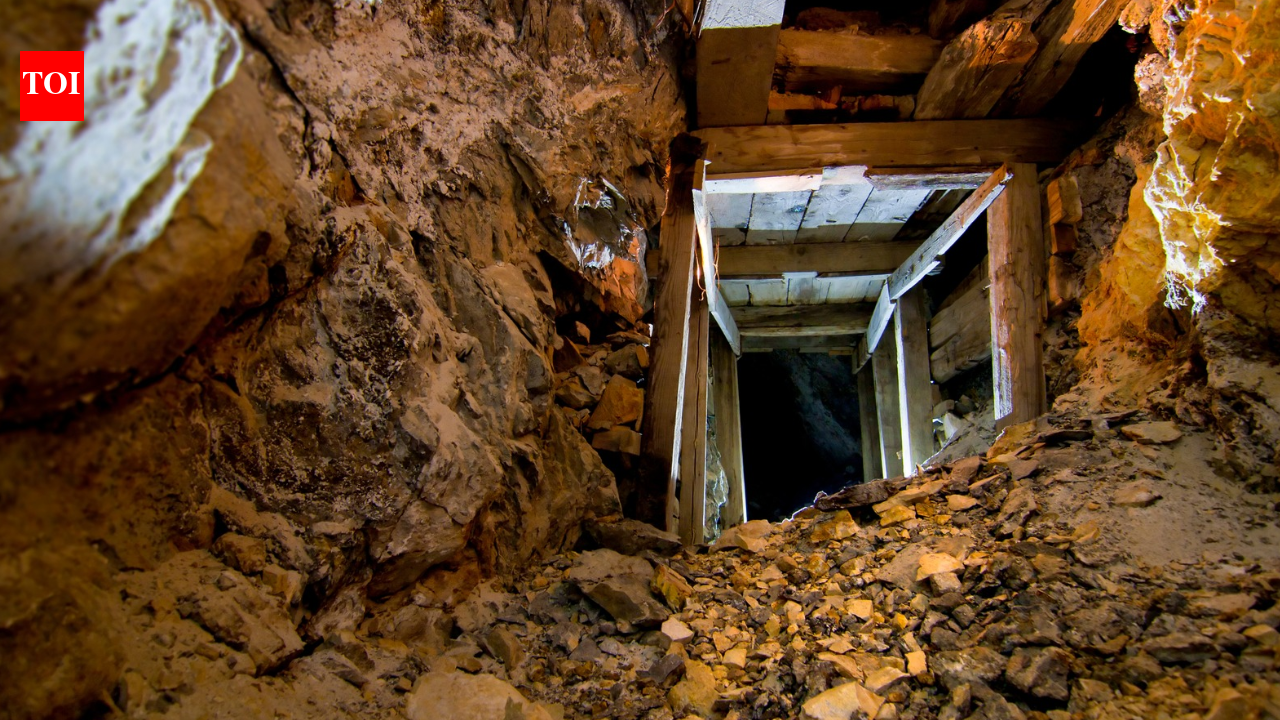
A former gold mine in South Dakota is becoming a massive underground lab for physics research. Construction crews started assembling giant detector structures in November 2026. Scientists will use the facility to study elusive neutrinos, hoping to understand how the universe began and why matter exists in our world today.
A former gold mine beneath the Black Hills of South Dakota is becoming the site of one of the world's largest underground physics experiments, where scientists hope to investigate some of the universe's deepest mysteries. The Deep Underground Neutrino Experiment (DUNE) is being built nearly a mile beneath the town of Lead, inside the Sanford Underground Research Facility, which occupies the old Homestake mine. Construction crews began assembling enormous detector structures in November 2026. Once operational, the experiment will study elusive particles called neutrinos to investigate how the universe evolved and why matter exists in far greater quantities than antimatter.
Former Homestake gold mine in South Dakota becomes site of massive neutrino experiment
For more than a century, the Homestake mine attracted workers to Lead in search of gold. The mine closed in 2001 and was subsequently converted into an underground research facility. The site, now known as the Sanford Underground Research Facility (SURF), already hosts experiments investigating fundamental questions about the universe.According to The Guardian, the mine has a history of neutrino research dating back to the 1960s, when physicist Ray Davis built an underground detector that became the first to record neutrinos from the Sun.
The new DUNE project will take that research to a much larger scale, with four giant detectors planned inside caverns excavated deep beneath the surface.
Construction of the detector structures began in early November, with teams from Fermilab, CERN and SURF assembling steel frameworks for enormous insulated containers, known as cryostats. CERN reported that each of the first two detector modules will hold approximately 17,000 tonnes of liquid argon, kept at around -185°C. The full experiment is expected to use about 70,000 tonnes of the extremely cold liquid.The underground work involves transporting thousands of steel beams down the mine shaft and assembling them inside the detector caverns. The detector apparatus is planned to be completed by 2030, with the underground facilities expected to be ready by 2029.
Scientists hope neutrino research will explain why matter exists
DUNE will study neutrinos, subatomic particles that pass through ordinary matter with very little interaction. Around a trillion neutrinos pass through the human body every second without being noticed. They are produced by the Sun, radioactive decay and particle accelerators, and come in three varieties that can change from one type to another as they travel.Once the experiment is operational, Fermilab in Illinois will send an intense beam of neutrinos through approximately 1,300km of the Earth to the detectors in South Dakota. When a neutrino occasionally strikes an argon atom, it will produce a flash of light and an electrical signal. Scientists will analyse these interactions to learn more about the particles and their properties.One of the experiment's central goals is to investigate why the universe contains so much more matter than antimatter. Scientists will compare neutrinos with their antimatter counterparts, antineutrinos, looking for differences that could help explain why matter came to dominate after the Big Bang.
The research will also examine the particles' different masses and could reveal previously unknown forces of nature.
The detectors will additionally observe neutrinos arriving from space, including those produced by exploding stars. These particles could provide information about supernovae and the formation of black holes.The project involves an international collaboration of researchers, engineers and technicians. CERN said a team of around 1,800 researchers is expected to begin using the completed experiment from 2030, while the neutrino beam from Fermilab is expected to reach the South Dakota detectors by 2031. The former gold mine is therefore set to become a major centre for research into the particles and processes that shape the universe.