
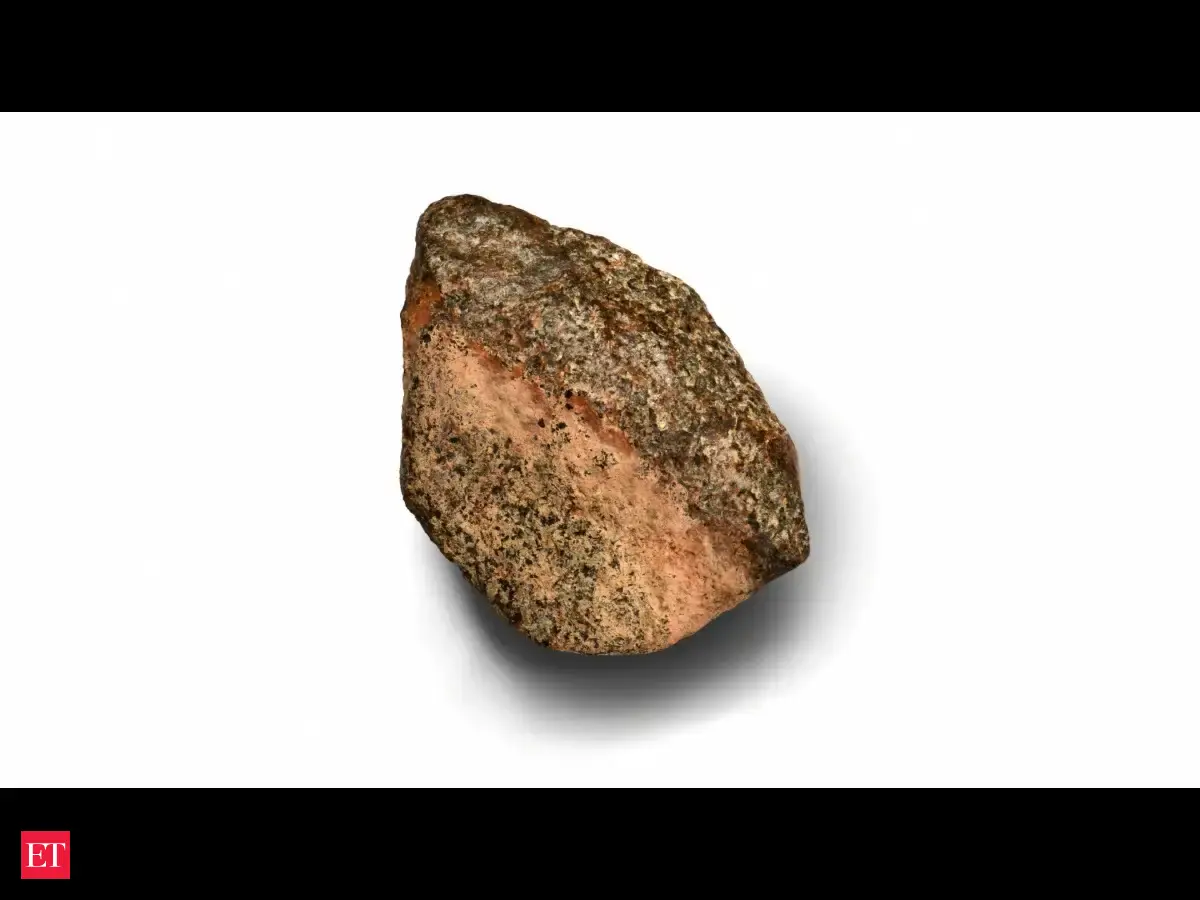
Scientists examined a 4.1-billion-year-old Martian rock found in the Sahara Desert to understand the planet's past. Published October 29, the study showed the rock has manganese oxide, which suggests Mars once had water. Scientist Carl Agee said, "We've never found one like this before," regarding the unique, valuable sample.
A rare 4.1-billion-year-old Martian meteorite found in the Sahara Desert is offering scientists new clues about the Red Planet's ancient past. Researchers say its minerals suggest Mars once had flowing water and an environment more like Earth.
Scientists studying a rare 4.1 million-year-old Martian rock found in the Sahara Desert of Mali in 2022 found that the Red Planet may once have had a wetter, Earth-like environment. The discovery, by the scientists of the University of New Mexico (UNM) and published Thursday, October 29, in the Journal Science, opened a new window to look at Mars' earliest geological history, which could help guide future exploration.
The 2-pound rose-colored rock, known as Teghaza 001 (Teg 001), has some 'unusual textural, mineralogical, and compositional features' which are not typically seen in Martian meteorites, UNM said.
A common byproduct of microbial life found in the Martian meteorite
The characteristics the team found in Teghaza 001 are similar to those of another famous water-rich Martian rock they studied, Black Beauty, formed on the Martian surface around 2.1 billion years ago. The only difference is that Black Beauty is made up of small, volcanic rock fragments, and Teghaza 001 has a single, coherent rock type.
Rare 4.1-billion-year-old Martian meteorite found in Africa offers new evidence of an ancient Earth-like Mars (Image courtesy: UNM)
Scientist Carl Agee, director and curator at UNM's Institute of Meteoritics (IOM), and colleague Karen Ziegler, a scientist in the IOM and research professor in the Department of Earth and Planetary Sciences, examined the meteorite and identified some characteristics that distinguished it from previously studied specimens. They found high levels of "manganese oxide, a common byproduct of microbial life," UNM said.
"I realized that this one was a little bit like Black Beauty, not exactly, but it resembled it in the oxygen isotope values," Agee said in a statement. Then he looked at it at a microscopical level and the high concentrations of manganese oxide, a compound, which is an indicator of environments conducive to life, and numerous Mars rovers are trying to detect.
"This is just one single meteorite. It's like going out back in time and chipping off a hunk of an outcrop, 4 billion years ago on Mars, and then we have this example of what was actually happening. That is why it's such a valuable sample. We've never found one like this before," Agee said in that statement.
One of the oldest Martian meteorites identified to date
NASA JPL scientist Yang Liu, whose domain of research focuses on extraterrestrial rocks, along with scientists at Caltech, discovered tiny zircon crystals. Liu, using uranium-lead age analyses of the crystals, dated the meteorite to an extraordinary 4.1 billion years old, one of the oldest Martian meteorites identified to date.
As per Agee, a few parts of Black Beauty are around that age, but the whole meteorite itself is a conglomeration of many different rock types. In contrast, "Teghaza 001 is just one unadulterated rock type, and it's 4.1 billion years or older, so that was a big surprise," he added.
One of the most significant findings is the evidence that billions of years ago, the Martian meteorite interacted with fluids there. "It's the oldest Martian igneous rock ever found by a huge margin, but in addition to that, it seemed to have these clues in its composition that suggested it had been in an environment that had fluids and water coursing through it."
The presence of the unusual oxygen isotope and the altered minerals suggests that when the Red Planet was in its early stage, it was not like today's dry and cold stage.
A slice of Teghaza 001, a Martian meteorite found in the Sahara in Mali in 2022.
Mars was once 'Earth-like'
It means the theories developed on Martian surfaces are true, that "Mars once had a warmer, wetter and more geologically dynamic environment," UNM explains. "This sample probably came from an environment on Mars that was more Earth-like," Agee said.
It is called the Pre-Noachian period, the oldest geological epoch, approximately 4.5 to 4.1 billion years ago, when Mars was probably like our planet, and if true, this is the period of time when life may have existed there.
"If there was ever abundant life on Mars, on the surface, not sequestered away in some subsurface, that would be the time that you would be looking at, the Pre-Noachian period," Agee noted.
"It's the very earliest time, and that was when maybe Mars still had a magnetic field, and it was shielded from radiation, and there were surface waters. There was a denser atmosphere. If primitive life was abundant in Mars. That is the time that is most likely for it to have happened," he explained.
Teg 001 may have come from a region on Mars that the rover hasn't explored yet
Most of the Martian meteorites are roughly 200 million years old, and because Teg 001 is chemically and geologically distinct from other Martian meteorites, scientists believe it may have originated from a previously 'underrepresented' area of the Red Planet, an area where a rover has yet to explore.
Scientists find evidence of ancient water on Mars in a 4.1-billion-year-old meteorite discovered on Earth. (Image courtesy: UNM)
Agee and co-authors also tried to identify possible locations on Mars that match the meteorite's composition, and in some cases, the origin took them to Mars's ancient southern highlands.
"This is just one single meteorite. It's like going out, going back in time and chipping off a hunk of an outcrop, 4 billion years ago on Mars, and then we have this example of what was actually happening," Agee told the university in the statement.
"That is why it's such a valuable sample. We've never found one like this before. The most exciting part about this find is its age, plus the alteration in the meteorite that indicates it has been in what I would call an Earth-like environment, with fluids coursing over the surface and volcanoes creating hydrothermal systems. There are surface waters and so on. And that's all reflected in the way that the meteorite has been sort of altered from its original state."
So if scientists could identify the place/s on Mars where an Earth-like environment once existed, it would open a gateway for future rover missions, where they should investigate or maybe gather some samples and return with them.