
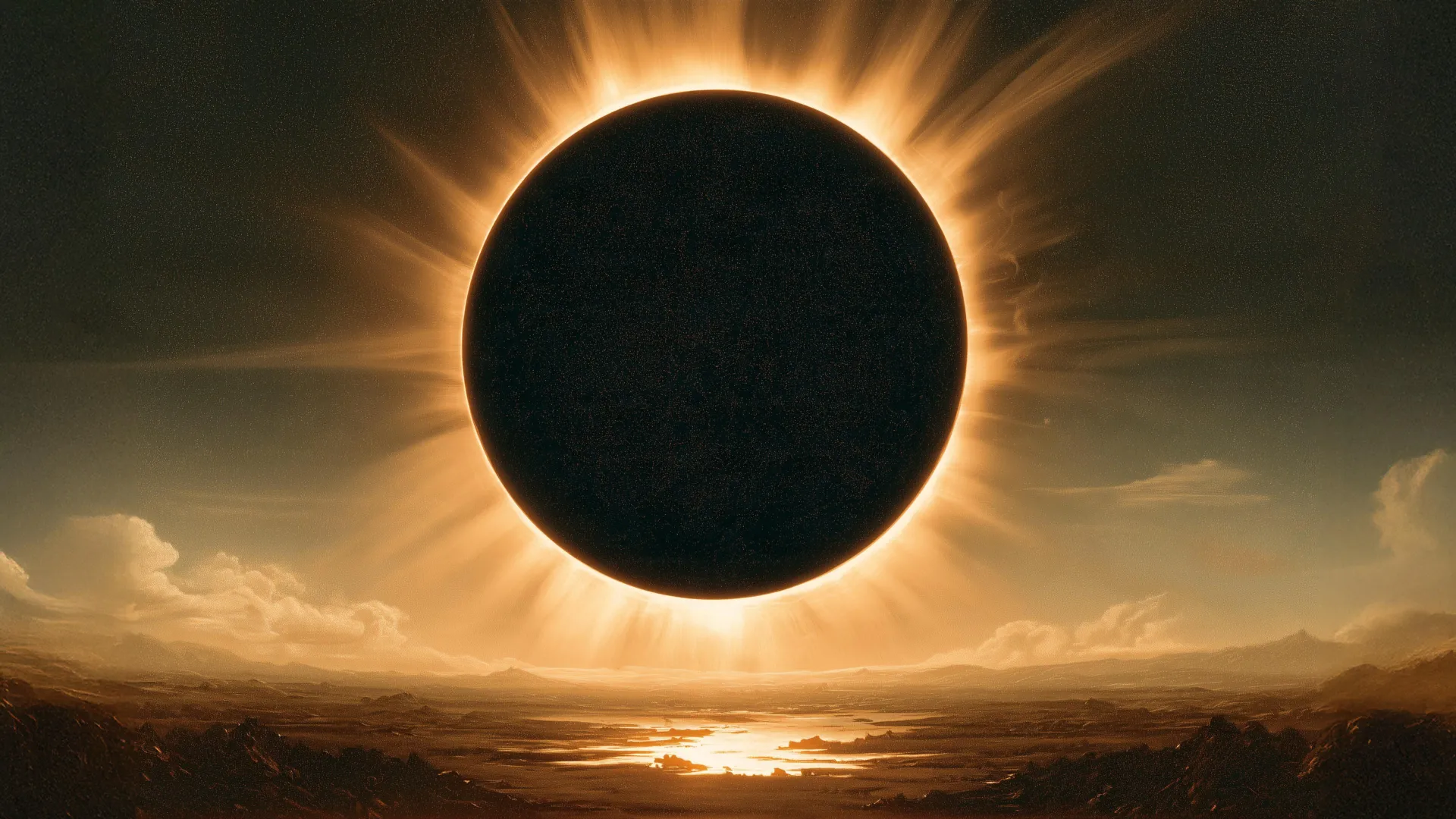
On July 17, 709 BCE, observers in the Lu Duchy witnessed a total solar eclipse. Researchers used this ancient record to study Earth’s rotation and solar activity. Lead author Hisashi Hayakawa said, "This correction allowed us to accurately measure the Earth's rotation during the total eclipse," helping scientists understand our history.
The researchers also examined an early account that may describe the solar corona, the Sun's faint outer atmosphere that becomes visible to the naked eye during a total solar eclipse. Their analysis of its possible shape suggests that the Sun was returning to a more active phase following an extended period of unusually low activity.
Published in Astrophysical Journal Letters, the findings provide more precise evidence of Earth's rotation speed in ancient times. They also offer potential independent support for previous reconstructions of solar activity based on radiocarbon measurements.
An Ancient Chinese Eclipse Record Holds a Crucial Clue
On July 17, 709 BCE, observers at the court of the Lu Duchy witnessed a total solar eclipse. The event was preserved in the "Spring and Autumn Annals," a historical chronicle compiled approximately 200 to 300 years later. The original account stated that "the Sun was totally eclipsed."
An additional description appears in the "Hanshu" (Book of Han), which preserves a passage written about seven centuries after the eclipse. This later account contains an unusual observation that may refer to the Sun's corona.
"What makes this record special isn't just its age, but also a later addendum in the 'Hanshu' (Book of Han) based on a quote written seven centuries after the eclipse. It describes the eclipsed Sun as 'completely yellow above and below.' This addendum has been traditionally associated with a record of a solar corona. If this is truly the case, it represents one of the earliest surviving written descriptions of the solar corona," explained lead author Hisashi Hayakawa, an assistant professor at Nagoya University's Institute for Space-Earth Environmental Research and Institute for Advanced Research.
Initially, however, the historical account appeared to conflict with modern astronomy. When the team calculated the eclipse's path using existing estimates of Earth's ancient rotation, their results indicated that a total eclipse should not have been visible from the previously assumed location of the Lu court in Qufu.
The researchers traced the discrepancy to a mistake in the city's geographic coordinates. By examining archaeological excavation reports and historical geographic evidence, they determined that earlier calculations had placed ancient Qufu approximately eight kilometers from its actual location.
Correcting this relatively small error made it possible to reconstruct the eclipse more accurately and extract valuable information about Earth's rotation and the Sun's appearance.
"This correction allowed us to accurately measure the Earth's rotation during the total eclipse, calculate the orientation of the Sun's rotation axis, and simulate the corona's appearance," explained Hayakawa, who holds doctorates in solar physics and oriental history.
Why Ancient China Preserved Such Detailed Astronomical Records
The survival of this remarkable observation reflects the importance of astronomy in ancient Chinese society. Successive dynasties employed specialists to monitor celestial events because unusual phenomena in the sky were often interpreted as omens.
This practice, known as omenology, was closely connected to political beliefs. Eclipses, auroras, and other extraordinary astronomical events were sometimes considered warnings that an emperor had acted improperly.
As a result, court astronomers carefully documented changes in the sky. The records maintained across successive dynasties eventually became some of the world's most valuable historical sources for studying ancient eclipses.
Even so, the researchers emphasize an important distinction between the original eclipse observation and the later description of the corona.
The 709 BCE event is regarded as the earliest explicit written record of a total solar eclipse that can be securely dated. It may also be associated with one of the oldest surviving descriptions of the solar corona, but that interpretation remains uncertain because the relevant passage appears in a source written centuries after the event.
Although the corona account requires caution, the established timing of the eclipse provides a reliable basis for investigating Earth's historical rotation. The possible corona description also offers a valuable comparison with other studies of ancient solar activity.
How a 2,700-Year-Old Eclipse Reveals Earth's Faster Rotation
Earth does not rotate at a perfectly constant rate. Over long periods, its spin has gradually slowed, partly because of friction associated with ocean tides generated by the Moon's gravitational pull.
Consequently, Earth rotated slightly faster 2,700 years ago than it does today.
Using the revised position of ancient Qufu, the researchers obtained improved constraints on Earth's rotation during the period spanning the eighth through sixth centuries BCE.
Their calculations placed delta T (ΔT), a measurement used to describe variations in Earth's rotation relative to a uniform time scale, between 20,264 and 21,204 seconds for the eclipse of 709 BCE.
"This new dataset fixes coordinate errors in previous Earth rotation studies. Additionally, it improves the accuracy of dating and reconstructing historical astronomical events," said coauthor Mitsuru Sôma of the National Astronomical Observatory of Japan.
These measurements help scientists better understand changes in the length of Earth's day over thousands of years. They can also improve calculations of when and where other ancient astronomical events would have been visible.
Evidence That the Sun Was Awakening From a Long Quiet Period
Beyond revealing Earth's rotational history, the eclipse may provide evidence of an important transition in the Sun's activity.
Scientists have previously reconstructed ancient solar cycles by studying radiocarbon preserved in tree rings. The possible corona description from 709 BCE offers another way to examine those findings.
"This unique historical addendum for the possible solar coronal structure is critical for providing a spot reference on solar activity reconstructions from tree rings and ice cores, as well as providing independent validation of solar activity models," explained coauthor Mathew Owens, a professor of space physics at the University of Reading.
Trees absorb carbon from the atmosphere during photosynthesis, including small amounts of radioactive carbon known as radiocarbon. Some of this material becomes locked into annual growth rings, creating a natural record that researchers can examine thousands of years later.
Radiocarbon levels are influenced by cosmic rays reaching Earth's atmosphere. When the Sun becomes more active, its magnetic influence generally reduces the number of cosmic rays that reach Earth, affecting radiocarbon production.
By measuring changes in radiocarbon concentrations across successive tree rings, scientists can reconstruct how solar activity varied long before modern instruments existed.
The Sun normally follows an activity cycle lasting approximately 11 years, during which the number of sunspots and the strength of solar magnetic activity rise and fall.
Occasionally, however, the Sun enters much longer periods of reduced activity called "grand minima." During these intervals, sunspots become exceptionally rare, and the usual cycle is much less pronounced.
One such interval, known as the "Neo Assyrian Grand Minimum" or "Homer Grand Minimum," lasted from approximately 808 to 717 BCE.
The eclipse of 709 BCE took place shortly after this prolonged quiet period ended.
According to the researchers, the possible description of the solar corona is consistent with a Sun that had resumed its regular activity cycles. Its apparent structure suggests substantial magnetic activity and indicates that the Sun may have been near the peak of its approximately 11-year cycle at the time.
This interpretation agrees with earlier solar activity reconstructions derived from radiocarbon measurements in tree rings, although the uncertainty surrounding the historical corona description means it cannot be considered definitive proof.
Ancient Astronomers Are Still Helping Scientists Understand the Universe
The findings demonstrate how observations preserved for thousands of years can continue to contribute to modern scientific discoveries.
By bringing together historical documents, archaeological evidence, geographic research, and sophisticated astronomical models, scientists can recover information that would otherwise be impossible to measure directly.
In this case, a correction of just eight kilometers helped transform an ancient eclipse record into a more precise source of information about Earth's rotation and a potential window into the Sun's distant past.
"Some of our ancestors were very skilled observers," noted coauthor Dr. Meng Jin of the Lockheed Martin Solar and Astrophysics Laboratory. "When we combine their careful records with modern computational methods and historical evidence, we can potentially find new information about our planet and our star from thousands of years ago."