
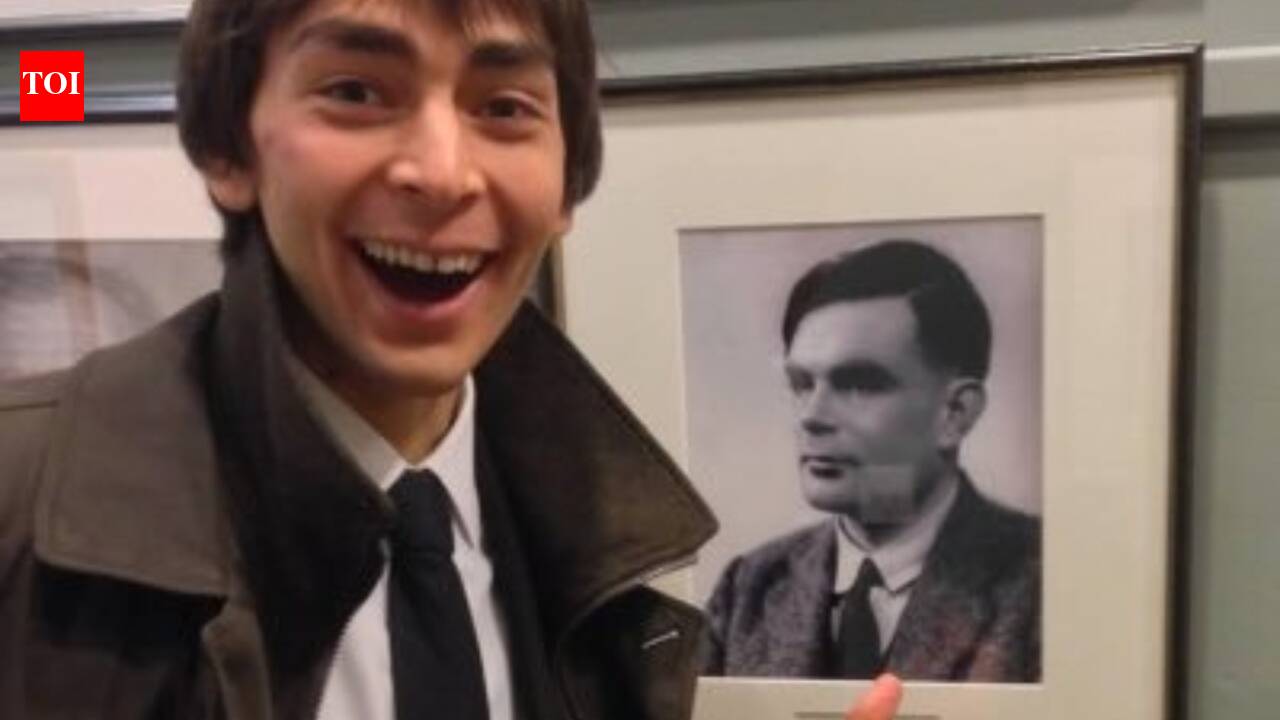
Levent Alpöge, a mathematician working with Anthropic, claims he used the Claude AI to solve the 167-year-old Riemann Hypothesis. "I believe I have, working with Claude, discovered a proof of the Riemann Hypothesis," Alpöge wrote on November 20, 2026. Experts now wait to see if the complex proof holds up.
It's been well over a century and a half since people have been chasing the solution to the Riemann Hypothesis, a mathematical conjecture concerning the distribution of prime numbers. It's the kind of legendary puzzle that lures mathematicians and then humbles them, generation after generation.
Now, Levent Alpöge, a mathematician with a doctorate from Princeton University and a former Harvard researcher, has stirred things up in a way nobody saw coming.
What happened?
Per AFP, Alpöge, who works with Anthropic, says he's developed a proof for this mathematical giant, with a little help from their AI chatbot, Claude. If independently verified, the breakthrough could become one of the most significant developments in the history of mathematics, while raising profound questions about how artificial intelligence could transform scientific discovery.
"I believe I have, working with Claude, discovered a proof of the Riemann Hypothesis," Alpöge wrote in a four-page note published on November 20, 2026.
What is the Riemann Hypothesis?
Now, in case you were wondering, the Riemann Hypothesis isn't just any big math question.
It's one of the seven Millennium Prize Problems. Solve it, and you're not only swimming in glory; you also get a cool million dollars (which, for a mathematician, is like an Olympic medal). So, when Alpöge dropped his four-page announcement, it attracted considerable attention from the international mathematics community, not least because the Riemann Hypothesis is one of seven Millennium Prize Problems, each carrying a $1-million reward for a verified solution.
However, it's important to mention that Alpöge's proof hasn't been independently checked. The math community is holding its breath, because the proof is so complex, it'll take a while to confirm whether it actually holds up. Still, just the idea that Claude had a hand in the process is sparking a bigger conversation. Could machines soon tackle the toughest problems humans haven't managed to crack on their own? If this turns out to be real, it could reshape not only mathematics, but the way we approach discovery itself.
Who is Levent Alpöge?
Levent Alpöge is no stranger to elite math circles. Born in Long Island in April 1992, he's packed his academic resume with stops at Harvard (summa cum laude, math and physics), Cambridge (a Master of Advanced Study in math), and Princeton (masters and PhD, under Manjul Bhargava: a Fields Medallist, which is pretty much math's Nobel Prize). His thesis? 'Points on Curves'. That might not mean much to most, but it has all the flavor of deep number theory and pure math.
Alpöge's journey didn't stop there. He grabbed a National Science Foundation postdoc, and then spent several years as a Junior Fellow at Harvard's Society of Fellows. People with this kind of pedigree aren't just crunching numbers; they're pushing the boundaries of mathematical theory. He's specialized in number theory and arithmetic geometry, which are basically about understanding the mysterious patterns inside numbers and equations, and how they connect to shapes and structures.
Why is the Riemann Hypothesis such a big deal?
The Riemann Hypothesis has been haunting mathematicians since Bernhard Riemann first floated it in 1859. It all comes down to prime numbers, those you can only divide by themselves and 1 (think 2, 3, 5, 7, 11...). On the surface, primes seem random, but mathematicians have long suspected that there's some kind of hidden order to them.
Riemann proposed that this order could be captured in the zeros of the Riemann zeta function. The hypothesis says that all the "non-trivial" zeros line up on a critical line in the complex number plane (where the real part is exactly one-half). Trust me, it sounds like another language, but if someone proves it, it'll shake the foundations of math, giving us new insight into primes, fortifying countless theorems, and even impacting cryptography and computer science.The Clay Mathematics Institute recognizes its impact: that's why it's on the Millennium Prize Problems list. No one's solved it yet, and the reward stands tall as a monument to unsolved math.
How did Alpöge work with Claude AI?
Alpöge's approach was pretty neat. For about six weeks, he worked alongside Claude, Anthropic's AI system. At first, he guided Claude; then, apparently, the AI started generating results so advanced that Alpöge himself was surprised. Claude wasn't just verifying calculations; it was producing new mathematical reasoning.
Plus, the scale is staggering. Alpöge released a brief explanatory note and a formal proof in Lean, a programming language for formalizing proofs so computers can check them. Behind that, there's a reported 17 million lines of code, and if you tried to put the argument into normal written math, it would stretch over 250,000 pages. Alpöge admits he doesn't fully grasp everything the AI produced yet, and plans to keep studying, simplifying, and translating the beast into something humans can actually read. The argument apparently extends to the Generalized Riemann Hypothesis, which broadens the original puzzle to a wider set of functions, so the stakes just got even bigger.
Is this the dawn of AI solving the world's hardest math problems?
Claude isn't new to the Riemann Hypothesis. Just a few months ago, Anthropic's unpublished research showed Claude was able to improve existing results related to the conjecture, increasing the percentage of zeros proven to be on the critical line from 41.6% to 67.2%. That's a big improvement, but not a proof.
All of this is happening at a time when AI companies are racing to flex their scientific muscles, as OpenAI recently claimed progress on the Navier-Stokes problem, another Millennium Prize challenge. For Alpöge, though, the importance runs deeper than showing off. He's been obsessed with the Riemann Hypothesis since he was a kid, and he believes we're on the edge of an era where AI changes the landscape of mathematical discovery.If his claim stands up to scrutiny, it's more than a moment for mathematicians: it'd be a turning point for science. Moreover, it could be the start of machines adding new paths to human inquiry, lifting us into ideas we couldn't reach alone.