
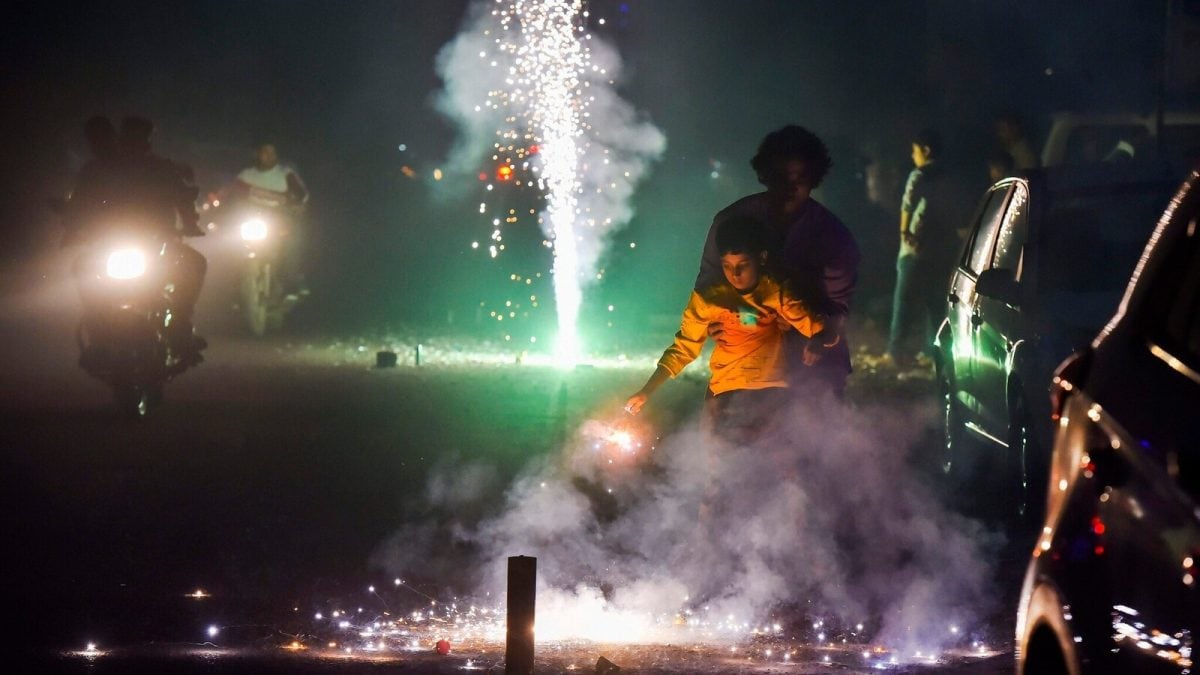
PM2.5 pollution levels jump by over 800 per cent on Diwali night due to firecracker smoke. Research shows that burning crackers releases toxic heavy metals like barium and strontium into the air. These pollutants get trapped near the ground because of low wind speeds, creating a dangerous chemical cocktail.
While stubble burning causes a portion of the air pollution, short-term spikes in toxic heavy metals like potassium, aluminium, barium and strontium come from firecrackers
While the sky lights up with vibrant bursts of crimson, emerald, and gold every Diwali, the air on the ground transforms into a toxic chemical cocktail. The dazzling colours seen in sparklers, ground spinners, and aerial shells are produced by burning heavy metals and inorganic salts.
Strontium provides deep reds, barium creates brilliant greens, copper produces shades of blue, and sodium yields bright yellows. Combined with potassium nitrate, sulphur, and charcoal -- which serve as oxidisers and propellants -- the pyrotechnic reaction generates high concentrations of fine particulate matter alongside gases like sulphur dioxide, nitrogen dioxide, and carbon monoxide.
Scientific Breakdown: How Toxicity Surges on Diwali Night
Comprehensive atmospheric research, including studies by IIT Bombay and regional monitoring networks, reveals a dramatic chemical shift in air composition on festivity nights. Fine particulate matter (PM2.5) levels routinely surge by 300 per cent to over 800 per cent within a few hours. During peak bursting hours between 10 PM and 1 AM, PM2.5 hourly concentrations in urban hot spots frequently cross 800 to 1,000 micrograms per cubic meter -- exceeding safe ambient guidelines by more than fifteen-fold.
Elemental source apportionment shows that pyrotechnic emissions contribute up to 85 per cent of elemental PM2.5 during Diwali peak hours. Laboratory analyses of filter samples collected on Diwali night show massive spikes in toxic heavy metals. Concentrations of barium increase by over 140 times compared to normal pre-Diwali baselines, while strontium levels surge over 450 times. Water-soluble sulphates and nitrates also dominate aerosol mass, increasing aerosol acidity and elevating volume-normalised oxidative potential by over 200 to 300 per cent.
Why the Pollution Trap Worsens in Early Winter
The sudden release of heavy emissions coincides with seasonal meteorological transitions across northern India. Lower ambient temperatures, high humidity, and low wind speeds create a surface-level inversion layer that prevents pollutants from dispersing.
While seasonal stubble burning accounts for a portion of regional background air pollution during late autumn, atmospheric tracking confirms that the violent, short-term midnight spikes in hazardous heavy metals like potassium, aluminium, barium, and strontium stem exclusively from firecracker combustion.
Scale of Combustion and Immediate Health Risks
Estimates from market associations and industry bodies indicate that thousands of metric tonnes of pyrotechnics -- comprising hundreds of millions of individual firecrackers, sparklers, and rockets -- are ignited across Indian cities over a single evening. This massive volumetric burn releases fine microscopic particles that easily penetrate deep into human lung alveoli and enter the bloodstream.
Health monitoring during the festive period consistently records surges in acute respiratory distress, asthma attacks, eye irritation, and skin allergies. The elevated oxidative stress from inhaling heavy metal aerosols poses heightened risks for children, elderly residents, and individuals with pre-existing cardiovascular conditions, making post-Diwali air recovery a critical public health focus each year.