
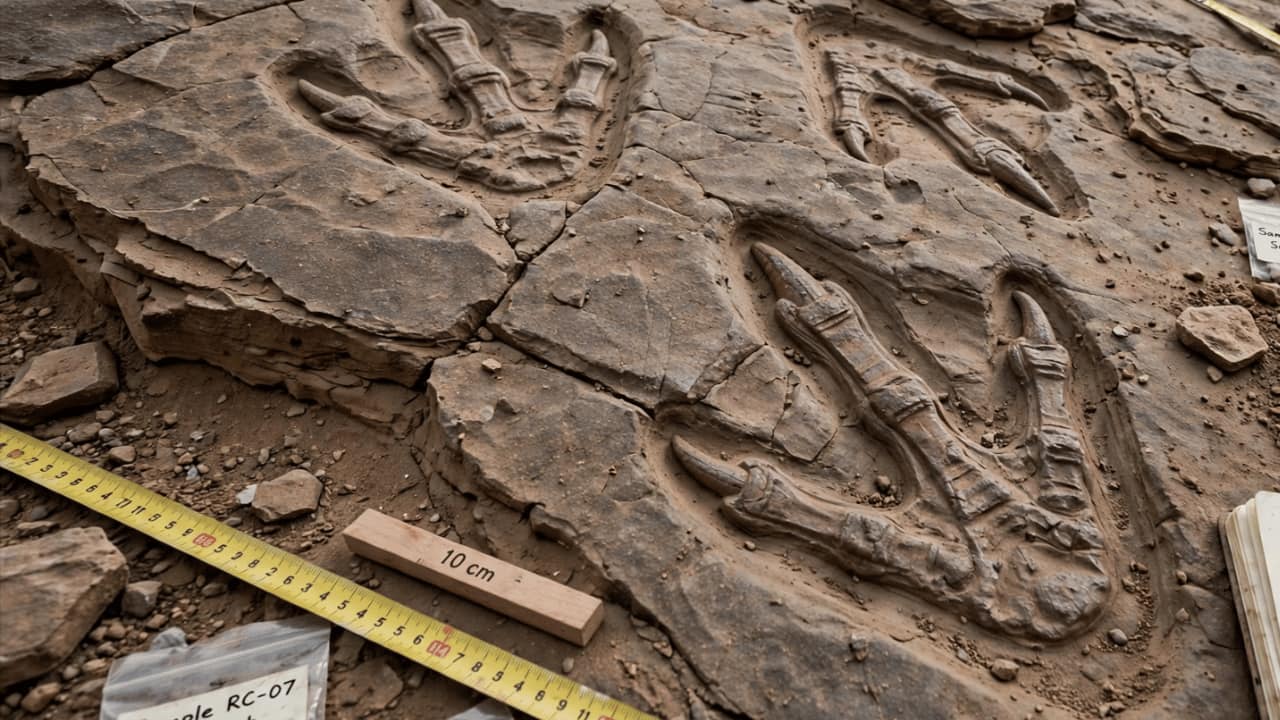
Scientists rediscovered a dinosaur footprint site in northern Mongolia after 70 years. The site revealed 31 fossilised tracks from 120 million years ago. These prints showed that giant meat-eating predators and long-necked herbivores lived there. Researchers said the largest footprint measured 57 centimetres, showing how big these ancient creatures got.
Scientists have rediscovered a dinosaur footprint site in northern Mongolia that had remained lost for more than 70 years. The discovery has revealed 31 fossilised dinosaur footprints, offering important evidence that enormous herbivorous dinosaurs and large meat-eating predators inhabited the region around 120 million years ago. The site, located in the Saizhurakh area of northern Mongolia, was originally reported nearly seven decades ago. However, the absence of detailed location information meant researchers could not identify its exact whereabouts for several years. A joint research expedition eventually relocated the site and conducted a detailed investigation.
According to the findings, the footprints belong to dinosaurs that lived during the Early Cretaceous period. Some of the meat-eating dinosaurs that left the tracks are estimated to have measured up to 8.8 metres (nearly 29 feet) in length. Researchers Discover 31 Dinosaur Footprints in Mongolia The research team identified a total of 31 fossilised footprints preserved in the Shinekhudag Formation, a geological formation dating back approximately 120 million years. The discovery includes footprints of two giant long-necked herbivorous dinosaurs, known as sauropods, along with tracks attributed to large carnivorous theropods.
Researchers found two sauropod trackways extending more than 15 metres (49 feet). Interestingly, the footprints overlap in several places, suggesting that one dinosaur may have followed almost the same route as another. Scientists believe this movement could be similar to the behaviour of modern elephants, which sometimes follow established paths while travelling through difficult terrain. Giant Meat-Eating Dinosaurs Left 57-Centimetre Footprints One of the most significant findings at the site is the presence of large predatory dinosaurs. These two-legged meat-eating dinosaurs, known as theropods, left broad, three-toed impressions in the ancient sediment.
The largest footprint measures approximately 57 centimetres (22.4 inches) in length. Based on the size and characteristics of the footprints, researchers estimate that the dinosaurs responsible for these tracks measured between 7.4 and 8.8 metres (24 to 29 feet) long. The researchers identified evidence that as many as five large theropods may have crossed the same area. However, the footprints do not establish that all the animals were present at the same time. The discovery is particularly important because evidence of large predatory dinosaurs from this period had previously been limited in northern Mongolia and neighbouring eastern Russia.
Why Is This Dinosaur Discovery Important? Before the discovery, scientists had relatively limited evidence of giant predatory dinosaurs inhabiting northern Mongolia during the Early Cretaceous period. Large theropods from comparable periods had already been identified in countries such as China, Japan and South Korea, as well as North America. However, their presence in northern Mongolia remained poorly documented. One possible explanation involved the region's ancient climate. Although the Earth was generally warmer around 120 million years ago, the continental interior of northern Asia may have experienced significant seasonal temperature variations and harsh winters.
Researchers had considered whether these environmental conditions limited the presence of very large dinosaurs in the region. The newly discovered footprints challenge that possibility by providing evidence that both giant herbivores and large carnivorous dinosaurs inhabited the area. How Were the Dinosaur Footprints Preserved? Around 120 million years ago, the region was characterised by a large lake environment that experienced changing water levels. During periods when the lake water receded, wet mud and sandy surfaces became exposed. Dinosaurs walking across these surfaces left footprints that were eventually covered and preserved in layers of sediment.
Over millions of years, these sediments developed into sedimentary rock, protecting the impressions and allowing scientists to study them today. The footprints provide information beyond what scientists can learn from dinosaur bones. They offer clues about the animals' movement, body size, foot structure and possible behaviour. Researchers Hope to Find Dinosaur Bones and Teeth The rediscovery of the Mongolian tracksite could lead to further discoveries. Researchers have identified gravel-bearing sandy layers near the footprint location that may contain dinosaur bones or teeth. Future investigations will focus on these deposits and nearby rock formations to search for additional fossil evidence.
The research was conducted by scientists associated with the Institute of Paleontology of the Mongolian Academy of Sciences, the National University of Mongolia and Okayama University of Science. The findings were published in the international scientific journal Ichnos on March 19, 2026, under the research title "A dinosaur ichnofauna from the Lower Cretaceous Shinekhudag Formation, Mongolia". The discovery provides an important new understanding of dinosaur distribution in northern Asia. A site that remained missing from scientific records for decades has now offered evidence of giant herbivores and powerful predators sharing an ancient Mongolian landscape.