
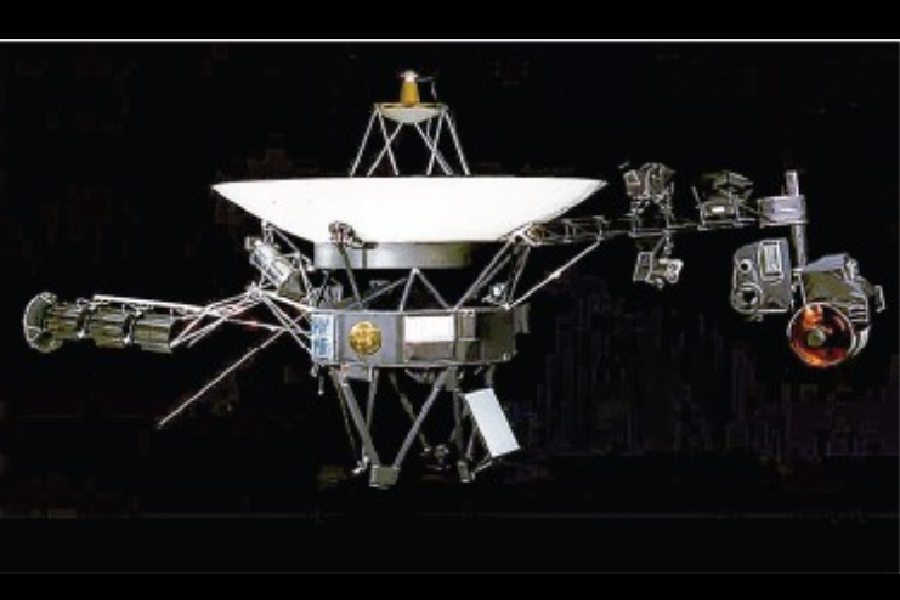
Nasa’s Voyager 1 is the first human-made object to reach one light-day from Earth, 49 years after its 1977 launch. The craft is 16 billion miles away, making communication slow. Project manager Suzanne Dodd said, "We can't do anything fast. And the data rates are very low. These spacecraft are old."
Nasa's Voyager 1 has become the first human-made object to reach a distance of one light-day from Earth, travelling far beyond the Sun's protective bubble, nearly half a century after its launch to explore the solar system's outer planets.
Making a milestone decades in the making, the US space agency announced that the spacecraft, launched in September 1977, had crossed a distance of 16 billion miles (25.8 billion km) from Earth, meaning signals sent to it take 24 hours to reach the spacecraft. That distance is 172 times the Earth-Sun distance.
"What an incredible milestone," said Linda Spilker, Voyager's project scientist, who recalled watching the spacecraft's launch from Cape Canaveral in 1977, never imagining she would be celebrating its one light-day milestone 49 years later.
The original Voyager 1 mission was designed to last five years and included two flybys each of Jupiter and Saturn, with the possibility of continuing to Uranus and Neptune, if all went well, Spilker said at a panel discussion on Thursday webcast live from Nasa's Jet Propulsion Laboratory (JPL).
The milestone comes as Nasa engineers investigate an anomaly that has prevented Voyager 1 from transmitting science and engineering data since November 14, although the spacecraft has remained in contact with Earth and continues to send a strong carrier signal. A carrier signal indicates that the spacecraft's radio transmitter is operating and its signal is reaching Earth.
Voyager 1 and its twin Voyager 2 are the only spacecraft ever to operate outside the heliosphere, the protective bubble of subatomic particles and magnetic fields generated by the Sun. Voyager 1 had reached the interstellar boundary in 2012 while Voyager 2, travelling slower, reached it in 2018.
The one light-day distance means it takes 24 hours to get a signal to the spacecraft and another 24 hours for a signal from the spacecraft to reach Earth. "It takes two days to diagnose anything with the spacecraft," said Suzanne Dodd, voyager project manager, a panel member. "We can't do anything fast. And the data rates are very low. These spacecraft are old... we're in a realm where we're going to see more anomalies with Voyager just due to the distance and the age."
"But we feel Voyager 1, although it's not sending us the telemetry data, it's pointed at the Earth. It's sending us a strong carrier signal. And I'm confident that it won't be too long and it'll send us data back," Dodd added.
Even when the spacecraft's scientific instruments cease to operate and communication with Earth eventually becomes impossible, Voyager will continue its journey in the direction of a star known as Gliese 445 more than 17 light years away in the constellation Ursa Minor. Nasa says Voyager 1 is expected to pass within about 1.7 light years of the star in about 40,000 years, cruising through interstellar space at about 61,000kmph.
"Even when we can longer talk to Voyager, they're both going to keep going," said Nicky Fox, Nasa associate administrator, science mission directorate, and another panel member, adding that "there's no end to the Voyager mission".
Both Voyager spacecraft carry a phonograph record, a 12-inch gold-plated copper disk containing sounds and images selected to portray the diversity of life and culture on Earth and intended for extraterrestrials that might encounter the spacecraft.
Since they moved out of the heliosphere, the Voyager spacecraft have provided scientists with the opportunity to understand the space between the stars, beyond the Sun's influence, said Jamie Rankin, Voyager's deputy project scientist.
Galactic cosmic radiation, which comes from sources across the galaxy, is about 10 times higher in the region where the spacecraft are travelling than within the boundaries of the heliosphere.
Voyager's scientific legacy extends beyond its milestones and current exploration of interstellar space, with its exploration of the outer planets inspiring more missions to the outer space system.
"Voyager's discoveries really opened the door to the exploration of the outer solar system," said Jonathan Lunine, chief scientist at JPL. The spacecraft discovered that Jupiter's moon Io is volcanic and that another moon, Europa, has a smooth, icy and fractured surface with few craters, leading scientists to suspect that an ocean might exist beneath its surface.
Lunine said Voyager's observations paved the way for the Galileo orbiter, which detected an ocean beneath Europa's surface and confirmed Io's volcanism, and for Nasa's Juno mission to study Jupiter's interior and storm systems first imaged by Voyager.
At Saturn, Lunine said, Voyager revealed Titan's dense nitrogen atmosphere and methane-based weather, paving the way for Cassini-Huygens, which discovered methane lakes andseas on Titan, as well as an ocean, plume and organic molecules on Enceladus, a Saturnian moon.