
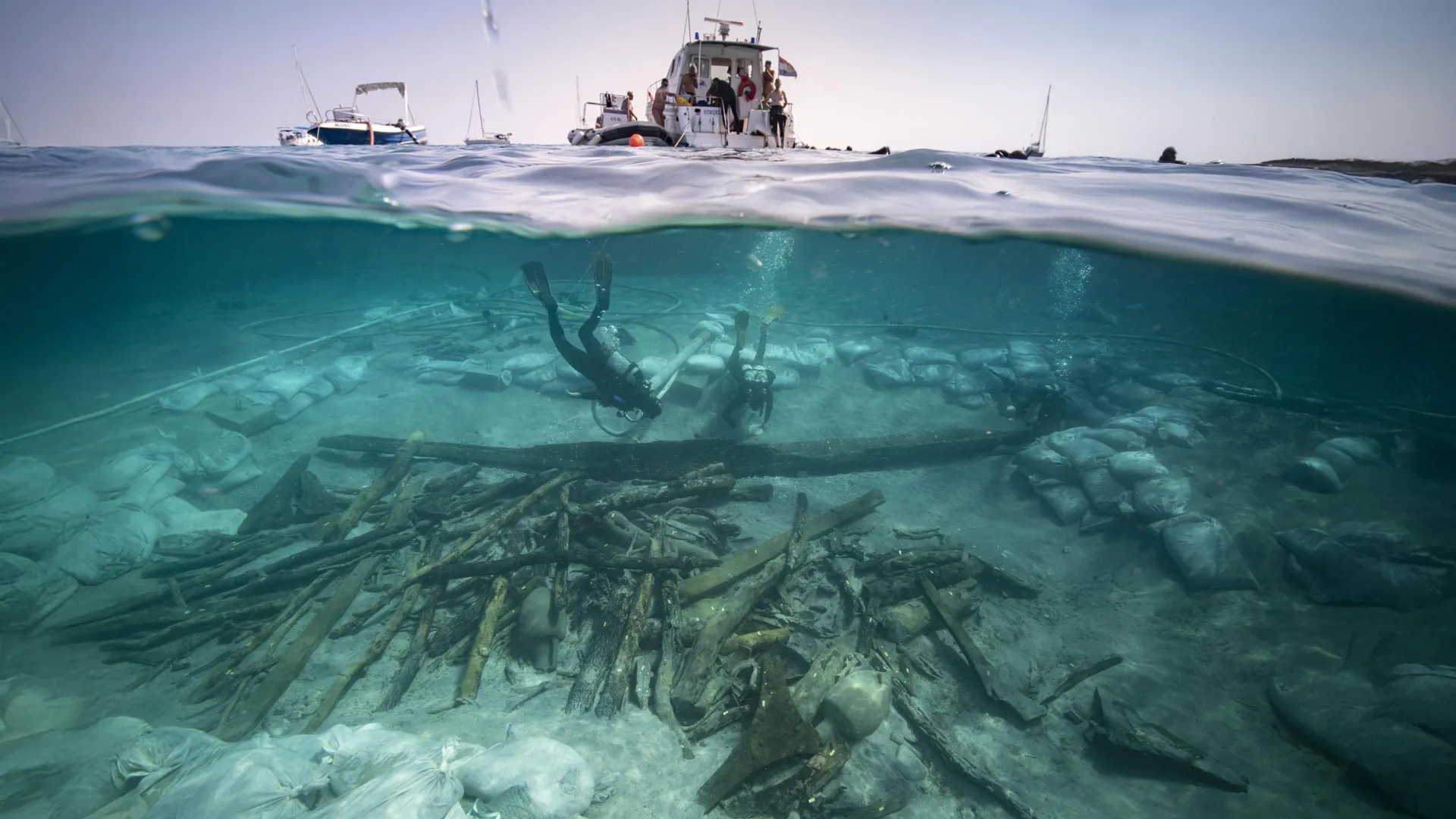
Researchers studied a 2,200-year-old Roman shipwreck found off the coast of Croatia. They discovered that ancient shipbuilders used pine tar and beeswax to waterproof their vessels. Dr. Armelle Charrié said, "In archaeology little attention is paid to organic waterproofing materials." These coatings protected ships from damage by marine creatures.
For as long as humans have traveled by sea, shipbuilders have faced the challenge of keeping water out while protecting vessels from saltwater, microorganisms, and marine creatures such as shipworms. Despite their name, shipworms are actually marine mollusks that burrow into wood and can cause extensive structural damage.
Yet until the mid-20th century, archaeological studies of ancient vessels largely concentrated on their wooden components. The protective materials that made these ships seaworthy received comparatively little attention, and waterproofing substances remain an understudied aspect of ancient maritime technology.
In a new study published in Frontiers in Materials, researchers from France and Croatia investigated the protective coatings of Ilovik-Paržine 1, a ship dating to the Roman Republic that sank approximately 2,200 years ago off the coast of modern Croatia.
"In archaeology little attention is paid to organic waterproofing materials. Yet they are essential for navigation at sea or on rivers and are true witnesses of past naval technologies," said first author Dr. Armelle Charrié, an archaeometrist at the Laboratory of Mass Spectrometry of Interactions and Systems in Strasbourg. "Studying the coatings, we found two different kinds on this vessel: one made of pine tar, also called pitch, and the other of a mixture of pine tar and beeswax. Analysis of pollen in the coating made it possible to identify the plant taxa present in the immediate environment during the construction or repairs of the ship."
Ancient Waterproofing Secrets Revealed
Since its discovery in 2016, the shipwreck and its cargo have been the subject of several scientific investigations. However, this is the first study to combine molecular analysis with the examination of ancient pollen to determine both the composition of the ship's waterproofing materials and the types of vegetation growing nearby when those coatings were produced or applied.
The research brought together specialists from the Department for Underwater Archaeology of the Croatian Conservation Institute and the 'ADRIBOATS' program of the Centre Camille Jullian at Aix-Marseille University in France.
"Some regions throughout the Adriatic have particular characteristics that led local populations to develop a specific shipbuilding style," said Charrié. "Only studies like ours offer an overview into these traditions which bear witness to genuine know-how and diverse traditions."
To uncover the ancient waterproofing recipes, the researchers examined the physical structure, molecular composition, and pollen content of the coatings. Among the techniques they employed was mass spectrometry, a powerful analytical method that allows scientists to identify substances and measure their abundance based on the masses of their molecular or atomic components.
An Ingenious Combination of Pine Tar and Beeswax
The team analyzed 10 samples of the ship's protective coating to determine the biological origins of the ingredients. Distinctive chemical signatures characteristic of pine trees appeared throughout the samples, revealing that the primary waterproofing material was pitch derived from heated conifer resin or tar.
Pitch is a thick, sticky substance that has been used for centuries to seal wooden vessels and protect them from water. When heated, it becomes easier to spread over surfaces and into gaps between wooden components.
One sample, however, contained evidence of a different recipe. Ancient shipbuilders had combined the pine tar with beeswax, creating a protective substance known to Greek shipbuilders as zopissa.
The addition of beeswax made the coating more flexible and easier to apply while hot. Flexibility would have been a valuable property aboard wooden ships, whose timbers could shift and flex as they encountered waves and changing environmental conditions.
Ancient Pollen Preserves a Record of the Ship's Past
The sticky nature of pitch gave it another remarkable property that ancient shipbuilders probably never considered. It could capture tiny airborne pollen grains from surrounding vegetation and preserve them for thousands of years.
Different plants produce pollen with distinctive shapes and structures, allowing scientists to identify the types of vegetation present in an area long after the plants themselves have disappeared. By examining both the variety and relative abundance of pollen grains embedded in the ship's coatings, the researchers narrowed down the possible locations where the pitch was manufactured or applied during repairs.
The pollen preserved aboard Ilovik-Paržine 1 pointed to a surprisingly diverse range of landscapes. Some of the plant species were characteristic of Mediterranean and Adriatic coastal areas and valleys, including forests dominated by holly oak and pine. Others were associated with matorral, a type of Mediterranean shrubland that can contain olive and hazel trees.
The discovery of alder and ash pollen suggested the presence of vegetation growing near rivers or coastlines, either close to the sea or farther inland. Smaller quantities of fir and beech pollen pointed to mountainous environments. Such vegetation is characteristic of the northeastern Adriatic coast, where the mountains of Istria and Dalmatia rise not far from the shoreline.
Evidence of Multiple Repairs Across the Mediterranean
The distribution and composition of the protective materials also revealed that the vessel likely received four or five distinct batches of waterproofing coatings.
The stern, or rear of the ship, and its central section shared the same coating. At the bow, or front of the vessel, researchers identified three batches that differed from one another. These variations suggest that the ship may have undergone a series of repairs using materials obtained from different locations around the Mediterranean.
Earlier investigations of the ship's ballast, the heavy material carried aboard a vessel to improve its stability, identified the ancient city of Brundisium as its likely place of construction. Known today as Brindisi, the port city lies on the southeastern coast of Italy and was an important maritime center in the ancient Roman world.
The new pollen evidence suggests that some of the waterproofing coatings were applied in the vicinity of Brundisium. Other layers may have been added along the northeastern Adriatic coast, near the region where the vessel ultimately sank.
The findings demonstrate how microscopic biological traces can reveal aspects of ancient maritime history that might otherwise remain hidden. Even when waterproofing materials appear chemically identical, the pollen trapped within them can preserve evidence of separate repair events and the environments in which they occurred.
"While it seems obvious that ships sailing long distances need repairs, it's simply not easy to demonstrate this," concluded Charrié. "Pollen has been very useful in identifying different coatings where the molecular profiles were identical."