
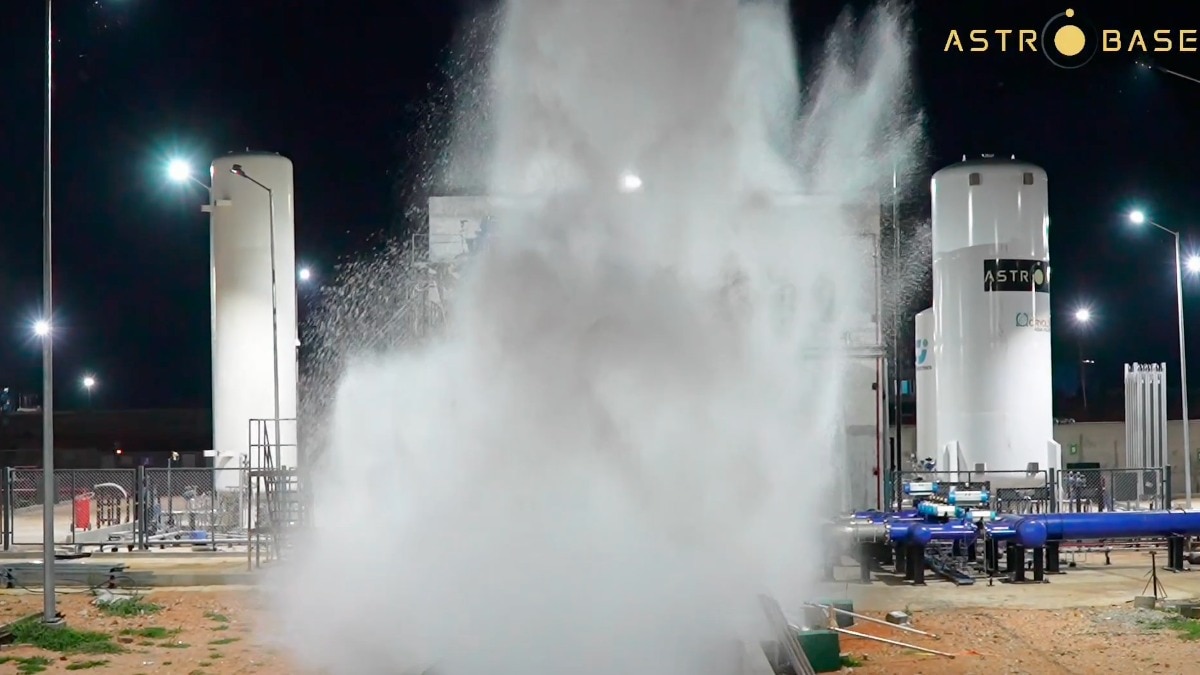
Astrobase has started qualifying a water deluge system before the EVEREST engine's hot-fire campaign. The system uses 1,000 litres of water every second to suppress acoustic energy during ignition. Founder Neeraj Khendelwal said, "Qualifying our water deluge system for the EVEREST hot fire testing campaign," as the startup prepares infrastructure.
Astrobase has begun qualifying a water deluge system before the EVEREST engine's hot-fire campaign. The exercise prepares critical ground infrastructure for testing the indigenous high-thrust propulsion system.
India's private space sector is preparing for a powerful rocket engine test, and one of the most critical systems being qualified is not the engine itself, but the infrastructure designed to protect it during ignition.
Space startup Astrobase has begun qualifying its water deluge system ahead of the hot-fire testing campaign of its EVEREST rocket engine. The company shared a video showing the system being tested, highlighting the enormous quantities of water required to suppress the acoustic energy generated during a rocket engine firing.
Astrobase founder Neeraj Khendelwal said EVEREST would require approximately one tonne of water every second during a hot-fire test to suppress acoustics.
That translates to nearly 1,000 litres of water every second, or around 60,000 litres every minute, underlining the scale of infrastructure needed to test powerful rocket engines on the ground.
"Qualifying our water deluge system for the EVEREST hot fire testing campaign," Astrobase said while sharing the video.
WHY DOES A ROCKET ENGINE NEED SO MUCH WATER?
When a rocket engine fires, its exhaust produces extremely intense acoustic waves, vibrations and thermal loads. These sound waves can reflect off the test stand and surrounding structures, potentially damaging sensitive equipment, instrumentation and the engine itself.
A water deluge system releases large volumes of water around the test stand and exhaust region during ignition. The water helps absorb and dissipate acoustic energy, while also cooling surfaces and reducing thermal stress.
This is particularly important during static fire tests, when an engine is operated at full or partial thrust while remaining fixed to a test stand.
The requirement for such a large volume of water is directly linked to the power of EVEREST.
AN 80-TONNE-CLASS ENGINE
EVEREST is an 800-kilonewton, 80-tonne-class rocket engine developed by Bengaluru-based Astrobase Space Technologies. It uses liquid oxygen and liquid methane as propellants and employs a full-flow staged combustion (FFSC) architecture, among the most advanced and technically challenging rocket engine designs.
The engine is being developed for a future reusable medium-lift launch vehicle. Its full-scale hot-fire campaign will be a crucial step in validating its performance under actual combustion conditions.
Astrobase has established a dedicated 21.5-acre engine testing facility in Andhra Pradesh, alongside its manufacturing and integration operations in Bengaluru.
WHY THIS MILESTONE MATTERS
Building a rocket engine is only one part of developing a launch vehicle. The supporting infrastructure, including propellant systems, test stands, cooling arrangements and acoustic suppression mechanisms, is equally important.
The water deluge qualification is therefore a significant preparatory step before EVEREST undergoes its hot-fire campaign.
For India's emerging private space industry, the test represents another step towards developing indigenous high-thrust propulsion systems and the ground infrastructure needed to manufacture and test them at scale.