
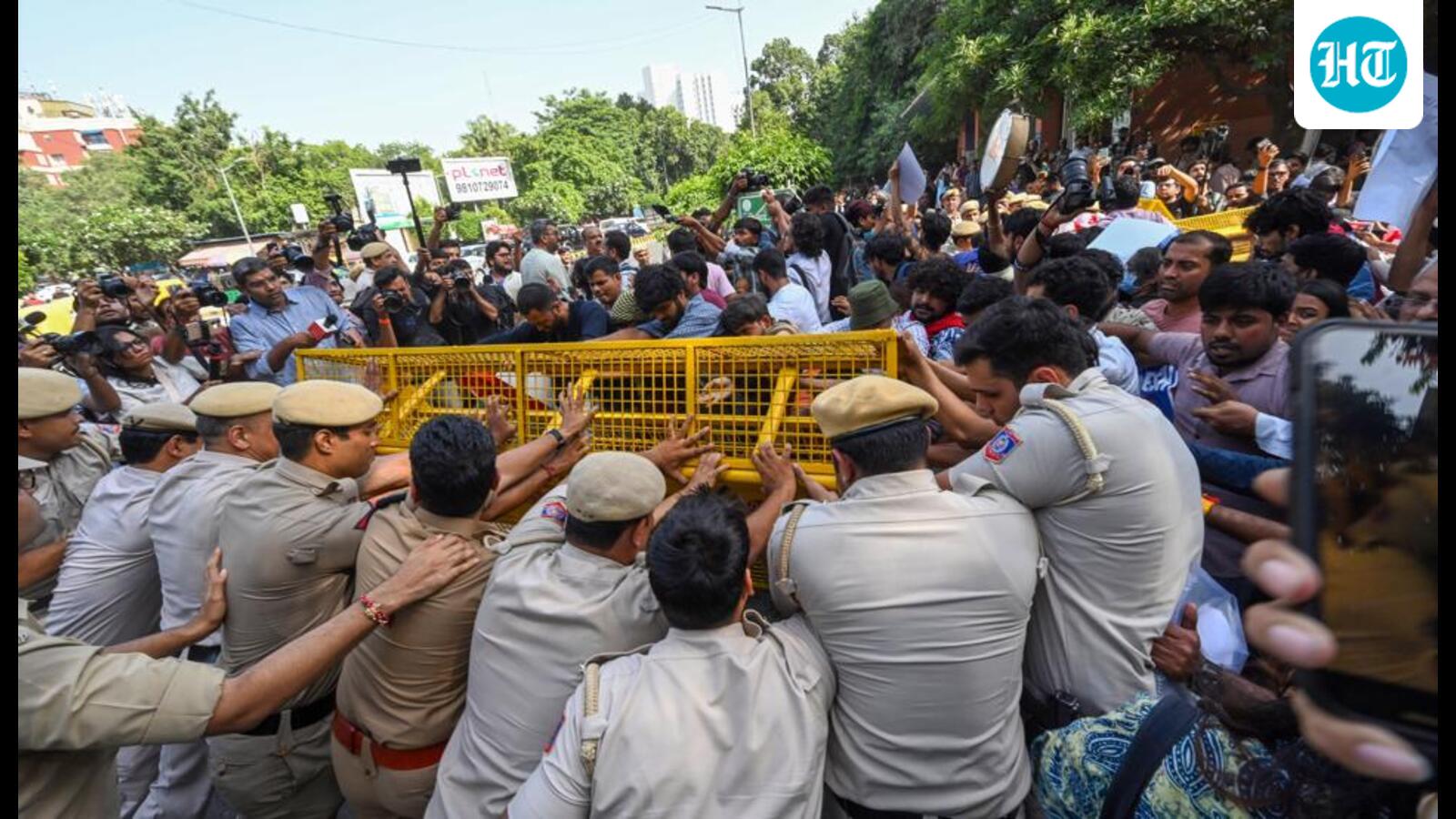
Many Indian leaders, including Narendra Modi and Arun Jaitley, started their political journeys through student protests. These figures once led mass movements against the government to demand change. Today, however, citizens who try to exercise that same right to dissent often face police action and struggle to be heard.
It is curious how the right to protest looks different from opposite sides of a barricade.
Arun Jaitley, former president of the Delhi University Students' Union, once escaped an early-morning attempt to arrest him during the Emergency. He returned to campus, burned an effigy of Indira Gandhi and courted arrest. Jaitley was in good company. The veteran Gandhian Jayaprakash Narayan's call for Sampoorna Kranti, which started as a student movement and quickly became the symbol of anti-Emergency resistance, was practically a political finishing school for India's students and future leaders. Lalu Prasad Yadav was leading the Patna University Students' Union. Student leader Nitish Kumar was swept into politics through the JP movement. Sitaram Yechury cut his political teeth in JNU's politics, marching to Indira Gandhi's residence and demanding her resignation as chancellor of the university. Sharad Yadav, president of Jabalpur University students' union, was backed by JP to contest a 1974 byelection -- which he won. Fighting on the other side, Mamata Banerjee, then a young Congress activist, blocked JP's convoy in Kolkata. She climbed onto his car and shouted slogans.
Prime Minister Narendra Modi, too, had his political apprenticeship in a mass movement. Then an RSS pracharak, he joined Gujarat's Navnirman Andolan of 1973, which began with student protests over rising canteen prices and grew into a statewide agitation. The movement brought Gujarat to a standstill. Within weeks, chief minister Chimanbhai Patel was forced to resign, the state assembly was dissolved, and Gujarat was placed under President's Rule. Modi's own website recalls Navnirman as his introduction to mass protest, a crusade against corruption that shaped his understanding of student concerns. Union home minister Amit Shah, too, came up through student politics. He was appointed joint secretary of the Gujarat ABVP and moved into the BJP's youth wing. He and Modi met in the RSS network in Ahmedabad. They were not outsiders to youth movements; they were aligned with it.
Jaitley did not ask the State for permission before his daredevilry. The Navnirman protesters did not wait for an invitation from the Gujarat police. Yechury did not seek an appointment before marching to the PM's residence. They simply exercised their democratic right to dissent and protest.
Imagine the inconvenience of having to explain this to a student at Jantar Mantar today. Citizens demanding answers now struggle to exercise the same right. Reports and visuals of protesters being beaten, dragged and subjected to sexual assault by police have surfaced. Protest sites have been denotified, trains cancelled, metro stations shut, and up to 7,000 citizens detained. And what are we to make of reports that people were intercepted en route to Delhi on suspicion of intention to join the protests? Evidently, the best protest is the one that never happens.
Those endorsing dissent while decrying disturbance to the rhythms of everyday life overlook India's history of mass movements. From strikes to road blockades, earlier protests were often disruptive by design to compel political action. Gujarat's Navnirman, especially, was marred by arson, attacks on police, strikes, and destruction of public property. Ahmedabad had descended into near-anarchy before the army was called in.
The anti-CAA protests, by contrast, saw largely peaceful sit-ins, with women sustaining a months-long protest. Today, those demanding accountability from the Election Commission and Chief Election Commissioner Gyanesh Kumar have faced disproportionate force by the police and state machinery; yet they display remarkable restraint and continue to insist on peaceful means. From the anti-CAA protests to those against the NEET-leaks and the CEC, demonstrators have invoked Gandhi, Ambedkar and the Constitution, making visible their commitment to peace and civic restraint. They know that the mechanisms of protest through which today's leaders came of age may today be framed as disruptions to public order.
Citizens should be able to trust the process that elects their government. When they are driven to the streets over fears about the integrity of the electoral process and their right to vote, any democracy should take pause. But yesterday's rebels have become today's leaders, and those who once knew the value of a street full of dissenting students now seem far less persuaded by it. They should remember that the students outside the barricades are asking for the same democracy they once demanded for themselves. It should not be so difficult to remember.