
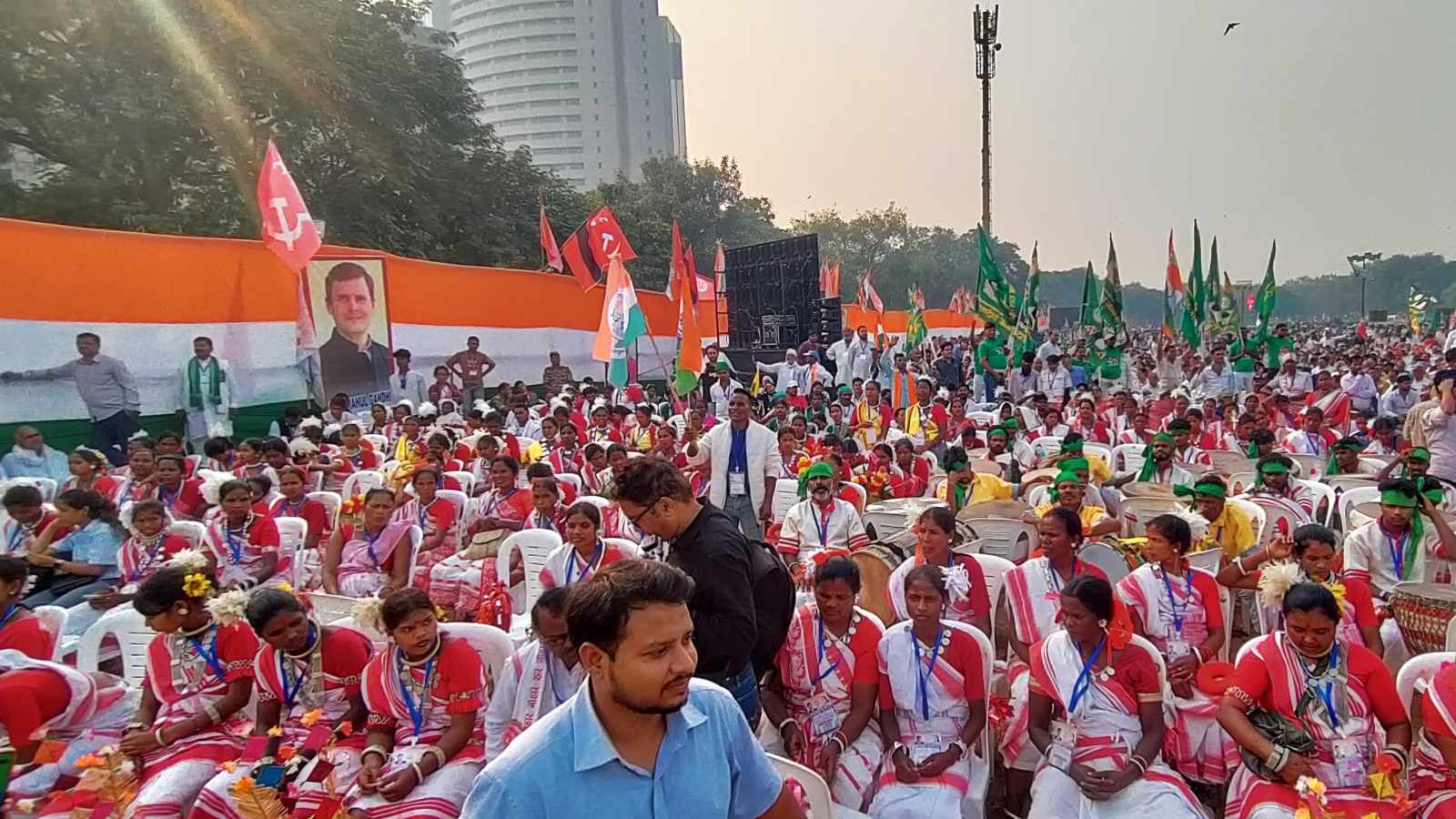
On November 1, about 1,300 Adivasis and Muslims from Jharkhand marched in Delhi to protest voter roll deletions. They used traditional songs and instruments to highlight how the Special Intensive Revision hurts tribal communities. Minister Shilpi Neha Tirkey said, "If SIR is meant to be about inclusivity, special provisions must be created."
'This land is our land': Hundreds of Adivasis in traditional attire march in Delhi as INDIA bloc holds Ramlila Maidan rally against Centre and CEC Gyanesh Kumar
About 1,300 Adivasis and Muslims from Jharkhand marched from Mahatma Gandhi Marg at Rajghat to Ramlila Maidan on Sunday (November 1) morning, and back to Rajghat in the evening, to protest against the deletion of voters from the electoral rolls in the state, where the Special Intensive Revision (SIR) has created specific hurdles for tribal communities.
In Jharkhand, where many residents have limited access to formal documentation, "how are people supposed to prove their identity?" Shilpi Neha Tirkey, Jharkhand Minister of Agriculture, Animal Husbandry & Co-operative, told The Indian Express. Shilpi led the group along with Jharkhand Congress working president Bandhu Tirkey.
Many residents, said Shilpi, did not fill out enumeration forms when Booth Level Officers (BLOs) visited. It came from a cultural belief: "We are the Adivasis, the first inhabitants and owners of this land. Why is the Government of India asking us to prove our identity?"
She said the cultural representation at the rally was organised to bring these realities to the government's attention. "If SIR is meant to be about inclusivity, special provisions must be created so that tribal people are not excluded," Shilpi said.
Fifty-year-old Jyoti Kujur marched at the front of the procession, singing a Kurukh song, and moving to its rhythm. Jyoti, who had come from Gumla district, wore a white sari with a red border, and the other women around her wore sarees of the same pattern, Jharkhand's traditional Panchi and Parhan.
As the women marched, sang, and danced together, the men marching alongside played the bheri, dhol, and mandar. The songs, Shilpi said, spoke about marching to Delhi and fighting for the rights that their ancestors too had fought for.
The performance was so eye-catching that even some police officers posted along the road were seen capturing the marchers on their mobile phone cameras.
Jyoti, who is a member of the Congress Seva Dal, said, "All the votes that have been deleted should be reinstated into the electoral roll, ab vote chori nahi chalegi."
Part of the procession were members of the Tana Bhagat community, a distinct socio-religious group with a rich history rooted in the freedom struggle.
"They are a distinct sect within the Oraon community. The Tana Bhagats follow the principles Mahatma Gandhi held closest, including ahimsa (non-violence). While traditional tribal worship includes animal sacrifices and offerings, the Tana Bhagats renounced these practices to walk Gandhi's path of non-violence," Shilpi said.
During the freedom struggle, she added, the Tana Bhagats mobilised people by blowing the bhair, a traditional musical instrument, which was brought and played at Sunday's rally as well.
Many of the women carried a matka on their heads, decorated with dried grass and marigolds. "The matka is a symbol of unity. Only unmarried women carry it on their heads," said Azhar Ali, 55, a Congress social worker from Gumla district.
On the prominent presence of women in the rally, Shilpi said, "In Jharkhand, tribal women have historically participated actively in all social causes, including land and rights struggles. When we campaigned across villages to explain the issues around SIR and the need to unite, women enthusiastically took up the campaign themselves."
The marchers came from several districts of Jharkhand - Gumla, Simdega, Dumka, Lohardaga, Ranchi. Members of the Oraon and Munda tribes, as well as the Muslim community, were present.
The SIR deletions have disproportionately affected marginalised communities, Ali said. "A very large number of voters have been deleted, and tribal and Muslim communities and those from the backward classes have had the highest numbers of deletions... There are more than 1,200 people here right now, about 25 per cent of them have had their votes deleted," Ali said.
Etwa Oraon, a tribal Congress worker from Ranchi, said the language, culture, customs of tribal communities are inherited ancestral legacies that have to be preserved and protected. The participants had gathered "to fight for those rights, to protest against vote theft, and to extend support to Rahul Gandhi ji," he said.
"Our leader, Shri Bandhu Tirkeyji travels across the entire nation campaigning so that tribals endure, their traditions survive, and their constitutional rights are safeguarded," Oraon said.
Shilpi said the tribal community was hopeful that the movement against the irregularities in the SIR would lead to a concrete solution that would address their concerns.
The draft electoral roll for Jharkhand published on August 5 excluded 43,61,987 names, which were put in the Absent, Shifted, Dead, or Duplicate (ASDD) category, reducing the state's electorate from approximately 2.64 crore to 2.21 crore.
The final electoral roll of Jharkhand is scheduled for publication on November 30, following the disposal of claims and objections by November 23.