
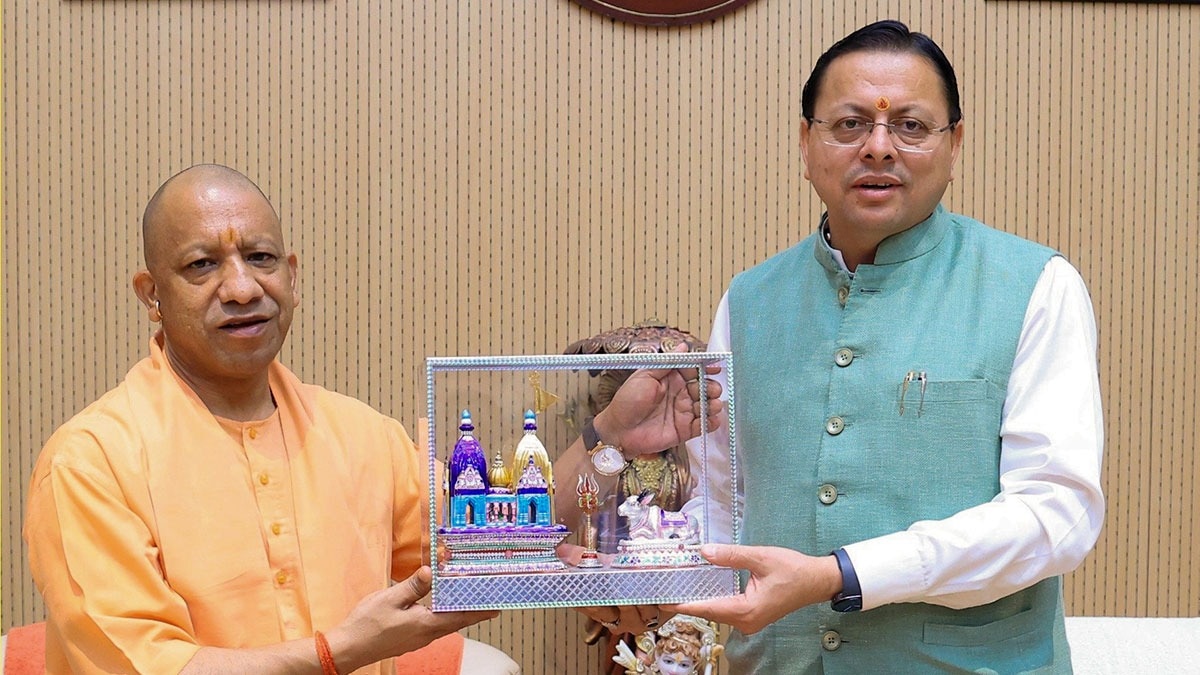
Uttar Pradesh Chief Minister Yogi Adityanath and Uttarakhand Chief Minister Pushkar Singh Dhami recently met in Lucknow to resolve long-pending asset disputes. These issues started after Uttarakhand was created in 2000. Dhami sought the transfer of 659.5 hectares of land and repairs to old bridges to ensure better public safety.
Assets-liabilities disputes have remained unsettled since the creation of Uttarakhand in 2000, but critics ask why the issue gains urgency only before polls
Headed for assembly polls, BJP-ruled Uttar Pradesh and Uttarakhand have renewed efforts to resolve disputes over assets and liabilities that have remained unsettled since their separation in 2000. The push came during a recent meeting between Uttar Pradesh chief minister Yogi Adityanath and his Uttarakhand counterpart Pushkar Singh Dhami in Lucknow, where both agreed to resolve the pending matters.
At the latest meeting, Dhami raised the transfer of 659.5 hectares of land held by Uttar Pradesh departments in Uttarakhand. The land is spread across Haridwar (615 hectares), Champawat (32 hectares) and Udham Singh Nagar (12.5 hectares). Uttarakhand says delays in the transfer have affected the maintenance of these properties and increased the risk of encroachment.
Dhami also sought repairs to the Banbasa Barrage and the Nagra Bypass Canal, along with reconstruction of old and dilapidated bridges, including those at Jhankaiya and Sukha Pul. These structures are important for public safety, movement and irrigation, particularly in the border areas. As Dhami urged that the work be prioritised, Adityanath assured him that positive action would be taken soon.
Uttarakhand irrigation minister Satpal Maharaj said departmental-level issues would be taken up immediately, with more complicated matters to be pursued separately.
The disputes go back to the formation of Uttarakhand on November 9, 2000, out of Uttar Pradesh, following a prolonged statehood movement. The division of assets and liabilities across departments, however, remained incomplete.
Uttarakhand has invoked the Uttar Pradesh Reorganisation Act, 2000, to argue that properties should be transferred to the state in which they are located. Successive governments have held meetings, proposed formulas and pursued some matters in court. A 75:25 formula for dividing irrigation assets, with the larger share going to Uttarakhand, had been proposed in 2018 during Trivendra Singh Rawat's tenure as Uttarakhand chief minister.
The most significant political intervention came in November 2021 when Dhami and Adityanath agreed to a joint survey of 5,700 hectares of land and 1,700 buildings in Uttarakhand under the Uttar Pradesh irrigation department, with properties useful to Uttar Pradesh retained by it and the rest transferred to Uttarakhand.
That agreement had settled several financial dues between the states, provided for the transfer of the Alaknanda Guest House in Haridwar and land in Kichha, and called for withdrawal of pending court cases. The two sides also agreed on the reconstruction of damaged barrages at Banbasa and Kichha. However, the latest meeting shows that important parts of the settlement, particularly those involving land and irrigation assets, still require attention.
For both governments, the issue has a clear electoral significance. In Uttarakhand, the transfer of land and control over assets located within the state has been a longstanding demand. Successive governments have faced questions over why properties and infrastructure within Uttarakhand remain under the control of Uttar Pradesh.
For Adityanath, the stakes are no less relevant. Uttar Pradesh has to negotiate the transfer of assets and settle financial liabilities while also ensuring that properties considered useful to the state are protected. A settlement can help the government project administrative efficiency and cooperation with a neighbouring state. It also allows the BJP governments in both states to demonstrate coordination and claim progress on a dispute that has long been a source of friction.