
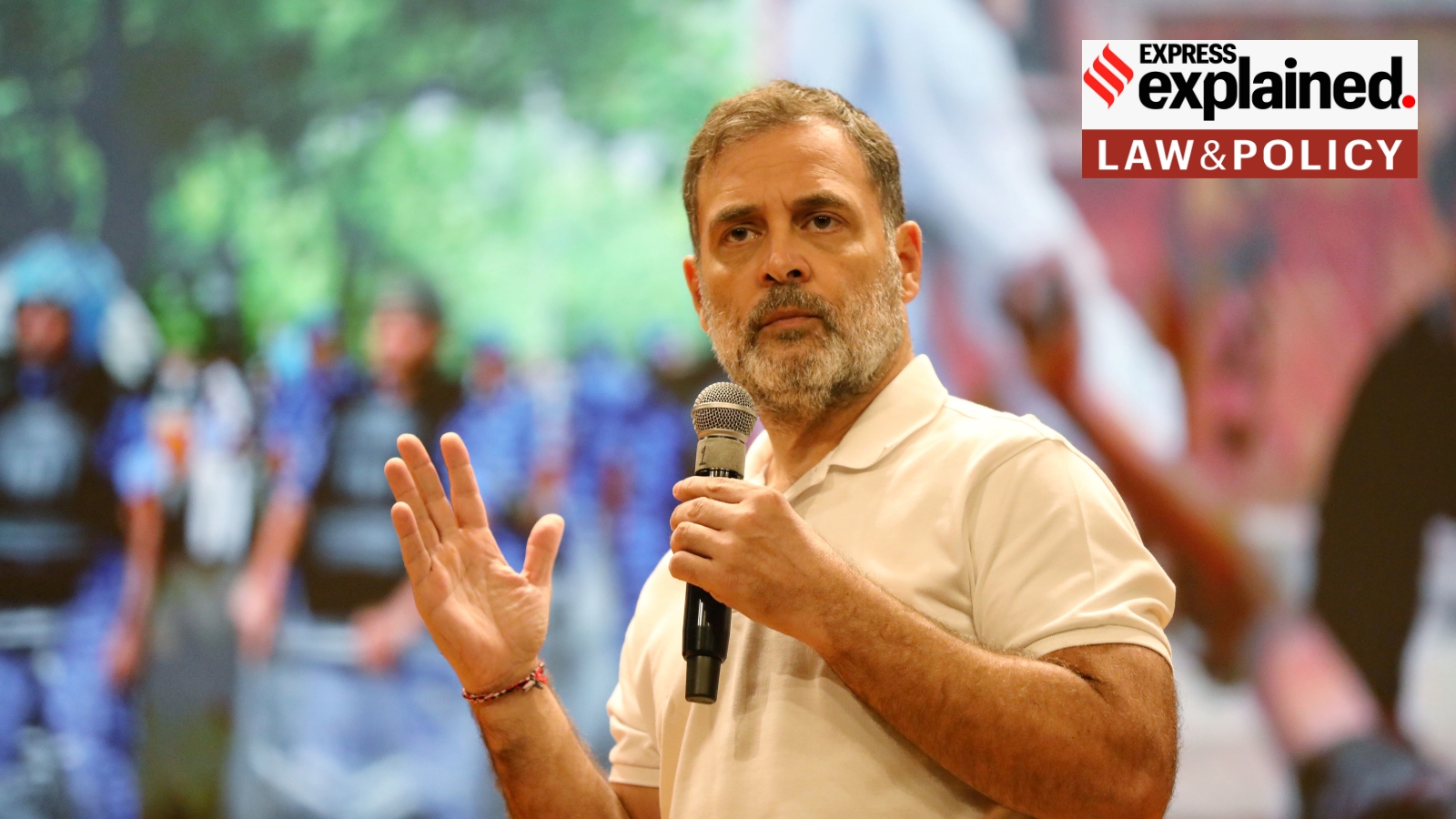
A special MP-MLA court in Sultanpur acquitted Rahul Gandhi on Monday, October 26, in a 2018 criminal defamation case. The court said the complainant, BJP worker Vijay Mishra, failed to show how the remarks harmed his reputation. Magistrate Shubham Verma held that Mishra was not an aggrieved person in this matter.
Over Gandhi's 2018 remark describing then BJP president Amit Shah as a "murder accused", the court held that the complainant, a BJP party worker, had failed to establish how the statement affected or harmed his reputation.
A special MP-MLA court in Sultanpur on Monday (October 26) has acquitted Rahul Gandhi in a criminal defamation case over his 2018 remark describing the then BJP president Amit Shah as a "murder accused". The court held that the complainant, BJP's Sultanpur district vice-president (VP) Vijay Mishra, had failed to establish how the statement affected or harmed his reputation.
An MP-MLA court is a specialised or designated court set up to fast-track criminal trials and legal proceedings involving sitting and former MPs and MLAs.
Mishra had alleged that Gandhi's comments humiliated him as a BJP worker. The Additional Chief Judicial Magistrate Shubham Verma held that he was not an "aggrieved person" entitled to file the complaint in the first place and that the remarks that were made during the Karnataka Assembly election campaign did not meet the threshold for criminal defamation in the context of political discourse.
Here's what to know about the background of the case, the legal framework surrounding criminal defamation, and what the court held in this case.
The case of criminal defamation against Rahul Gandhi
During the Karnataka Assembly election campaign in May 2018, a journalist at a press conference in Bengaluru asked Gandhi about Shah's defence of BJP leader and former Karnataka Chief Minister B S Yediyurappa. The journalist referred to Gandhi's allegations against Yediyurappa, noting that he had received a clean chit from the court and the Reddy brothers had also been acquitted.
Gandhi was responding to this question when he questioned Shah's credibility, referring to the Sohrabuddin encounter case and the death of a CBI judge, B H Loya, who had been hearing the case. "Amit Shah has been accused of murder. The Supreme Court themselves have mentioned the Loya case, so I don't think Amit Shah has a lot of credibility," Gandhi said, and went on to describe him as a "murder accused".
"The party that talks about honesty, decency, has a person who is accused of murder and he is President," he added.
This forms the backdrop of Gandhi's remarks. A special CBI court had discharged Shah in the Sohrabuddin encounter case in December 2014, and in April 2018 the Supreme Court dismissed petitions seeking an independent inquiry into Loya's death, holding that the material before it indicated that he died of natural causes.
The complaint against Gandhi was filed by Mishra, who said that Gandhi's comments had harmed Shah's and the BJP's reputation and, in a way, his own standing as a party worker.
The legal framework
Examining the case against the Constitutional guarantee of the right to freedom of speech under 19(1)(a) and the reasonable restrictions enumerated under 19(2), and the right to reputation under Article 21.
Under the Indian Penal Code (since replaced by the Bharatiya Nyaya Sanhita, 2023), Section 499 defines criminal defamation as any "words either spoken or intended to be read, or by signs or by visible representations" intended to harm the reputation of a person, would amount to defamation. It allows any company or a group to claim defamation and requires that the statement made "lowers the moral or intellectual character of that person" in front of others.
Section 199 of the Code of Criminal Procedure (CrPC, since replaced by the Bharatiya Nagarik Suraksha Sanhita, 2023) permits a criminal defamation complaint only by "some person aggrieved by the offence".
The Supreme Court in G Narasimhan v. T. V. Chokkappa (1972) held this requirement as mandatory, saying that a group claiming defamation must be "a definite and a determinate body". In 2010, in Khushboo v. Kanniammal, it also stressed that the person making the complaint should have his own reputation at stake. It said: "It is the reputation of an individual person which must be in question and only such a person can claim to have "a legal peg for a justifiable claim to hang on."
In reference to speeches made in a political context, the Sultanpur court relied on the Supreme Court's 2024 order in Arvind Kejriwal v. State (National Capital Territory of Delhi), in which the court had said that "the threshold has to be higher than usual, especially in the context of public discourse among political personalities and parties".
What the court held
The court had to examine whether Mishra was an "aggrieved person" and if Rahul Gandhi's remarks against Shah amounted to defamation. The court observed that Gandhi's remarks did not name Mishra and only referred to Shah and the BJP in the broader political context. It held: "There is no direct or indirect allegation against the complainant; rather, the statement is predominantly about Amit Shah, and at most, part of the statement relates to the BJP."
The court further said that Mishra neither established that he was authorised to represent the party nor provided documents showing that he claimed a position as the party's district VP. It said that even if the court entertains the argument that any party official has the right to file a complaint, that itself would open floodgates to multiple suits over the same remarks. It said: "In a legally governed civilized society, any concept that gives rise to multiplicity of suits or supports it cannot be recognized by law and by the courts, especially, in the context of proceedings for criminal defamation."
The court further held that Mishra was not an aggrieved person under Section 199 CrPC and that he had not established that he belonged to a "definite and identifiable class or group of persons" to which the alleged imputation could be linked.
The defence had argued that it is imperative to consider the political context in which Gandhi's comments were made. He was only responding to the questions posed to him during an election campaign wherein discussions on unemployment, development, corruption, etc., were also raised.
The court observed that these remarks made in response to a journalist's questions were made in the context of questioning the credibility of the political figure. The court said: "It is common during election campaigns for political leaders to question each other's credibility. Such statements are not unusual; rather, they are part of the essential discourse in a functioning democracy."
The court said that there was no evidence that Mishra's reputation had been suffered. It said "No evidence has been filed, from which it is concluded that Amit Shah's reputation and the complainant's reputation are so deeply connected with each other that any diminution in Amit Shah's reputation by society or the public is seen and deemed as a harm to the complainant's reputation."
The complaint was first presented to Mishra by two of the party's members. The court questioned the inconsistencies in their accounts, including where these two had met, how they travelled to Mishra's house and how the video had been shown.
The court also said that the complaint, when viewed as a whole, appears "prima facie, to be doubtful, unrealistic and unsubstantiated, and to have been done with a political or otherwise motivated intent, in any manner whatsoever, merely for the purpose of filing the complaint, which is entirely contrary to the intent of the law".