
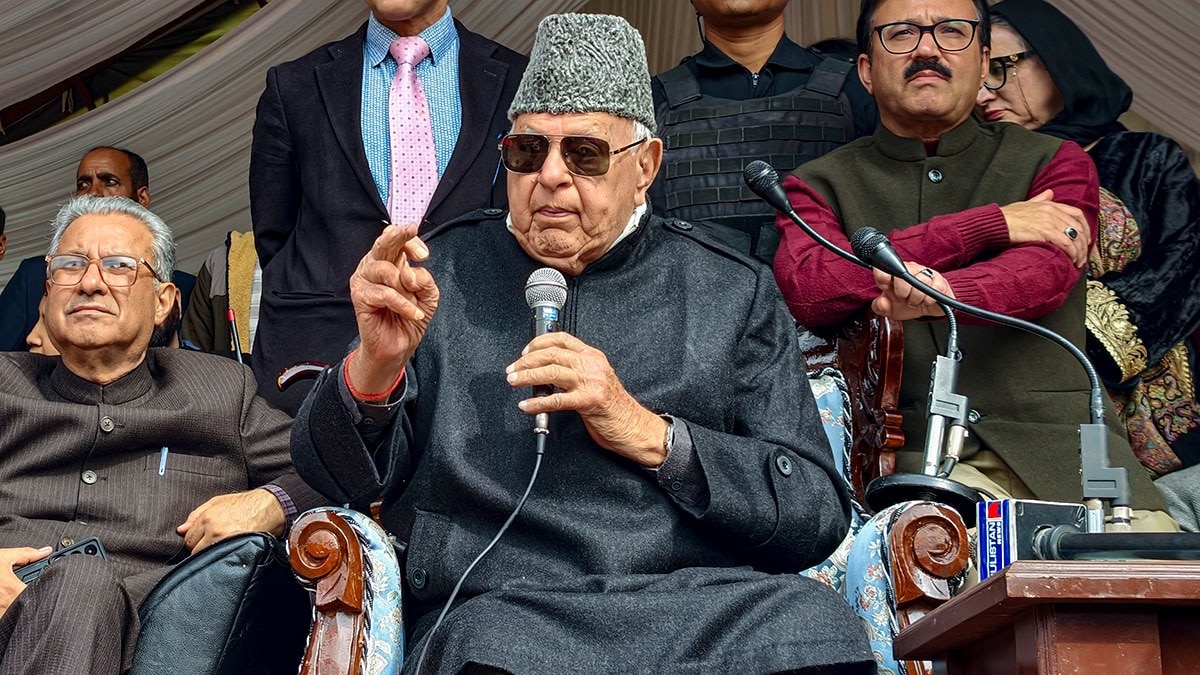
National Conference president Farooq Abdullah sparked a furore on October 24 in Baramulla by claiming Pakistan is protecting Kashmiris. He questioned New Delhi’s intentions and warned that Kashmiri identity risked erasure. Abdullah said, "Kya ummeed kareingey aap Delhi se? Kya yeh aap key liye insaaf kareingey?" regarding the central government.
The Abdullah enigma goes far beyond his latest and controversial contention that Pakistan is 'protecting' Kashmiris by keeping the Kashmir issue alive
Farooq Abdullah has spent an entire political career speaking his mind on Kashmir -- and, as many observers feel, paying the price for being unpredictable. On October 24, in Baramulla, the National Conference (NC) president and former Jammu and Kashmir chief minister once again sparked a furore when he purportedly declared that Pakistan was "protecting" Kashmiris by keeping the Kashmir issue alive on the global stage. He even warned that Kashmiris' identity risked erasure and went on to question New Delhi's intentions.
The remarks triggered political outrage. But to understand why Abdullah continues to make such controversial statements -- and why these resonate with sections of his audience -- one must look at the longer arc of his career, which has been marked by repeated confrontations with the Centre, the dismissal of his government in J&K in the past, his detention under the Public Safety Act. In fact, his is a complex persona that intelligence veterans and biographers have described as both politically indispensable and chronically underestimated.
Abdullah, speaking at a NC convention in Baramulla, said: "Kya ummeed kareingey aap Delhi se? Kya yeh aap key liye insaaf kareingey? (Can the BJP-led central government be expected to do justice to the people of Kashmir?)"
"Have the courage to confront them. If you don't, you (Kashmiris) will be wiped out. Your name and identity will be erased," Abdullah exhorted the gathering of NC workers and elected legislators from north Kashmir. "They (BJP government) are silent today because of the pressure from the world."
"Aur hamara padosi laga hua hai inke peechay. Woh har jagah pahuch jate hain aur kehtey hain ki Kashmir ka faisla abhi nahin hua hai. Woh hamein bacha raha hai, warna inke iradey neik nahin hain (Our neighbour (Pakistan) is after them (New Delhi). They go everywhere and say the Kashmir issue remains unresolved. That is protecting us, else their (New Delhi's) intentions are not good)," said Abdullah, the 'neighbouring country' immediately read as a reference to Pakistan. The remarks drew instant applause from the audience.
Abdullah accused the central government of duplicity, of saying one thing and doing "something entirely different". He emphasised that the people of Kashmir weren't enemies of the country, and that they had always affirmed the region's accession to the India of Mahatma Gandhi, Jawaharlal Nehru and Maulana Abul Kalam Azad. "[But] I want to tell the present rulers to correct yourself," he said.
Abdullah's comments evoked a sharp reaction from the BJP as those voicing Pakistan's narrative on Kashmir. J&K BJP unit chief Sat Paul Sharma demanded a public apology and suggested that Abdullah shift to Pakistan if he were to continue making such statements. Former J&K BJP chief Ravinder Raina termed the NC leader's remarks as "highly condemnable and unfortunate" and accused Pakistan of fostering terrorism in J&K.
Abdullah, though, is not new to controversies. In his decades-long political innings, he has made various remarks that invited a strong political backlash, particularly from the BJP and critics who viewed them as anti-national, pro-Pakistan or insensitive on Kashmir's status or that of Kashmiri Pandits.
In a May 2025 interview in the backdrop of the Pahalgam terror attack, Abdullah had stated that the mass killings and exodus of Kashmiri Pandits from Kashmir in the 1990s did not occur during his tenure as chief minister since he had already resigned over the appointment of Jagmohan as governor. He allegedly added that if it had indeed happened under him, "so be it" ("hua toh hua").
Earlier, during the period between 2015 and 2018, Abdullah repeatedly stated that the part of the former princely state under Pakistani control "belongs to Pakistan and this won't change" even if wars are fought, while the Indian side belongs to India. In the past, he has on many occasions also argued that both sides of Kashmir should get autonomy and advocated dialogue with Pakistan to achieve peace. Such statements drew sharp criticism for allegedly undermining India's formal claim on the whole of Kashmir.
Abdullah's bitterness is seen as having grown since the abrogation of Article 370 of the Constitution and downgrading of J&K from a state to two Union territories in August 2019. In its aftermath, he was reported as saying that Kashmiris felt like "slaves" or second-class citizens and that they would prefer Chinese rule instead. He has been consistent in his opposition to the developments of 2019 and been demanding restoration of J&K's special status.
After the abrogation of Article 370, Abdullah was booked and detained under the Public Safety Act in September 2019. The government dossier, which formed the basis of his detention, listed 27 charges against him. The dossier said Abdullah had the potential to fuel public disorder and further accused him of opposing the sovereignty of India by "saying Pakistan-occupied Kashmir was an integral part of Pakistan". The dossier said he had made the statements "for the purpose of rebellion against India". Abdullah was also accused of justifying acts of terror "by glorifying terrorists".
Books and narrations by intelligence veterans and biographers also offer a peek into the persona called Farooq Abdullah. Former RAW chief A.S. Dulat, while discussing Abdullah with writer Aditya Sinha and Asad Durrani, former chief of Pakistan's ISI, in the chapter 'The Unloved Dr Farooq Abdullah' in the trio's joint book The Spy Chronicles: RAW, ISI and the Illusion of Peace, states: "Other politicians might think Farooq is a joker, they might think anything of Farooq, but Farooq cannot be ignored, his very presence cannot be ignored." Dulat further notes: "I also believe Farooq would make an outstanding foreign minister."
In his review of Dulat's recent book on Farooq Abdullah, The Chief Minister and the Spy (2025), Sinha opines that Abdullah understands Kashmir like no other Kashmiri: "It is neither a biography nor a memoir, but a stream of reminiscences that collectively do a good job of mining Farooq's psyche, based on whatever Dulat saw and heard. Such empirical evidence is compelling, especially in clarifying Farooq's complexity. He (Farooq) understood Kashmir like no other Kashmiri, even his own legendary father, National Conference founder Sheikh Abdullah, and certainly far more than the flash-in-the-pan separatists and terrorists that have come and gone."
Sinha further writes that 2002 was a painful time for Abdullah. "It was a terrible year for Dr Farooq. He was promised the vice-presidency of India by both Vajpayee and home minister L.K. Advani, but in the end, he was left with nothing, not J&K, and not even a bungalow in New Delhi," he writes.
Dulat, in another book Kashmir: The Vajpayee Years (2015), writes that even during the worst of times, Kashmiris never lost their sense of humour. "When Rubaiya Sayeed was released from captivity on 13 December 1989, a popular saying was 'Mufti Saeben geb, panch duh lab', meaning Mufti's lamb found in five days. And when they began to tire of Mufti's rule in 2004, they said about Farooq: 'Uss fetir ko wapas lao' (Bring back that lovable fool)," writes Dulat.
What Abdullah has now said about Pakistan raking up Kashmir perhaps needs to be understood in the historical context. Dulat elaborates this point in Kashmir: The Vajpayee Years: "Kashmir has been a trouble spot since Partition because Pakistan has never accepted the finality of its accession to India; it still remains in some perverse minds its unfinished agenda, despite three wars."
At another place in the same book, Dulat mentions his interaction with the late Agha Ashraf Ali, a prominent educationist of Kashmir and father of poet Agha Shahid Ali. "During the 2014 parliamentary elections, I asked Agha Saheb who he would have voted for. Farooq, of course, he exclaimed, as if it was a no-brainer. He is the only one who can stop [Narendra] Modi," Dulat quotes Agha as saying.