
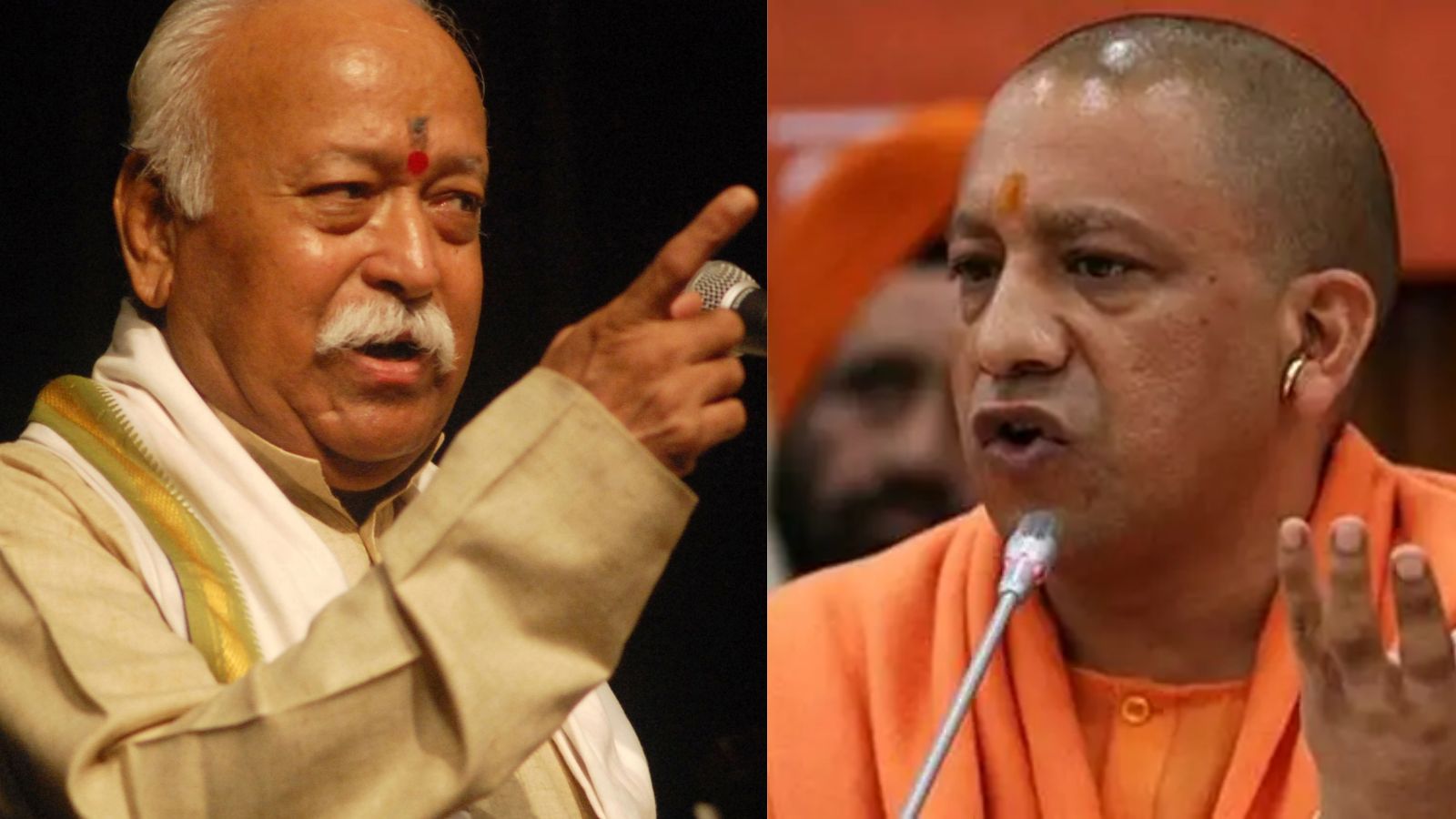
BJP and RSS leaders are defending Diwali firecrackers, linking them to tradition while dismissing pollution concerns. On November 10, Mohan Bhagwat claimed firecrackers once cleaned the environment. Yogi Adityanath said on November 11 that his government would not ban them. The party now faces a balancing act regarding court rules.
What began as objections to restrictions has now acquired a religious dimension, with BJP leaders invoking Bakrid to allege selective targeting of Hindu festivals.
When RSS chief Mohan Bhagwat defended traditional Diwali practices earlier this week, he argued that firecrackers once helped clean the environment by killing insects and that lighting lamps with ghee and flaxseed oil purified the air.
"In olden times, firecrackers did not use modern chemicals. So the smoke from firecrackers would kill all insects. The environment would get cleaned. People would light ghee and flaxseed oil lamps. This would lead to a special air in the environment. There is science behind this. If we do things with this understanding, it will be good. The environment will become pure," Bhagwat said at a gathering in Nagpur on November 10.
A day later, Uttar Pradesh Chief Minister Yogi Adityanath offered a more direct defence of Diwali celebrations, dismissing concerns over pollution and asserting that his government would not ban firecrackers.
"So I said if there is pollution, it will also get over. Don't worry. Those who polluted the whole system with their corrupt practices are not being questioned. But if people burst firecrackers for a day, it is being said it has led to pollution," Adityanath said at a government programme in Lucknow on November 11.
"Good that people celebrated Diwali with great pomp and joy and burst a lot of firecrackers. And we said we will not ban it. I was myself participating in fireworks show in Ayodhya," he added.
The statements reflect a political narrative that has evolved within the Hindutva ecosystem over the past decade, where bursting firecrackers is defended in the name of tradition. What began as objections to restrictions has increasingly acquired a religious dimension, with BJP leaders invoking Bakrid to allege selective targeting of Hindu festivals.
But the argument also presents the BJP with a political balancing act. As the ruling party at the Centre and in several states, it must enforce restrictions imposed by the Supreme Court even as its leaders defend fireworks. It must also reconcile this position with the concerns of its substantial urban middle-class constituency, for whom air pollution is a major issue.
Senior functionaries of the BJP and RSS, however, reject the suggestion of any contradiction.
"There is no contradiction. There has been no study directly linking firecrackers to Delhi pollution. Pollution in Delhi is linked to so many factors including dust, stubble burning, topography and vehicular pollution. Diwali is for just two days. A study by IIT Kanpur says that multiple factors are responsible for pollution. People know this. When all other factors are taken care of, then we can think about fireworks also. But why choose fireworks first?" a senior Delhi-based RSS functionary told The Indian Express.
BJP national spokesperson Guruprakash Paswan argued that protecting traditions and addressing environmental concerns were complementary objectives.
"CPCB data shows that this was the cleanest October. There has been a coordinated effort on pollution control with all neighbouring states. Three thousand industrial units have been shut down and garbage mountains have been cleared. We support tradition, but we are equally concerned about pollution. The Prime Minister has said that nature and the environment are a collective responsibility. We respect the Supreme Court. Tradition has its own place, and I see perfect harmony between the two," Paswan told The Indian Express.
"In our larger ideological framework, environmental protection is a priority. We have a disaster-resilience framework and are making significant progress in renewable energy," he added.
Asked about Adityanath's remarks, Paswan said, "The media should not cherry-pick statements. He has made many statements on environmental protection, but nobody talks about them."
Pollution to religious identity
The defence of Diwali fireworks has increasingly acquired a religious dimension in the BJP's political discourse.
On November 3, BJP national spokesperson Gaurav Bhatia accused actors Dia Mirza and Naseeruddin Shah of selective environmental activism.
Speaking at the BJP headquarters in New Delhi, Bhatia said, "There is selective messaging. You say that people should take care of the environment." He questioned their silence on alleged water pollution associated with animal slaughter during Eid and Bakrid.
His remarks followed a controversy in Mumbai after the Brihanmumbai Municipal Corporation (BMC) withdrew a pollution-awareness video featuring Mirza after objections from Mumbai BJP president Ameet Satam.
In a November 1 post on X, Satam said, "We don't need lessons on how to celebrate #Diwali from @deespeak. Our traditions are deeply rooted in our culture."
The Bombay High Court subsequently directed the civic body to restore the video, expressing displeasure over an environmental-awareness campaign being drawn into a religious controversy.
The incident illustrated the tension between the BJP's political messaging and the obligations of institutions under its administration.
On November 9, RSS-linked Swadeshi Jagran Manch leader Ashwani Mahajan also questioned the attribution of Delhi's pollution to fireworks.
"It has become fashionable to blame Diwali crackers for pollution in Delhi," he wrote on social media, citing pollution readings to argue that air quality at some monitoring stations had been worse before Diwali than on the festival itself.
A decade-old argument
The roots of this political position can be traced to Supreme Court interventions restricting firecracker sales in Delhi-NCR in 2016 and 2017.
In October 2017, then RSS general secretary Suresh Bhaiyyaji Joshi questioned the restrictions at a press conference following the organisation's Akhil Bharatiya Karyakari Mandal meeting in Bhopal.
"Crackers that pollute and harm the environment should be banned but not all crackers are pollutants," Joshi said, arguing for a balanced approach. He also raised the possibility that restrictions could eventually extend to other traditional practices, including lighting earthen lamps during Diwali.
Around the same time, Prafulla Ketkar, editor of the RSS-linked Organiser, argued on social media that Hindu traditions were being targeted in the name of secularism, modernity and progress.
RSS's broader ideological position
The broader ideological position was articulated in March 2019, when the RSS Akhil Bharatiya Pratinidhi Sabha adopted a resolution titled "Need to Protect the Traditions and Beliefs of Hindu Society" at its meeting in Gwalior.
The resolution argued that Hindu traditions were being undermined from perspectives that did not adequately appreciate their cultural significance. It maintained that reforms should emerge through social and religious leadership and consensus rather than legal processes alone.
By November 2023, the debate had acquired a sharper political edge. Kapil Mishra, then Delhi BJP vice-president, described the sound of firecrackers during Diwali as an expression of resistance, freedom and democracy, while arguing that children bursting crackers was part of Hindu tradition.
Middle class challenge
The debate presents a distinctive challenge for the BJP because of its substantial support among urban voters exposed to some of the country's worst air pollution.
A Lokniti-CSDS post-poll survey during the 2025 Delhi Assembly elections found that the BJP enjoyed a 31 percentage point advantage over AAP among affluent voters and a three percentage point advantage among middle-class voters.
Yet, concern over pollution does not necessarily translate into voting decisions determined by the issue. Research presented at the CSDS in March 2025 examined why air pollution had limited electoral salience in Delhi despite widespread public concern.
This creates room for the BJP to make two arguments simultaneously: that governments must address the multiple structural causes of pollution, and that Diwali celebrations should not be singled out for restrictions.
The BJP's position is further complicated by its responsibilities in government. In Delhi, where it came to power in February 2025 after years of opposing the AAP government's restrictions on firecrackers, the administration has had to enforce the Supreme Court's directions.
In the run-up to Diwali this year, the Delhi Police seized thousands of kilograms of illegal firecrackers and registered cases against unauthorised sellers. Yet, the festival saw large-scale bursting of firecrackers across the Capital.
Opposition's take
The Opposition, meanwhile, has generally approached the issue through the prism of pollution control and government accountability rather than directly challenging the BJP's religious framing.
The AAP has criticised the BJP government's handling of pollution. The Congress has similarly questioned pollution control measures and enforcement.
Neither party, however, has consistently made Diwali fireworks a central political campaign.