
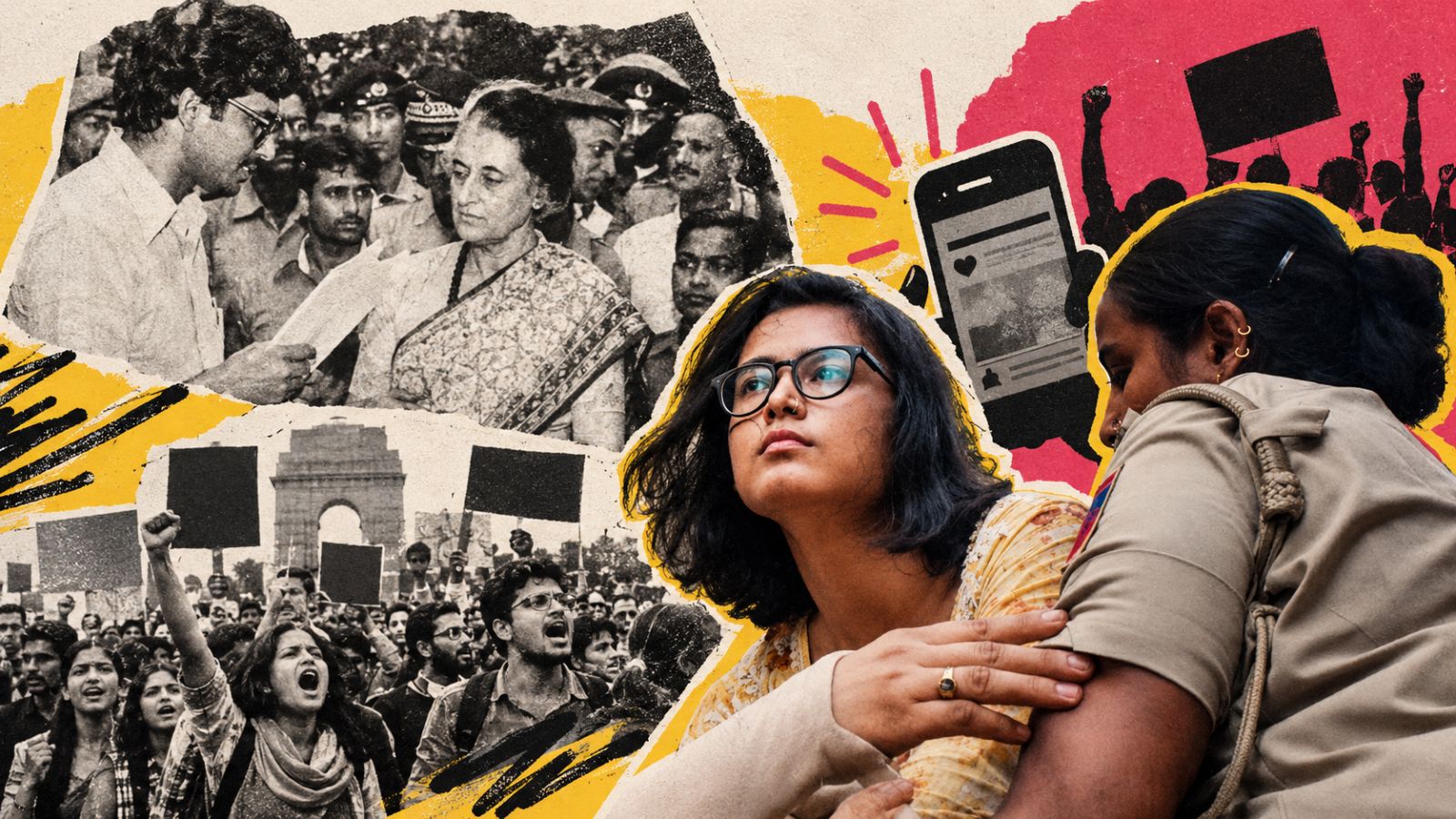
Student protests in India have a long history, from Sitaram Yechury confronting Indira Gandhi in 1977 to the current 2026 movement. Recent protests led by the Cockroach Janata Party forced Education Minister Dharmendra Pradhan to resign. Now, students are back on the streets, demanding the Chief Election Commissioner also step down.
Millennials were called apolitical; Gen Z is written off as smartphone-obsessed. But India's history of student movements suggests that young people have never been as disengaged as they are made out to be.
Young, confident, and with his eyes on a piece of paper, Sitaram Yechury stood close to an unfazed Indira Gandhi in an unforgettable moment in 1977, captured in a black-and-white photograph alluring in its composition and powerful in its historical significance. A student leader at Jawaharlal Nehru University asked the Prime Minister of India to resign as Chancellor of the University, only months after the infamous Emergency ended. It was a quiet march that the JNU students led by Yechury had taken to the Prime Minister's residence, and their memorandum was heard. Indira Gandhi later resigned from the post of Chancellor.
Student protests, however huge or unprecedented they may seem in the 2020s, have always existed, practiced in one form or another. They have also often pushed the establishment into urgency and action, even when other forms of protest have struggled to make themselves heard. What makes the 2026 movement so momentous is not just its reach or rapid rise, but also the composition- the mix of all genders out there, leading the fight, undeterred by the police action against them and coming back every day. Women were everywhere, media cameras snapping pictures of them being dragged away by their legs and arms by the police, standing atop bumpers and in front of police vehicles to stop their compatriots being taken by force.
The timing of this movement is equally striking. It comes amid similar protests in other parts of the world - France, Italy and Albania - following the waves of protests in Nepal and Bangladesh in previous years, as well as in countries as far apart as Indonesia, Peru, Mexico, the Philippines and Morocco. While the causes and outcomes of these movements differ, several have forced governments to respond to public demands, and some have even led to governments being overthrown. In India, the first round of protests led by the Cockroach Janata Party resulted in an immediate acceptance of their demand - the resignation of Education Minister Dharmendra Pradhan, following the controversy over the NEET examination and the subsequent demand for a retest.
The second round is, however, much bigger, calling for the saving of democracy. They want the resignation of Chief Election Commissioner Gyanesh Kumar for what they allege was the exclusion of millions of eligible voters during the Special Intensive Revision process the Commission launched last year (on this very day, October 27). Both times, the police action was brutal, and reports of violence against women were appallingly many. But women kept coming back; the video of a young girl leaving her home in Telangana without telling her parents to go to the Delhi protests became symbolic. She said in the video that she did not know anyone in Delhi but was so moved by the protest that she was taking the first flight she could.
Activists and fellow protesters ensured she reached there safely.
Even Neha Bora, who has become the face of the protest, had little support from the family, who were followers of the ruling Bharatiya Janata Party that Neha was fighting against, until their mother softened and reached out. Their story, too, reflects the personal battles that can accompany a public fight for a cause.
The recurring myth of the apathetic young
This kind of passion and resolve to keep fighting for a cause they believe in among a generation that was often dubbed frivolous in the past may seem incredible. Even the term Gen Z came to be associated with the lingo they used or else their preconceived smartphone addictions. They were written off as a generation lost entirely in their pages on social media, paying attention to little else.
Such assumptions had begun much earlier, when the internet first dropped on a generation of millennials who found themselves in the IT world, cocooned there with their day-and-night schedules and deadlines. There seemed to be periods of lull and an absence of a large section of youth in matters of public affairs, with a trend to call themselves apolitical and stay away from what they thought did not affect their world. But they could still move mountains, and the participation of youth in Anna Hazare's anti-corruption movement of 2011 contributed to the political climate that eventually saw the Congress-led UPA government lose power in 2014.
Another major protest broke out at JNU in 2016 when new young leaders rose to question the ruling party and shout for 'Azadi'. The protests emerged amid a wider debate over nationalism, freedom of expression and dissent on university campuses. However, the movement did not spread or sustain itself on the same scale across the country, and several of its prominent leaders were subsequently silenced or faded from public view. Umar Khalid, one of the most consistent among them, has been in prison for over six years now.
The next major wave of student protests came in December 2019, when the government introduced and passed the Citizenship Amendment Bill, which subsequently became the Citizenship (Amendment) Act. This one did not flicker out like in 2016 and began to send ripples across the country.
Women were a big part of this movement too, with former student leader Aishe Ghosh among the prominent figures. And then there was, of course, the Shaheen Bagh protest led by women, surprising everyone with its composition of middle-aged and elderly women, relentless in their pursuit of stopping the CAA and protecting their children's citizenship. The anti-CAA wave might have been the big movement that changed everything if it were not for COVID-19, which burst into our midst in March of that year and disrupted the protests.
Doomscrolling didn't kill political consciousness
These are but a few movements picked up from across the decades to remind ourselves that the children of tomorrow, if not today's, will always rise, no matter what worlds of their own they seem lost in. Perhaps it was exactly because they were lost in those worlds that they could come together so quickly, so prepared, and so well-informed. The doomscrolling need not always be about funny reels; it could pave the way to larger paths.
Like parliamentarian John Brittas said in an interview, a meme has become more powerful than a manifesto, compelling Prime Minister Narendra Modi to speak the language of Gen Z and bringing even older political leaders such as Sonia Gandhi onto social media. Perhaps that is the most interesting contradiction about this generation: the same digital spaces blamed for keeping young people distracted are also helping them find each other, organise and make themselves heard.