
The Cockroach Janta Party protest in central Delhi saw hundreds gather on Friday despite heavy security. Small groups of students and citizens turned up, but the event lacked a clear leader after three main CJP figures got detained. Many people showed up, yet the crowd never became a unified march.
At around 4 pm, the protest announced by the Cockroach Janta Party (CJP) in central Delhi was a collection of small groups, with five or six people gathered here and a dozen there. By 5 pm, some of these clusters had grown into larger groups, raising slogans against Chief Election Commissioner Gyanesh Kumar and the government. As evening set in, the groups began merging, drawing hundreds of people into the inner circle of Connaught Place. Thousands of security personnel deployed across Connaught Place suggested that Delhi was bracing for a major confrontation. But the protest site offered a different picture.
Small groups of students, Left activists and ordinary citizens turned up, but there was no clear meeting point, no visible chain of command, and no leader directing the crowd.
I interacted with dozens of people, young and old. My sample size might have been small, but so was the crowd, relatively speaking, at a protest that followed a Congress march just a week earlier, and compared with the CJP's July demonstration.
My interactions with the crowd suggested a mixed gathering. There were committed protesters who believed in the cause, but also onlookers who appeared to have turned up out of curiosity. It is difficult to quantify the split, but roughly one in four people I spoke to seemed more interested in seeing what was unfolding than in the protest rather than participating directly. Some even told me they had plans to head to Connaught Place's pubs and clubs, which remained open on Friday.
By evening, the crowd in the heart of the capital looked like it had crossed the 1,000-mark. Yet the crowd never quite became a unified march. By the time I left around 8 pm, hundreds had been detained, yet small clusters continued to march sporadically across Connaught Place.
The situation captured the central problem confronting the CJP-led protests. There was a turnout, and many people were willing to assemble despite the heavy security presence. But the CJP appeared unable to turn that participation into a coordinated demonstration, particularly after its three main leaders were detained or arrested.
A CROWD WITHOUT A CJP COMMAND CENTRE
The Tiranga March had been called by CJP leader Abhijeet Dipke, who was detained just before the protest could begin on Friday. He had been served notice by the Delhi Police asking him not to proceed with the march. His counterparts, CJP leaders Ashutosh Ranka and Saurav Das, were already under arrest.
With Dipke detained, there was no prominent CJP leader visibly directing the protest. Nor was there an apparent alternative "plan B" to bring the groups together or decide what they should do next. More than two hours after Dipke's detention, no CJP functionary was visibly leading the gathering.
The result was a protest that grew through individual groups converging rather than through an identifiable mobilisation effort.
Around 5.25 pm came the first sign of a march, when approximately 100 protesters carrying the Tricolour made a circuit of Connaught Place's inner circle, starting at Palika Market's Gate No. 1.
Around the same time, around 100-120 Students' Federation of India (SFI) members gathered near Tolstoy Marg, close to Jantar Mantar.
Activists associated with the All India Students' Association (AISA) also joined the demonstration, although AISA leader Neha Bora was detained from Mandi House by 5.15 pm.
The demonstration, to put it mildly, appeared rudderless.
India Today Digital tracked the protest from Janpath to Connaught Place, where slogans such as "Dilli Police hai-hai", "Tanashahi nahi chalegi" and "Gyanesh Kumar isteefa do" rang out, but in pockets.
CPI(M) Rajya Sabha MP John Brittas appeared to be the only prominent political leader present at the protest, who reached CP around 7.30 pm.
At Friday's protest in Connaught Place, the Tricolour brought students, Left activists and other citizens together, but with them seemingly asking one another, "What next?"
Sustaining a protest, coordinating its movement and giving it political direction require a degree of planning. At Connaught Place, the first appeared possible. The second and third — highly elusive.
A CROWD OF MANY CAUSES, UNSURE OF WHERE TO GO
There were also onlookers who seemed less interested in the cause than in the spectacle unfolding around them. Some people I spoke to said they had plans to head to Connaught Place's pubs and clubs later in the evening. With several pubs empty, the protest was one of the things drawing people's attention before the night began. Notably, protests in the national capital have cost businesses in Connaught Place, one of New Delhi's key commercial districts, thousands of crores of rupees in losses.
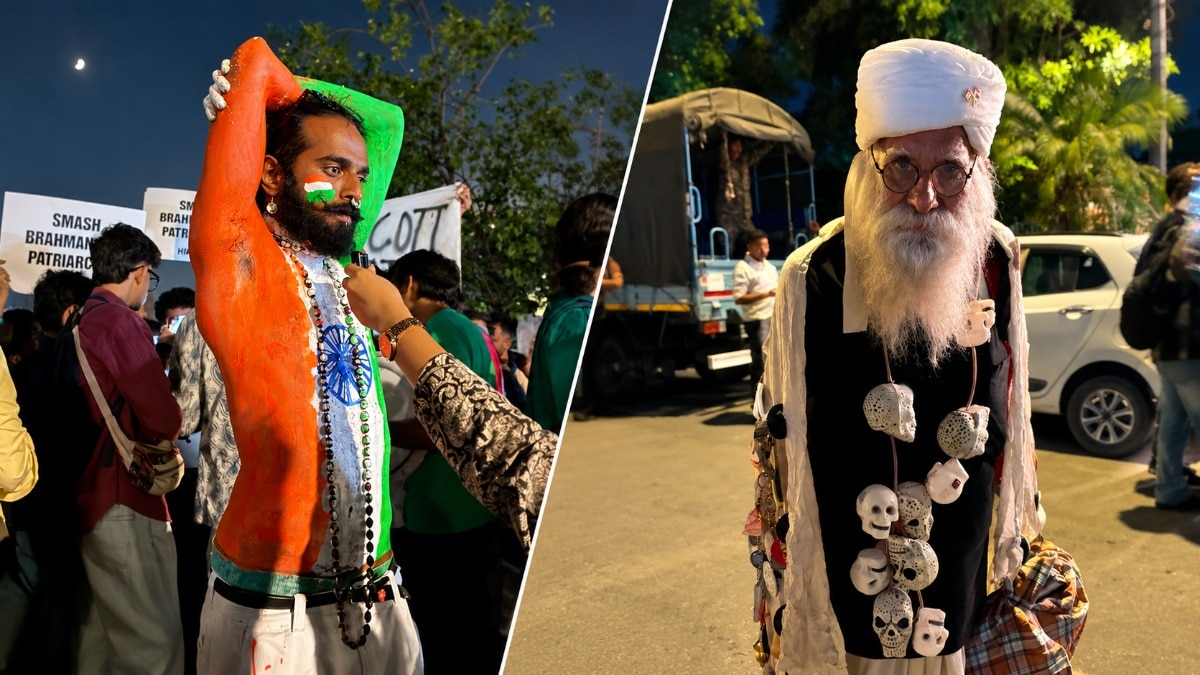
Then there was a man dressed in an elaborate costume, with fake plastic skulls dangling around his neck, promoting his YouTube channel. He seemed to have no discernible reason to be at the protest.
Meanwhile, Aruna Singh, a retired professor of sociology, looked around and asked me, "Is the crowd coming? Where are they?" It was a question that captured the mood of the protest.
Kavya Sharma, a Delhi University student, said she had come because she believed carrying the national flag and standing up for a cause was no crime. "It's no crime to stand here with the Tricolour, so I am here," she said. But even she was unsure where to go or which group to join, with several clusters of protesters occupying different parts of Connaught Place. For some time, she was at Palika Bazar Gate No. 1. For some time, she was at the entrance of Jantar Mantar. She later joined the crowd marching in CP's inner circle.
The gathering also drew people who had arrived without any link to the protest. An African man turned up out of curiosity, while another protester stood alone, the Tricolour wrapped around him like a cape. He said he had come to draw attention to the violence involving Kuki, Meitei and Naga communities in Manipur, lamenting that nobody seemed to care about what was unfolding in the state.
His presence appeared out of place amid the slogans against the Chief Election Commissioner, but it also revealed something about the gathering. For some, the protest was an opportunity to be heard, even if their grievances had little to do with the immediate cause.
Then there was a man wearing skulls around his neck, promoting his YouTube channel, as if Halloween had arrived early in the capital.
With media personnel and security forces outnumbering the protesters, Connaught Place on Friday became a spectacle of a protest that had plenty of grievances to air but neither the numbers to command attention nor the leadership to give it direction.
A REPEAT OF CJP's JULY LEADERSHIP VACUUM?
The events on Friday recalled the July 20 protest, when the detention of senior CJP leaders left the demonstration without clear direction. The absence of a visible contingency plan after Dipke's detention suggests that CJP has not resolved the problem exposed during that earlier mobilisation.
The scale of the security arrangements made the lack of leadership more pronounced. Rapid Action Force personnel were stationed every 300-400 metres, carrying batons, tear gas shells and firearms. Delhi Police, RAF and Sashastra Seema Bal personnel were deployed across the inner and outer circles, with senior officers patrolling the area and briefing personnel, closely watching every move, even from the skies, with dozens of drones hovering over Connaught Place.
Police repeatedly asked small groups to disperse, and the leadership, who could have had a dialogue with the authorities, was non-existent.
A senior Delhi Police officer told India Today Digital that detentions could be avoided as long as protesters remained peaceful and did not enter Central Park. An IPS officer said, "The national flag was acting as a shield for the protesters, which is why the police were not moving against the gathering despite prohibitory orders under Section 163 of the Bharatiya Nagarik Suraksha Sanhita."
In Mumbai too, the turnout was embarrassing for CJP. Well-placed sources present at the protest site told India Today Digital that barely a few dozen people turned up at Azad Maidan, a venue that can accommodate 5,000-6,000 people.
The protest laid bare both the reach and the limits of CJP's mobilisation — its leaders called people to the streets but offered no clear plan, and when they were detained, the gathering was left to fend for itself.
Celebrated Hindi author and satirist, Harishankar Parsai, warned in his essay Aawara Bheed Ke Khatre, "A directionless crowd can become a danger in itself."