
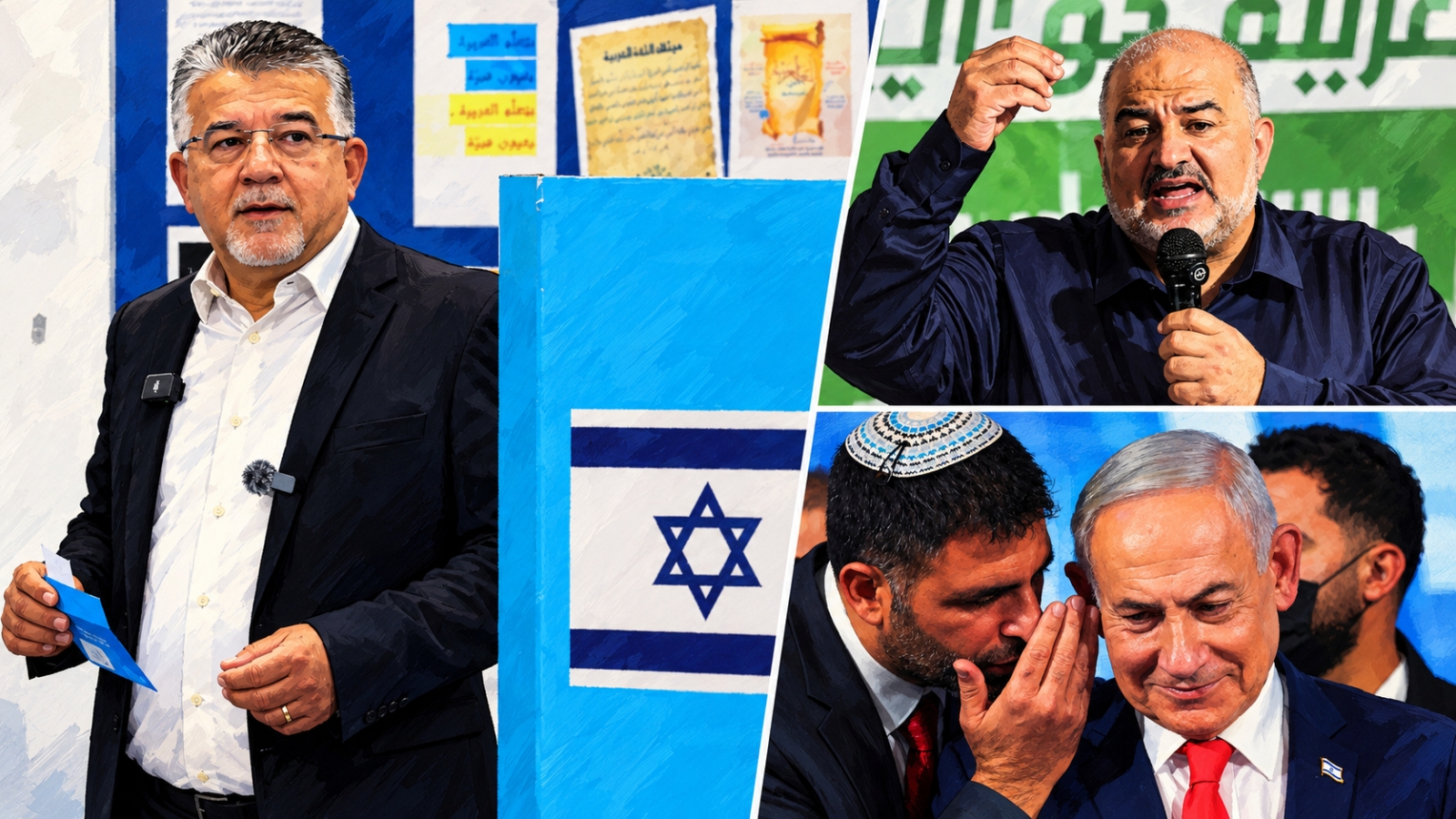
Israel’s Arab-led parties won a record 19 seats in the Knesset during the October 2 election. With neither major bloc reaching the 61 seats needed for a majority, Ra'am and the Joint List now hold a decisive role. These parties could influence who forms the next government in Israel.
Ra'am and the Joint List have won a record 19 seats in the Knesset, potentially giving them a decisive role in government formation as Netanyahu's bloc and the opposition fall short of a majority.
Israel's Arab-led political parties have emerged as the most crucial players in the country's government-formation process after securing a record 19 seats in the 120-member Knesset in the parliamentary election held on October 2. The final results gave the Joint List 11 seats and the Islamist Ra'am party eight, putting them in a position to influence whether Prime Minister Benjamin Netanyahu remains in power or the opposition attempts to form a government.
Netanyahu's Likud-led bloc won 53 seats, while the opposition grouping led by Gadi Eisenkot secured 48. Neither has the 61 seats required for a parliamentary majority. The Arab parties' combined tally could, therefore, provide the opposition with a route to a majority, although political differences and resistance to cooperation with Arab lawmakers could complicate negotiations.
News agency Associated Press reported that the 19 seats represent a historic high for Arab-led parties in Israel's parliament. Palestinian citizens of Israel account for about a fifth of the country's population and have the right to vote and serve in the Knesset.
All ballots counted · Official certification pending
Israel election 2026: Who won how many seats?
The 120 Knesset seats split three ways. Neither major bloc reaches the 61 needed for a majority on its own.
All ballots counted · Official certification pending. The Central Elections Committee has finished counting the regular and double-envelope ballots. Seats shown are the reported completed-count figures (Globes, Oct 29, 2026, 6:15pm Israel time), still subject to final verification. Official results are expected on Nov 4, 2026. Bloc groupings are editorial, not Central Elections Committee categories.
BlocsBy party
61 = majority
UTJ
Netanyahu bloc
Eight seats short of a 61-seat majority.
Likud 27
Shas 6
United Torah Judaism 7
Otzma Yehudit 7
Religious Zionism-Zehut 6
Opposition bloc
Thirteen seats short of a majority without support from outside its bloc.
Yashar 21
B'Yachad 12
The Democrats 8
Yisrael Beytenu 7
Arab-led parties
Two separate parties, not one bloc. The Joint List and Ra'am could take different positions in coalition talks.
Joint List 11
Ra'am 8
All 120 seats
Groupings are editorial. The blocs follow how Israeli media group the parties; they are not official Central Elections Committee categories. Forming a government is a separate process from the count, and no coalition is certain.
Sources: Seats: completed Central Elections Committee count as reported by Globes (Oct 29, 2026, 6:15pm Israel time), pending official certification, expected Nov 4, 2026. Bloc totals cross-checked with The Times of Israel (Oct 29, 2026).
Express InfoGenIECreated by Aniruddha Dhar
Who are Israel's Arab parties?
The two main Arab-led political formations in the election are Ra'am, led by Mansour Abbas, and the Joint List, headed by Yousef Jabareen. Both represent Arab citizens of Israel, but they differ in their political approaches and the extent to which they are willing to participate in Israeli-led governments.
Ra'am, whose Hebrew name stands for the United Arab List, is a moderate Islamist party. It has pursued a pragmatic approach to Israeli politics, arguing that participation in government and coalition negotiations can help secure resources and policy changes for Arab communities.
The Joint List, meanwhile, brings together three political groups with communist, left-wing and Palestinian nationalist traditions. It has emphasised equality for Arab citizens, Palestinian rights and opposition to policies it considers discriminatory.
In an interview with news agency AFP ahead of the election, Abbas said Ra'am wanted to become an influential partner in government negotiations.
"We want to be influential partners, so that we can bring decisions to the next government's table and... resolve the major problems and challenges facing Arab society," Abbas said in Nazareth.
Israel election 2026 · Arab-led parties
Ra'am vs Joint List: Who are Israel's Arab parties?
Together they won a record 19 seats, but they are separate parties with different roots, leaders and coalition strategies.
All ballots counted · Official certification pending. The Central Elections Committee has finished counting the regular and double-envelope ballots. Seats shown are the reported completed-count figures (Globes, Oct 29, 2026, 6:15pm Israel time), still subject to final verification. Official results are expected on Nov 4, 2026. Bloc groupings are editorial, not Central Elections Committee categories.
Ra'am
Led by Mansour Abbas
8seats
Joint List
Led by Yousef Jabareen
11seats
Who they areSeatsCoalition stance
Ra'am
Joint List
What it is
Islamist party. Its full name is the United Arab List.
An alliance of three parties running on one list.
Roots
Emerged from the southern branch of the Islamic Movement in Israel.
Hadash, a communist-led Arab-Jewish front; Ta'al, Ahmad Tibi's party; and Balad, a Palestinian nationalist party.
Approach
Pragmatic. Works with Jewish-led parties to win budgets and services for Arab citizens.
Stays outside government. Says it will not seek ministries, but may back a government from outside.
Top of the list
1. Mansour Abbas2. Yoav Segalovitz, a Jewish former deputy public security minister from Yesh Atid
1. Yousef Jabareen, Hadash chairman2. Ahmad Tibi, Ta'al chairman
Key moment
In 2021, the first Arab-led party to join an Israeli governing coalition, under Bennett and Lapid.
Won 15 seats in 2020. Split before the 2021 and 2022 elections; reunited on Aug 19, 2026.
Ra'am
2022
2026
Up three seats.
Joint List
2022
2026
In 2022 Hadash and Ta'al ran together and won 5; Balad ran alone and missed the 3.25% threshold.
Arab-led parties combined: a record 19
2022: 10
2020: 15
Bar is out of 25 seats. The previous high was 15, won by the Joint List in 2020.
Ra'am
Joint List
What they say
Mansour Abbas told Channel 12 that "everyone is speaking with us", and said he is willing to join an Eisenkot-led coalition if it proves viable (The Times of Israel, Oct 28).
Ahmad Tibi said the Joint List would not seek ministries or formal coalition membership, but would consider backing a government from outside in return for commitments on crime in Arab communities and an end to Bedouin home demolitions (Ynet, Oct 28).
The arithmetic, on paper
Netanyahu bloc 53 + Ra'am 861Exactly a majority, but Netanyahu called a government relying on "anti-Zionist Arab parties" unthinkable (The Times of Israel, Oct 28).
Opposition bloc 48 + Ra'am 8 + Joint List 1167But Naftali Bennett and Avigdor Liberman, with 19 seats between them, have pledged not to rely on Arab parties (The Times of Israel, Oct 28).
Sums of seats are not coalitions. Red lines, abstentions and outside support all shape who governs, and talks begin only after official results.
Sources: Seats: completed Central Elections Committee count as reported by Globes (Oct 29, 2026), pending official certification. Lists: Central Elections Committee approved lists (via the Israel Democracy Institute). Joint List reunion and leadership: Ynet (Aug 19, 2026). Ra'am background and Segalovitz: J./JTA (Oct 20, 2026). Positions: The Times of Israel and Ynet (Oct 28, 2026). 2020 and 2022 results: Central Elections Committee.
Express InfoGenIECreated by Aniruddha Dhar
What does Ra'am want?
Led by Mansour Abbas, Ra'am has sought to use its parliamentary strength to address issues affecting Arab communities, particularly violent crime, public services and economic opportunities.
Abbas has made tackling the crime wave in Arab society a central political priority. AFP reported that more than 170 Arab-Israelis had been killed in 2026, according to the Abraham Initiatives coexistence organisation.
The party also sought to demonstrate its commitment to cooperation between Jewish and Arab citizens by including Yoav Segalovitz, a former senior Israeli police official and Jewish politician, on its candidate list.
Abbas described the move as a "positive commitment to Arab-Jewish partnership". He said Segalovitz had "considerable professional expertise" in fighting crime.
Ra'am has previously demonstrated its willingness to participate in coalition politics. In 2021, it became the first independent Arab party to join an Israeli governing coalition, supporting the government led by Naftali Bennett and Yair Lapid, which ended Netanyahu's tenure as prime minister at the time.
Abbas told AFP that his party would not join a coalition with Netanyahu and that its option was to partner with Eisenkot's opposition bloc.
What does the Joint List want?
The Joint List, led by Yousef Jabareen, represents a different political approach. It brings together parties with communist and Palestinian nationalist leanings and has focused on Palestinian statehood, equality for Arab citizens and opposition to Israeli government policies towards Palestinians.
Jabareen, a university professor specialising in human rights, told AFP that the Joint List could provide a "safety net" for an alternative government to Netanyahu's.
However, he made clear that the party would not offer unconditional support to the opposition.
"I do not see, in the near future, a government that we could actually be part of. The current government continues to pursue the war on Gaza, settler terrorism in the West Bank, racist policies and legislation targeting Arab citizens," Jabareen said.
He added that Joint List was prepared to "cooperate with opposition parties", but that its support would depend on their response to the party's policy proposals.
"We are not in anyone's pocket, and we are not giving anyone a blank check. We have demands," he said.
Why do Israel's Arab parties matter?
The 19 seats won by the Joint List and Ra'am could prove important in determining the next government. With Netanyahu's bloc at 53 and the opposition at 48, the opposition would reach 67 seats if both Arab-led parties supported it.
However, the arithmetic does not automatically translate into a governing coalition. AFP reported that Jabareen was open to cooperation with the opposition but did not see the Joint List joining a government under the current political circumstances.
There is also resistance among some Jewish-led opposition parties to allying with Arab-led groups. News agency Reuters reported before the elections that Eisenkot had ruled out forming a government with the parties most Arab voters were expected to support, citing a lack of shared values.
The 2021 precedent is significant. Ra'am joined the Bennett-Lapid coalition, but the current political climate and the wars following the October 7, 2023, Hamas-led attack have made cooperation more contentious.
AP reported that the opposition's options include seeking support from Arab-led parties, forming a unity government with Netanyahu or attempting other parliamentary arrangements.
Netanyahu's allegations and the dispute over Arab parties
The election result has also been followed by allegations of voter fraud and foreign interference raised by Netanyahu and his Likud party. Netanyahu accused Arab parties of benefiting from irregularities, but Reuters reported that he offered no evidence for the claims.
Arab leaders rejected the allegations. Ahmad Tibi of the Joint List told Reuters that Netanyahu's campaign was intended to prevent Eisenkot from considering a government that relied on external support from Arab parties.
Israel's election authorities said there was no basis to suggest that the election's integrity had been systematically compromised. The Shin Bet also said its investigation into suspected foreign interference should not cast suspicion on Arab voters as a community.
Reuters reported that President Isaac Herzog called for investigations while warning against tarnishing an entire community. The allegations have added another layer of tension to negotiations over the next government, with the role of Arab lawmakers becoming a central political question.
What happens next?
Following certification of the election results, President Isaac Herzog will consult political party leaders and decide which lawmaker should receive the first mandate to form a government.
The opposition will have to decide whether it is prepared to seek support from Ra'am and the Joint List. If negotiations fail to produce a coalition with the support of at least 61 lawmakers, Israel could face another election, with Netanyahu continuing as caretaker prime minister in the meantime.