
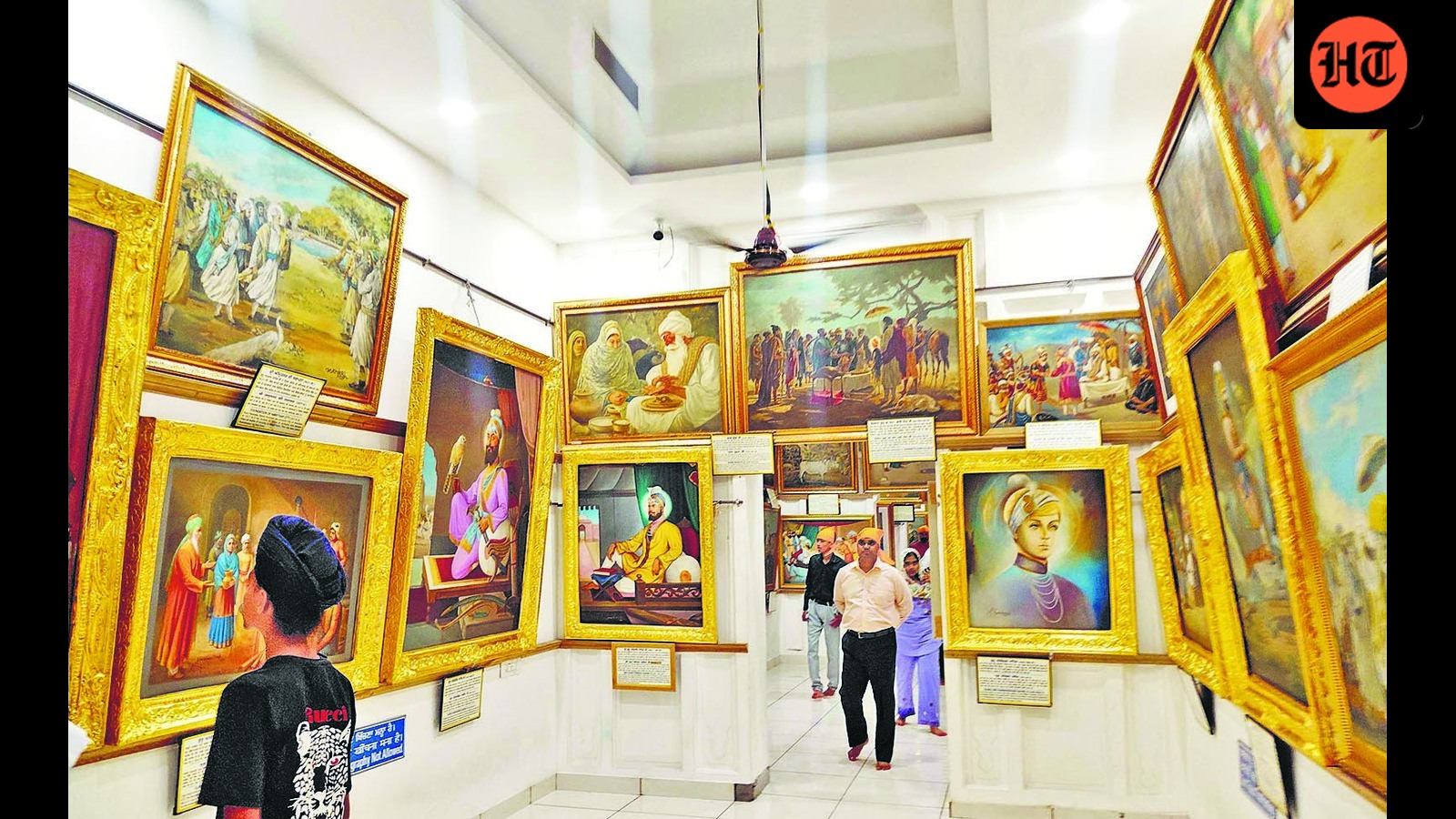
The Central Sikh Museum at the Golden Temple now holds over 900 portraits after adding 145 works in the last decade. SGPC chief Harjinder Singh Dhami recently announced plans to add more figures. Author Sarabjit Singh Ghuman said, "The remembrance becomes everlasting because the display is at the most revered place."
Situated on the first floor near the main Clock Tower entrance (Darshani Deori) along the parikarma (circumambulatory path) of Harmandar Sahib (Golden Temple), the Central Sikh Museum (Kendriya Sikh Ajaibghar) operates far beyond the scope of a traditional exhibition space. Spanning about 6,000 square feet across seven main halls, the Shiromani Gurdwara Parbandhak Committee (SGPC)-managed museum functions as the official archive of Sikh martyrdom, resistance, and community contribution. Inclusion within its galleries represents the highest form of recognition bestowed by the Panth (the Sikh community).
Recent additions -- including portraits of former Supreme Court judge and judicial rights activist justice Kuldip Singh, exiled leader Gajinder Singh, and Khalistan Commando Force co-founder Gurdev Singh Debu -- highlight its evolving scope. SGPC chief Harjinder Singh Dhami also announced plans to install a portrait of slain anti-drug activist Parwinder Singh Jhota during a recent visit to Mansa.
With 145 portraits inducted over the past decade alone, the museum's collection now exceeds 900 works.
Unveiled in formal ceremonies marked by Gurbani 'kirtan' and 'ardas' in the presence of Sikh clergy, an induction permanently elevates personal sacrifice into sacred memory.
"Installation of a portrait of any Sikh figure having a sizeable contribution to the community is recognition of one's struggle and deeds. The remembrance becomes everlasting because the display is at the most revered place in Sikhism," says Sikh author Sarabjit Singh Ghuman.
Chronicle of contrasts
A single hall illustrates this contrast. On one side hang portraits of 20th-century Sikh militants and political assassins, including slain militant preacher Jarnail Singh Bhindranwale and former Prime Minister Indira Gandhi's bodyguards-turned-assassins, Satwant Singh and Beant Singh. On the opposite side hang decorated war heroes -- such as Lt Gen Jagjit Singh Aurora, Lt Gen Harbaksh Singh, and Marshal of the IAF Arjan Singh -- alongside freedom fighters Bhagat Singh and Udham Singh.
This juxtaposition evokes diverse reactions from pilgrims and researchers navigating the space. "Martyrdom differs for different persons," says Chetandeep Singh, a visitor from Ludhiana. "Militants who laid down their lives for the rights of Sikhs may be terrorists in the eyes of the government, but for us, they are martyrs. At the same time, Sikh military officers have done the nation proud," he adds.
Another visitor, Jasneet Kaur, echoed a similar sentiment, remarking simply that "both kinds of Sikhs fought for the good (of the community)."
However, some visitors were perplexed. "I don't understand the logic behind displaying both kinds of personalities together," said Anita Rani, a visitor from Delhi. Janesh Kumar, a tourist from Rajasthan, added: "Displaying portraits of war heroes is a commendable move, but the display of others can only be explained by the management."
Vetting protocol
According to SGPC member Rajinder Singh Mehta, candidate selections begin with written requests from families or community organisations, which are then evaluated during executive meetings. However, the process has drawn criticism that political proximity often accelerates approvals, while long-pending historical figures face delays. A notable example of this delicate balance occurred when a proposal to install a portrait of former Prime Minister Manmohan Singh was deferred following internal community objections.
"Sometimes, proximity to the top brass of the SGPC or leaders of the Shiromani Akali Dal dictates who gets installed," says veteran journalist Jagtar Singh. "Under pressure, low-profile figures who are little-known are accommodated, diluting the museum's historical gravitas."
The SGPC refutes claims of political favouritism. "Decisions on displaying portraits are taken purely on merit. Every application requesting an installation is thoroughly vetted and evaluated at multiple institutional levels," says SGPC chief secretary Kulwant Singh Manan.
Modernisation lag
With over 900 heavy gilt-framed paintings mounted across 6,000 square feet, administrators face spatial constraints. To free up wall space, staff frequently adjust frame density, relocate paintings to secondary corridors, or transfer older works to SGPC archival storage facilities within the complex.
To address overcrowding permanently, the SGPC passed a resolution in 2017 to double the museum's floor space and modernise its layout. While structural and financial complexities have kept the overhaul in limbo for years, the museum manager says the project remains active.
"I assumed charge a few months ago," says museum manager Gurtinderpal Singh Bhatia. "The plan for uplifting the space on modern lines remains intact and will soon be executed."
Box
For the record
Established: July 11, 1958, by the SGPC
Location: Clock Tower entrance (Darshani Deori), Golden Temple Complex
Area: About 6,000 square feet across 7 main gallery halls
Collection size: 900+ portraits (145 added over the past decade alone).
Key exhibits
Rare manuscripts: Signature of Guru Hargobind ji in the form of the Mool Mantra
Relics of Guru Gobind Singh Ji: Wooden comb, Kamar Kassa (waist cloth), and Gatra (sword belt)
Historical weapons: Baba Deep Singh's Dumala Chakkar (turban ring), sword of Bhai Mehtab Singh (used to behead Massa Rangarh), and Maharaja Ranjit Singh's Kamar Kasa sword (Battle of Kasur)
Historical artefacts: Sikh-rule coins, ancient long guns, small portraits, and old instruments of Gurmat Sangeet
Modern history memorabilia: Tear-gas shells used by Punjab Police inside the shrine complex during the 1955 Punjabi Suba Movement
Iconic artworks: Works by artists, including Sobha Singh, Kirpal Singh, Master Gurdit Singh, Thakur Singh, Bodh Raj, Amar Singh, Mehar Singh, Dawinder Singh, Amolak Singh, Bhupinder Singh, Sukhwinder Singh, and Gurvinderpal Singh.