
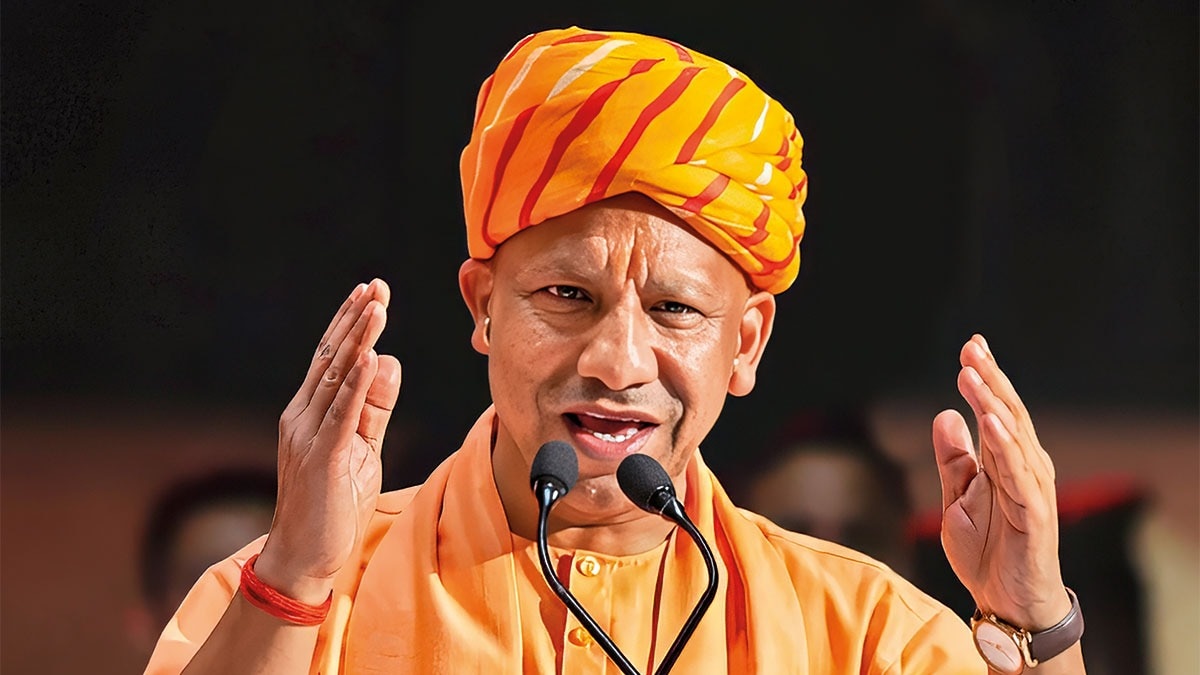
On November 7, over 3 million diyas lit up Ayodhya for Deepotsav, a festival Yogi Adityanath started in 2017. The event served as a curtain-raiser for his bid for a third term in Uttar Pradesh. Yogi said, "Where devotees were once chased with lathis, millions of diyas are lit today."
On November 7, Diwali eve, over 3 million diyas lit up 56 ghats along the Saryu river in Ayodhya for Deepotsav, a festival chief minister Yogi Adityanath started in 2017, his first year in office. Each edition has outdone the last, and the 10th one this time, where vice-president C.P. Radhakrishnan was the chief guest, broke all past records for the number of diyas.
The next morning was Diwali, and Yogi used the occasion to inaugurate his political pitch for the 2027 assembly election. "Where devotees were once chased with lathis into the Saryu, millions of diyas are lit today," he told the seers gathered here at Karsevakpuram, a reminder of the struggle to get the Ram temple built in Ayodhya. The celebrations served as a curtain-raiser for the BJP and Yogi's bid for a third consecutive term in Uttar Pradesh, and the message was unequivocal: the party will not be lowering its Hindutva pitch.It is not just Yogi, Prime Minister Narendra Modi has as much riding on the state.
The MP from Varanasi opened a Rs 150 crore garment unit there in late October with Yogi by his side. Party leaders say he is keeping a close watch on the poll preparations. India's most populous state sends 80 MPs to the Lok Sabha, and the road to a fourth term for the BJP in 2029 also runs through Lucknow.The newly organised state working committee is proof of the party's intentions. It runs to 712 names, beginning with Modi, defence minister Rajnath Singh, party veteran Murli Manohar Joshi and Yogi, and going down to district functionaries from Meerut to Gorakhpur. When the committee met in Lucknow on October 30 to draw up the election blueprint, special invitee Union home minister Amit Shah likened the state government to the mythical "Angad's foot", which no one could move, and offered the cadre a controversial sweetener: "If the BJP forms the government in UP, we'll implement the Uniform Civil Code."Away from the stage, the harder work of revamping the state organisation is under way.
Earlier UP campaigns were largely orchestrated by Shah and BJP election strategist Sunil Bansal. Bansal was elevated to national general secretary in 2022 and, following party president Nitin Nabin's reshuffle this August, assigned charge of West Bengal and Telangana. The UP brief has gone to Vinod Tawde, who is said to work closely with the PM. Party leaders hope his experience in Bihar, where the BJP is in power, will stand him in good stead. On the ground, the task rests with state president Pankaj Chaudhary and his 46-member team, which includes more than 25 OBC (Other Backward Class) leaders.
All six regional presidents have also been replaced. WINNABILITY QUOTIENTTeams led by Tawde have been assessing seats through the Purvanchal and Awadh regions for winnability. Work on about 125 seats (of the total 403 in the assembly) is over, say party sources, adding that legislators who fall short may not get a ticket. One telling signal came on October 6, when the eight BJP nominees for UP's Rajya Sabha byelections filed their papers. Seven retiring members, including a few heavyweights, did not feature in the new list. Replacements included OBC Morcha chief Prakash Pal, western UP regional in-charge Ram Pratap Singh Chauhan and state minister Dharampal Singh.
All 10 candidates -- eight from the BJP, two from the Samajwadi Party (SP) -- were elected unopposed.The changes reflect the emphasis on caste and regional representation, but their implications run far deeper. Retiring the incumbents signals a willingness to take tough calls, and will have state BJP leaders on their toes, especially with speculation rife that a majority of the 255 sitting MLAs may be dropped.The recent Legislative Council election results seem to have come as a rude shock to the party. It won six of the 11 seats that went to the polls, but lost Lucknow Graduates' and both Varanasi seats.
The losses in the PM's Lok Sabha constituency came despite Yogi, Chaudhary and other heavyweights leading the campaign. A review is now under way, and there is talk of dropping sitting MLAs in Varanasi's assembly seats.At the state executive meet, Shah also made a pointed appeal to set aside mutual differences, a tacit admission of the frictions the Council polls had exposed. The meeting set five targets: active booth committees, closer contact with workers, regular mandal and district reviews, voter outreach to youth, women and first-timers, and cadre training. Booth management, in fact, will remain a priority: UP has 162,459 polling booths grouped into 27,633 shakti kendras and 1,918 mandals.
The RSS, too, has increased its involvement after a 'muted role' in 2024. The Sangh has publicly backed Yogi this time.Yogi was an unexpected choice for the top post in 2017, but he has spent nearly a decade cultivating the image of the tough 'bulldozer' administrator while also reinforcing his right-wing Hindutva politics. Yet, his equation with sections of the party organisation has not always been smooth. The coming election will be a test not just of his political authority but also the BJP's ability to restore its social coalition in India's most politically consequential state. Victory would make Yogi the first CM to score a triple win in the Modi era and also elevate him nationally in the BJP hierarchy.
DECISIVE CONTESTFour states go to the polls alongside UP -- Punjab, Goa, Manipur and Uttarakhand -- but it's clear which contest is decisive. For the BJP, the challenges are not only external. Party leaders acknowledge discontent on a few fronts, including sections of its core vote. Brahmins, who constitute roughly a tenth of UP's electorate, have 52 MLAs and hold influence across many more seats, are concerned about their representation. In December last year, BJP Brahmin legislators met in Lucknow to discuss what they described as bias against their community.Critics have also revived allegations -- which the government rejects -- of favouritism towards Thakurs, the community Yogi belongs to.
Relations between elected representatives and the bureaucracy are also a source of friction. Anti-incumbency is another big elephant in the room. Fears that they may not be nominated have got many leaders jittery. The shake-up has already commenced: in mid-October, two-time BJP MP from Aonla, Dharmendra Kashyap, who was passed over for an RS berth, signed off with a 'Tata bye-bye' post on social media. A day later, he was with Opposition leader Akhilesh Yadav in Lucknow, joining the SP.The BJP also has lessons to learn from the 2024 setback, when it won just 33 (allies won another three) of UP's 80 LS seats, down from 62 in 2019.
The Opposition SP-Congress alliance also cracked the party's carefully stitched coalition of non-Yadav OBCs and non-Jatav Dalits. A CSDS-Lokniti post-election survey then had recorded a big drop in OBC support for the NDA compared to the 2019 Lok Sabha election (19 points among Kurmi-Koeri voters and 13 points for other non-Yadav OBCs). The slide was 19 points among the non-Jatav Dalits. OPPOSITION ARITHMETICOpposition unity will continue to weigh heavy on both camps this election as well. An analysis of constituency-level results from the past four elections shows why. The SP's electoral strategy has evolved through alliances with the Congress in 2017, the Bahujan Samaj Party (BSP) in 2019 (Lok Sabha), smaller caste-based parties in 2022 (assembly), and back with the Congress in 2024 (LS).What both the BJP and SP camps realise is that despite hitting a nadir, Mayawati's BSP can still play spoiler.
The party's vote share in 2022 exceeded the BJP's winning margin in 137 of 273 seats. Across these constituencies, the BSP averaged 14.4 per cent of the vote, against an average BJP winning margin of six percentage points. The saffron party's tally clearly depended on a divided opposition. The BSP has no MLAs in the assembly right now, but Mayawati is defiant. On October 9, party founder Kanshi Ram's death anniversary, she rallied the cadre in Lucknow with nephew and political heir, Akash Anand, briefly suspended from the party, back by her side.For the SP, alliance arithmetic has proved complicated, with even formal tie-ups not guaranteeing vote transfer from allies.
What has altered the equation is the party's repositioning around the PDA or Pichhda (Backward Classes), Dalit and Alpsankhyak (minorities). Between the 2017 and 2022 assembly polls, the BSP's vote share fell by 9.5 percentage points per seat. For each point lost, the SP-led alliance gained 0.6 points, and the BJP-led alliance 0.3. Between the 2014 and 2024 Lok Sabha elections, the BSP fell 10.3 points per seat, and the SP-Congress combine rose by 13.4 points, while the NDA's share was broadly unchanged. The next election, then, could turn on smaller shifts. Akhilesh knows this, and has lured in ex-BSP satraps -- Naseemuddin Siddiqui, Babu Singh Kushwaha and others.
BSP co-founder R.K. Chaudhary is now a Samajwadi MP from Mohanlalganj. These moves help the party take in sections of the BSP's social base faster, even as the latter weakens.A seat-level exercise illustrates the stakes. Analysis of the 2022 assembly poll results shows that a 10 per cent shift of the BSP vote to the SP alliance has only a marginal effect on the NDA tally. But a 50 per cent transfer could cut it to 190, below the majority mark of 202 in the 403-member assembly. These are hypothetical calculations, but they show why the BSP's catchment zone matters to both camps. Meanwhile, a new complication arrived for the SP on November 12.
All India Majlis-e-Ittehadul Muslimeen (AIMIM) chief Asaduddin Owaisi and Nagina MP Chandrashekhar Azad of the Azad Samaj Party have launched a third front, which could splinter the Muslim-Dalit votes further. RALLYING FORCE: CM Yogi with UP in-charge Vinod Tawde and others at a BJP 'Save Democracy' rally, Ghaziabad, November 5.THE FINAL TESTSince mid-May, the Yogi government's pre-poll bonanza has targeted an announcement of at least one schemepayout per week. The latest came on November 11 when Yogi handed out appointment letters to 1,146 selected junior assistants in the revenue department and released Rs 215 crore in financial assistance to 4,300 beneficiary farming families in the state insurance scheme for dead or disabled farmers.
Earlier, anganwadi workers' honorarium was raised, some 2.5 million students got free tablet computers and 'Mission Rojgar' promised 100,000 government jobs in the next six months.The biggest sop has yet to come. The Yogi regime is said to be weighing a Ladli Behna-style cash transfer for women: Rs 50,000 each, with Rs 20,000 before the vote and the rest in three instalments if the BJP returns to power. Meanwhile, sugarcane crushing season is almost here and everyone wants a hike on last year's Rs 400 and Rs 390 a quintal. Numbers being bandied about include Rs 10-20 (state) to Rs 550 (farm unions).
Western UP will be closely watching the outcome.For now, nothing seems settled. Issues like the theft of donations at the Ram temple, the NEET paper leak and 'vote chori' have given the Opposition ammunition. The test for the BJP is whether organisational repair, the Sangh's backing and its record in office can offset all this and a decade of incumbency. For the Opposition SP alliance, what matters is whether the coalition that prevailed in 2024 can hold in an assembly contest. The answer will decide who governs Lucknow and, for Modi, the ground on which he seeks a fourth term in 2029.- Ends