
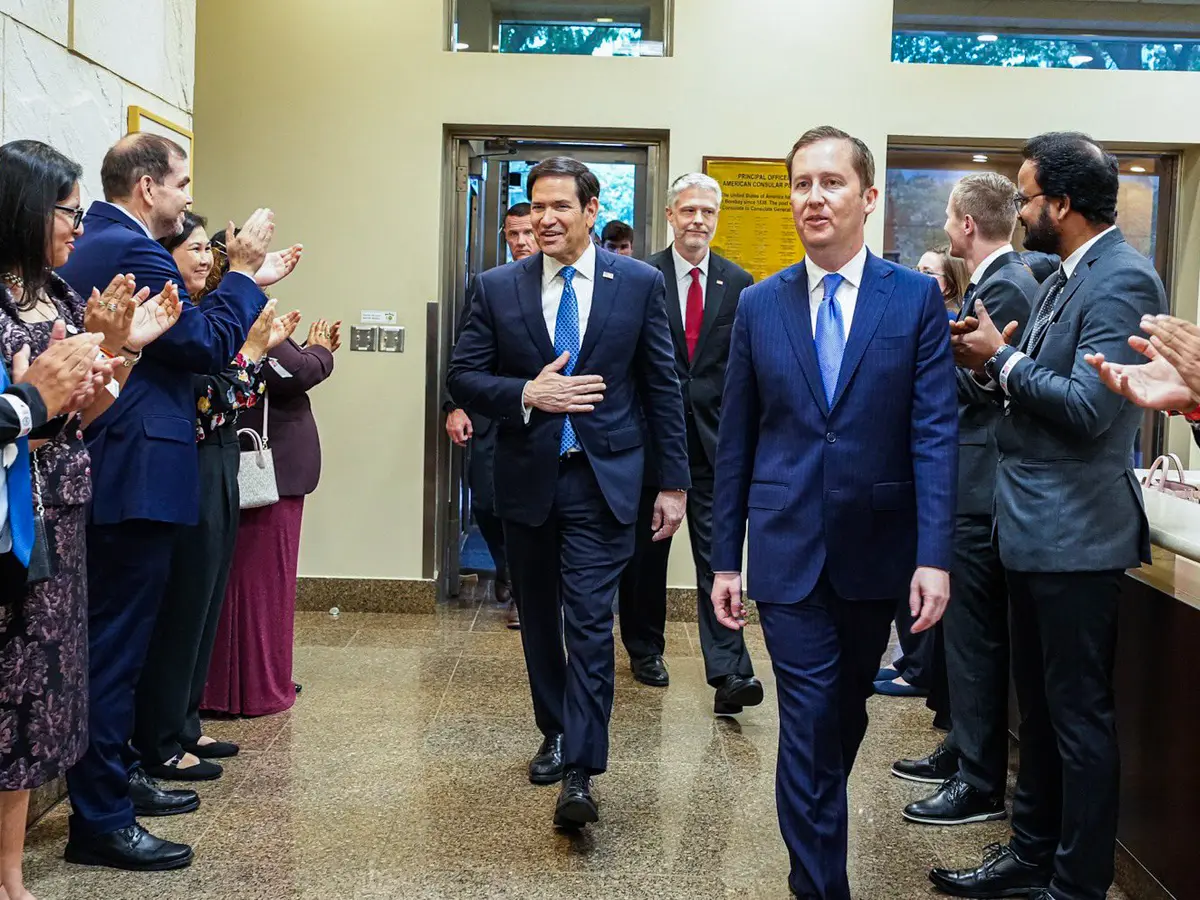
US Secretary of State Marco Rubio called "UN experts" an "oxymoron" on Wednesday (Oct 21). He said, "I am not going to get involved in their politics." Rubio refused to comment on India's protests, noting that domestic political matters are for the people of the country to decide and navigate.
US Secretary of State Marco Rubio took a swipe at UN experts after being asked about allegations of a crackdown on protests in India. But his response went beyond a pointed remark, as he made clear where Washington stands on India's domestic political affairs.
US Secretary of State Marco Rubio on Wednesday (Oct 21) described the term "UN experts" as an "oxymoron" when asked about the United Nations' criticism of India's handling of protests. Respecting India's sovereignty, the Trump envoy also declined to weigh in on the issue and said that domestic political matters must be decided by the people of the country concerned.
Responding to a reporter's question about protests by opposition parties and students in India and the UN experts' allegations of a crackdown, Rubio said he would not get involved in India's internal political affairs. "Well, the UN experts, yeah. My favourite. The UN experts, or is that an oxymoron?" Rubio remarked.
Washington's position on India protests
Clarifying Washington's position, he said, "No, it's a domestic political matter. I mean, I am not going to get involved in their politics. This is a democracy. They have elections here. So I am not going to align on their domestic political matters."
Rubio said demonstrations and the expression of differing political opinions were part of democratic discourse, distinguishing peaceful protests from riots involving vandalism, arson and destruction of property. He said the ability of people to express themselves and engage in political debate was an important feature of democratic societies. Citing Cuba as a contrast, Rubio pointed to restrictions faced by opposition voices there, including the risk of imprisonment, oppression or exile.
"But we're not going to comment on internal political matters. That's for the Indian people to decide and navigate," he said.
India criticism of UN
Earlier, India exposed the double standards of the United Nations and its frontal organisations after contrasting stands taken by the representatives to paint protests in India as an issue of alleged human rights abuse. At the United Nations, India stressed that human rights should not be used as an instrument of political pressure or selective targeting of countries.
Indian diplomat Barkha Tamrakar, who addressed the Assembly on Tuesday (Oct 20), said that India's constitutional safeguards, including Article 21 of the Constitution, protect human rights and ensure due process, as United Nations experts raised concerns over alleged excessive use of force against protesters and restrictions on peaceful demonstrations.
"India firmly opposes any attempt to convert unverified allegations, incomplete statistics, or a report that contains no India country observation into a negative characterisation of the world's largest democracy... Human rights should not be used as an instrument of political pressure or selective country targeting," Tamrakar said, emphasising the need for impartial and evidence-based engagement on human rights issues.
The strong rebuttal came after UN experts had claimed that authorities in India were restricting peaceful assembly and indulging in "enforced disappearances". Contrastingly, a much milder stand was expressed by UN Human Rights Chief Volker Türk when it came to speaking of the police crackdown on violent protests in France and other parts of Europe, with Türk even going to the extent of calling protestors "vandals".
Before that, India on Thursday hit out at the UN for relying on anonymous submissions to make claims about the alleged ill treatment of young people in the country. Addressing the 81st Session of the UNGA Third Committee, Anuj Swarup, First Secretary of India's delegation challenged a UN report on youth activism, which accused India of youth repression, and said that it was "heresy dressed up as a UN report". Calling the approach of Gina Romero, the Special Rapporteur on the rights to freedom of peaceful assembly and of association, unverified and damaging to the credibility of the UN's human rights institutions, he said this was "precisely the reason the UN has lost credibility".