
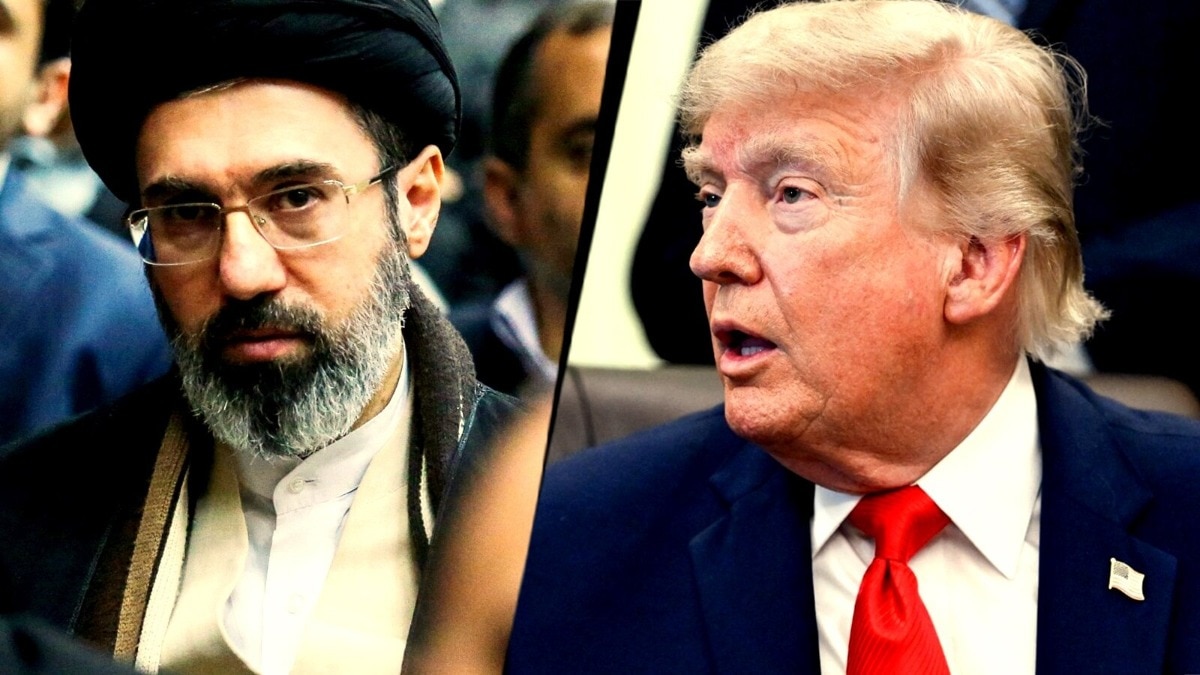
Iran’s Supreme Leader Mojtaba Khamenei warned that US policy will not change after Democrats swept Congress in the November 3 midterm elections. He said those expecting a shift are "seriously mistaken." Despite Trump’s electoral setback, Tehran remains firm and threatened to widen the conflict if Washington resumes any military attacks.
Donald Trump's electoral setback has done little to soften Tehran's position towards Washington. Iran's Supreme Leader, Mojtaba Khamenei, has warned that anyone expecting the Republican defeat to trigger a shift in US policy towards the Islamic Republic is "seriously mistaken".
US President Donald Trump has suffered a big setback after Democrats delivered a stunning rebuke to his second-term presidency by sweeping powers in both chambers of Congress in the November 3 midterm elections. The results saw Republicans lose ground in traditionally conservative strongholds, with several Trump-backed candidates also failing to secure victories. The Democratic gains are set to make Trump's remaining two years in office considerably more difficult.
But the electoral setback has done little to soften Tehran's position towards Washington. Iran's Supreme Leader, Mojtaba Khamenei, has warned that anyone expecting the Republican defeat to trigger a shift in US policy towards the Islamic Republic is "seriously mistaken". He also threatened to widen the Middle East conflict if Washington resumes military attacks on Iran.
"Those who still harbour even the slightest hope that the behaviour of the hegemonic system might change through partisan or factional shifts, or who imagine that making concessions to the United States can dissuade it from hostility towards the Iranian nation, are seriously mistaken," he said in a written statement published on his website.
DEMOCRATS DELIVER HISTORIC BLOW TO TRUMP
The victory of Democrats is particularly damaging for Trump because Republicans lost ground in states that had long been considered safe territory for the party. The results went far beyond a routine midterm setback, exposing the extent of voter dissatisfaction with Trump's second-term presidency.
Democrats captured Senate seats in Kansas, Texas and South Carolina, among other states, while also taking control of the House of Representatives. In Kansas, Democrat Adam Hamilton defeated Trump-backed Republican Roger Marshall, securing the party's first Senate victory in the state in 94 years. South Carolina also witnessed a major political upset, with Democrat Annie Andrews defeating Republican Darline Graham for a seat the Republicans had held since 1964.
The losses also raised questions about Trump's influence within his own party. Several candidates who enjoyed his endorsement or closely aligned themselves with his style failed to win their races. Among them was Texas Attorney General Ken Paxton, who lost his Senate bid, while Republican candidates also suffered setbacks in other key contests.
Trump had made the elections a litmus test of his influence, urging supporters to vote as though he himself were on the ballot.
The Democrats' gains were fuelled by voter frustration over the cost of living, economic pressures and the administration's handling of the war with Iran. The conflict has also contributed to higher energy costs, adding to the economic concerns facing American households.
The midterms are particularly important because Americans do not elect a president in these contests. Instead, they choose all 435 members of the House of Representatives and a portion of the Senate. These elections determine which party controls Congress for the remaining two years of the presidential term.
With Democrats now controlling both chambers, Trump faces a significantly more difficult political environment. Congress has the power to block legislation, scrutinise government spending, investigate the administration and challenge presidential appointments. While the president retains considerable authority over foreign policy and military operations, a hostile Congress can make governing considerably harder.
Meanwhile, Trump has said he is prepared to accept the outcome and work with Democrats. Speaking to The New York Times as the results came in, he said: "I am absolutely willing to accept those results."
He added: "We'll work with the Democrats, and we'll, you know, look forward to working with them. We'll probably work something out." However, he also blamed his absence from the ballot for the Republican losses, arguing that the outcome would have been different had he personally contested the election.
IRAN'S THREAT AGAINST TRUMP ADDS TO TENSIONS
Even as Trump grappled with the political fallout, Tehran was using the election day to intensify its anti-American messaging.
A massive billboard towering over Tehran's busy Enghelab Square carried an explicit threat against Trump: "We will kill Trump."
The display depicted the US president behind bars, with his head bowed. Another nearby installation showed Trump alongside US Vice-President JD Vance, special envoy Steve Witkoff and Israeli Prime Minister Benjamin Netanyahu. All four were portrayed with bloodied faces and torn suits, against a backdrop of battered American and Israeli flags.
The displays were accompanied by crowds waving red flags and carrying banners reading, "There will be blood". The messaging was a public expression of revenge following the February 28 US-Israeli strikes that killed Iran's former Supreme Leader Ayatollah Ali Khamenei and triggered the regional war.
The latest billboard is not an isolated incident. Tehran has repeatedly used public displays to mock Trump and threaten retaliation since the conflict began. However, the latest installation takes the rhetoric further by explicitly threatening the US president's life.
THE DANGEROUS CALM BEFORE ANOTHER STORM
The exchange of threats comes amid growing concerns that the military confrontation between Iran, the US and Israel could enter another dangerous phase.
Reports have suggested that Washington and its regional allies have been preparing for the possibility of fresh military action against Iran following the November 3 midterm elections. The possibility of renewed strikes has added to concerns that the conflict, which began on February 28, could intensify despite diplomatic efforts to prevent another round of fighting.
On the other hand, Iran has been strengthening its military preparedness, particularly around strategically important nuclear facilities, amid fears that they could again become targets.