
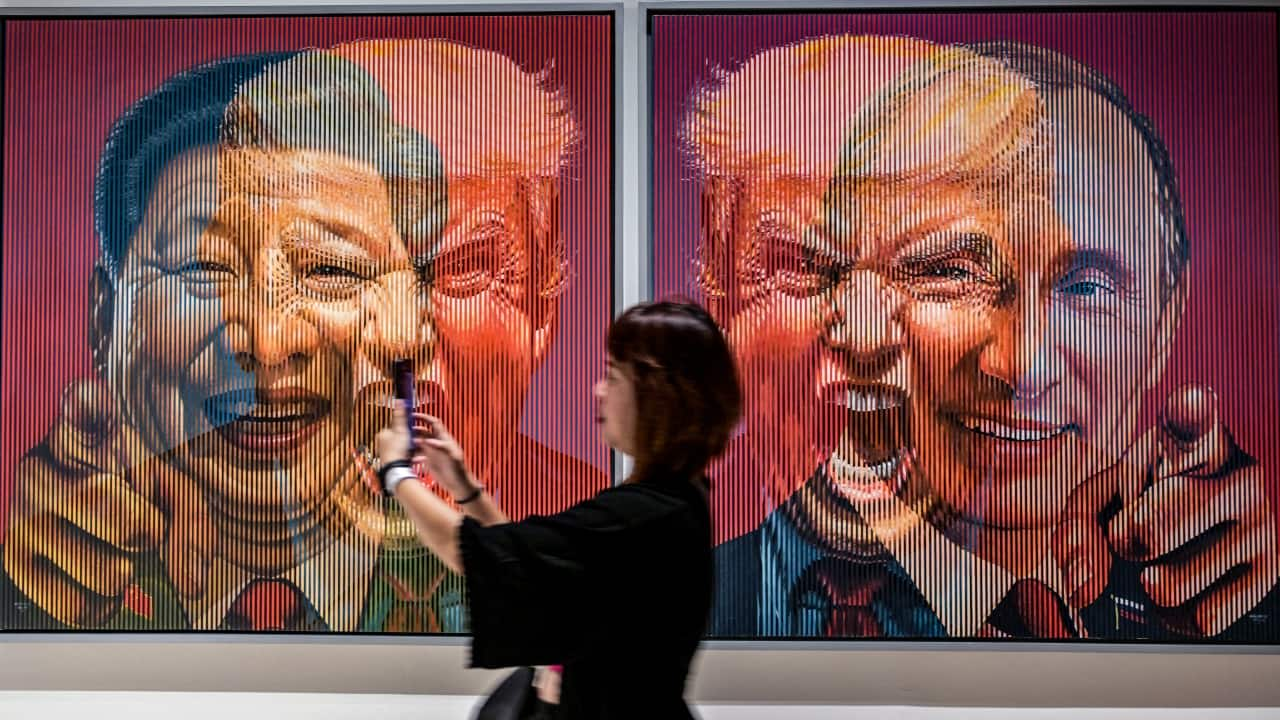
Donald Trump, Xi Jinping and Vladimir Putin will meet in Shenzhen on November 19 to discuss nuclear arms. The United States and Russia currently have no binding limits on their arsenals after the New START treaty expired. Officials said an agreement is not expected as Beijing remains cautious about negotiations.
The world's three largest nuclear powers are preparing to sit across the same table, but for the first time in over five decades, the United States and Russia have no legally binding limits on their deployed strategic nuclear arsenals. US President Donald Trump, Chinese President Xi Jinping and Russian President Vladimir Putin will meet in Shenzhen on November 19, with Washington pushing for nuclear arms reductions following the expiry of New START, the last US-Russia nuclear arms-control treaty. The White House has confirmed that Trump intends to raise the issue, although officials have cautioned that an agreement is not expected.
Beijing has confirmed the meeting but has not committed to nuclear negotiations. The disagreement centres on a question: Can countries with vastly different nuclear arsenals agree to the same arms-control framework? What happened to the last nuclear arms treaty? Signed in 2010, New START placed legally binding restrictions on American and Russian strategic nuclear forces. Under the agreement, each country was limited to 1,550 deployed strategic nuclear warheads and 700 deployed missiles and nuclear-capable heavy bombers. The treaty also established inspections, data exchanges and notifications to help both governments monitor each other's strategic forces.
According to the US State Department, the agreement facilitated 328 on-site inspections and more than 25,000 notifications by February 2023. Russia suspended its participation in the treaty in February 2023 amid tensions over the Ukraine war. Inspections and information exchanges were disrupted, although Moscow said it would continue observing the central limits. The agreement expired on February 5, 2026, after its maximum extension period ended. United Nations Secretary-General António Guterres warned that the expiry marked the first time in more than half a century that Washington and Moscow faced no binding limits on their strategic nuclear arsenals.
He urged both governments to negotiate a successor framework with verifiable restrictions. What happens without New START? The treaty's expiration does not automatically mean that either country will deploy more nuclear weapons. But it removes enforceable numerical limits and the treaty-based verification arrangements designed to monitor compliance. According to the Congressional Research Service, New START had already lost important verification mechanisms following Russia's suspension. Without a replacement agreement, Washington and Moscow have no bilateral treaty requiring them to restrict deployed strategic warheads to New START levels.
SIPRI warned in June that weakening arms-control arrangements, nuclear modernisation programmes and geopolitical tensions were contributing to growing nuclear risks. However, the wider Nuclear Non-Proliferation Treaty remains in force. What has disappeared is the specific US-Russia framework for limiting strategic nuclear weapons. Why is China refusing to join a new nuclear deal? The numbers explain the disagreement. According to the Federation of American Scientists' 2026 estimates, Russia has approximately 4,400 nuclear warheads in its military stockpile, compared with 3,700 for the United States and 620 for China.
These estimates include deployed and reserve military warheads, rather than only the deployed strategic weapons restricted under New START. China argues that Washington and Moscow, which possess substantially larger arsenals, should take primary responsibility for reductions. On October 16, Chinese Foreign Ministry spokesperson Mao Ning said it was "neither fair, reasonable nor realistic" to expect Beijing to join trilateral nuclear disarmament negotiations at the present stage. Washington, however, wants future agreements to account for China's expanding nuclear capabilities. SIPRI estimates that China's arsenal grew from approximately 600 to 620 warheads during 2025, as Beijing continued modernising its nuclear forces.
That leaves the countries divided over which arsenals should be restricted, what limits should apply and how compliance would be verified. Why does this matter to India? India is not participating in the Shenzhen meeting and was never a party to New START. Nevertheless, China's expanding nuclear capabilities form part of India's regional security environment. The Federation of American Scientists estimates India's nuclear stockpile at 190 warheads in 2026, compared with Pakistan's 170 and China's 620. India's declared nuclear doctrine is based on credible minimum deterrence and a no-first-use posture.
New Delhi has also advocated universal, non-discriminatory and verifiable nuclear disarmament. Any future US-Russia-China agreement would not automatically bind India, but restrictions affecting China's arsenal would be relevant to regional nuclear security. Can Trump, Xi and Putin reach an agreement? For now, there is no announced framework for three-way nuclear arms negotiations. China's Foreign Ministry said on November 16 that the leaders would discuss global peace and strategic stability but did not confirm nuclear reductions as an agreed agenda item. The White House has described the meeting as a possible starting point for future talks, rather than one expected to produce an immediate agreement.