
The Uttarakhand Assembly will meet for a two-day session in Gairsain starting October 27. However, the government scheduled a meeting for October 24 in Dehradun. Congress MLA Pritam Singh said, "This decision suggests that holding the assembly session in Gairsain has been reduced to a mere formality." The debate continues.
Thank you for your feedback.
Your feedback has been reported succesfully.
The Uttarakhand Assembly is set to convene for a two-day session from October 27 in Gairsain, the state's summer capital, ahead of which the state government has scheduled a legislative agenda meeting for October 24 -- in Dehradun, the winter capital.
The location of the business advisory committee (BAC) meeting was criticised by the Opposition Congress, which said that it should have been held in Gairsain itself.
Chakrata's Congress MLA, Pritam Singh, who is a member of the BAC, said: "This decision suggests that holding the assembly session in Gairsain has been reduced to a mere formality, and that the state government lacks any genuine commitment to developing Gairsain as a summer capital," he said.
The dispute has revived a longstanding political debate in Uttarakhand over where the Himalayan state's seat of legislative and administrative power should lie -- Dehradun in the plains, or Gairsain in the hills.
Uttarakhand's two Assembly complexes
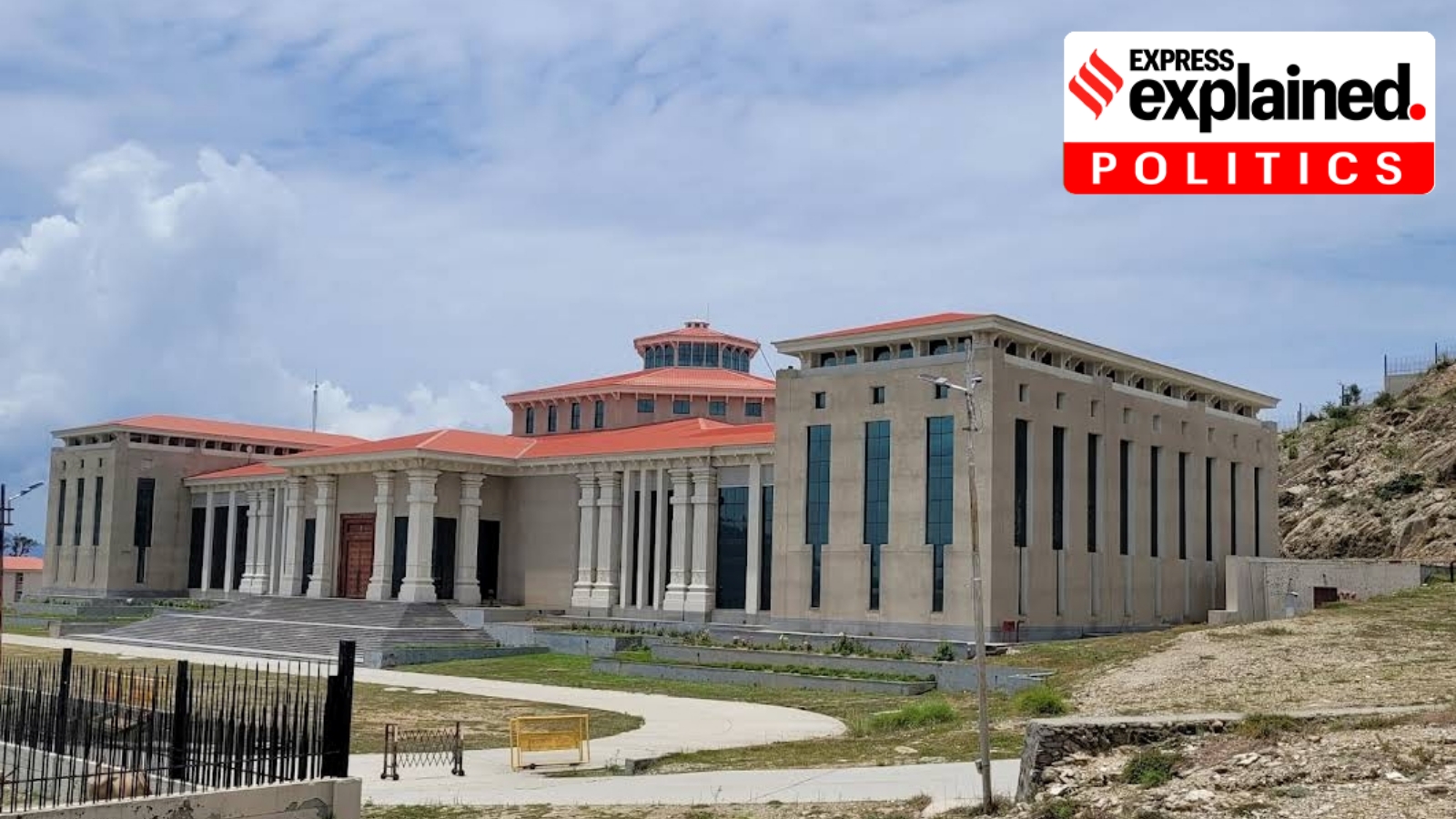
The main Uttarakhand Assembly complex is located in Dehradun. A second Assembly complex at Bhararisain, near Gairsain town, was built following a movement for a capital in the mountains, a demand that predates Uttarakhand's formation in 2000. Dehradun, located in the plains, was designated the temporary capital when the new state was carved out of Uttar Pradesh.
Successive governments have since held occasional Assembly sessions in Gairsain, but Dehradun has continued to house the principal administrative machinery.
Gairsain, a tehsil in Chamoli district, lies in the foothills of the Dudhatoli mountain range, near the geographical divide between the Garhwal and Kumaon regions. According to the 2011 Census, Gairsain tehsil had a population of 61,996.
A demand rooted in the statehood movement
The demand to establish the capital of a separate hill state at Gairsain emerged decades before Uttarakhand was formed.
Freedom fighter Veer Chandra Singh Garhwali, remembered for his role in the 1930 Peshawar incident in which soldiers of the Garhwal Rifles refused to fire on unarmed protesters, advocated a capital in the hills in the 1960s. The idea was subsequently taken up by regional political organisations campaigning for a separate Uttarakhand.
In 1992, Kashi Singh Aery, then an MLA from Didihat and a leader of the Uttarakhand Kranti Dal (UKD), formally advanced the demand for Gairsain to become the capital of the proposed state.
The demand gained more political weight in 1994, when the Ramashanker Kaushik committee, constituted by the Uttar Pradesh government to examine the creation of a separate hill state, recommended Gairsain as the most suitable location for its capital, because of its location between the Garhwal and Kumaon regions.
The recommendation reflected one of the central arguments behind the statehood movement -- a government based in the hills would be more accessible to the people living there and better placed to address their concerns.
The movement for a separate state was also driven by demands for political representation, employment and development. At the time, the Uttarakhand region had 22 seats in the Uttar Pradesh Assembly, despite having a population comparable to Himachal Pradesh, which had a substantially larger legislature.
The statehood campaigners argued that decisions taken from the plains often failed to account for the geography and needs of the mountainous region, where access to healthcare, education, roads and government services remained difficult.
The Uttarakhand Mahila Manch, which played a significant role in the statehood movement, was among the organisations that demanded Gairsain as the capital.
Why Dehradun became the capital
When Uttarakhand was formed on November 9, 2000, Dehradun was designated the temporary capital, rather than Gairsain.
The absence of adequate infrastructure, along with limited rail and air connectivity, was among the reasons cited for choosing Dehradun. The city already had an established administrative infrastructure and was considerably better connected to the national capital and other parts of the country.
The decision, however, left unresolved the question of a permanent capital.
In 2001, the state government constituted a commission headed by retired judge Virender Dixit to examine possible locations for a permanent capital. The commission submitted its report in 2009, recommending Dehradun as the more suitable location, citing factors including its distance from the national capital, concentration of population and relative safety from natural calamities.
The Congress and the BJP have both faced criticism over their handling of the issue. While both parties have periodically endorsed the sentiments associated with Gairsain, neither has shifted the principal administrative machinery out of Dehradun.
The question of a permanent capital has consequently remained a recurring political issue, particularly during Assembly elections.
2014: New Assembly complex comes up Bhararisain
The Bhararisain Assembly complex emerged from efforts to give the Gairsain demand a physical and institutional presence.
In November 2012, then Chief Minister Vijay Bahuguna, who was with the Congress, held a Cabinet meeting in Gairsain at the local block office. The meeting revived discussion about shifting the capital to the town and was accompanied by an announcement that Gairsain would host at least one Assembly session each year.
Bahuguna laid the foundation stone of a permanent Vidhan Sabha building at Bhararisain in January 2013.
The Congress government under Chief Minister Harish Rawat began holding Assembly sessions at Gairsain in 2014. Before the permanent complex was ready, proceedings were conducted in a specially constructed tent that served as the Vidhan Sabha Mandap.
In June 2014, the temporary Assembly was arranged as a 100-foot-by-80-foot tent, equipped with microphones, a sound system, lighting, galleries for visitors and the press, and designated chambers for senior constitutional and government functionaries.
The permanent complex at Bhararisain was developed across 47 acres at an altitude of approximately 2,380 metres above sea level. Construction began in 2014, with the wider project initially reported to cost around Rs 110 crore. By January 2017, the Assembly building and other facilities were still awaiting completion of parts of the planned infrastructure and the release of additional funds.
2020: Gairsain declared the summer capital
The BJP government under Chief Minister Trivendra Singh Rawat took a significant step towards recognising Gairsain's political importance in March 2020.
On March 4, after presenting his Budget during an Assembly session at Gairsain, Rawat announced that the town would be declared Uttarakhand's summer capital. He dedicated the decision to those who had sacrificed their lives during the statehood movement.
The announcement partially fulfilled a demand that had remained unresolved for more than two decades. The Governor, Baby Rani Maurya, gave her assent in June 2020, and the government issued a formal notification declaring Bhararisain, or Gairsain, the summer capital.
The declaration was a political milestone, but it did not make Gairsain the state's sole capital. Dehradun continued to house the Chief Minister's residence, Raj Bhavan, the principal Secretariat and other key administrative establishments.
The BJP had promised in its 2017 Assembly election vision document to provide Gairsain with top-class infrastructure and consider declaring it the summer capital. The 2020 decision allowed the party to claim that it had acted on a longstanding demand of the hill region.
The Congress, however, pointed out that the initial steps towards developing the Assembly complex and holding sessions there had been taken under Congress-led governments.
2021: Plan for a new administrative division
In March 2021, Rawat announced that Gairsain would become the state's third administrative division, alongside Garhwal and Kumaon.
The government also outlined plans for roads and other infrastructure. In March 2021, Rawat said Rs 350 crore had been sanctioned for development in Gairsain and referred to road projects and a proposed helipad. In November 2020, he had announced a 10-year infrastructure development plan worth Rs 25,000 crore for the summer capital.
In April 2021, the succeeding government under Chief Minister Tirath Singh Rawat put the decision to create the Gairsain division on hold, bringing the uncertainty surrounding the administrative expansion into focus once again.