
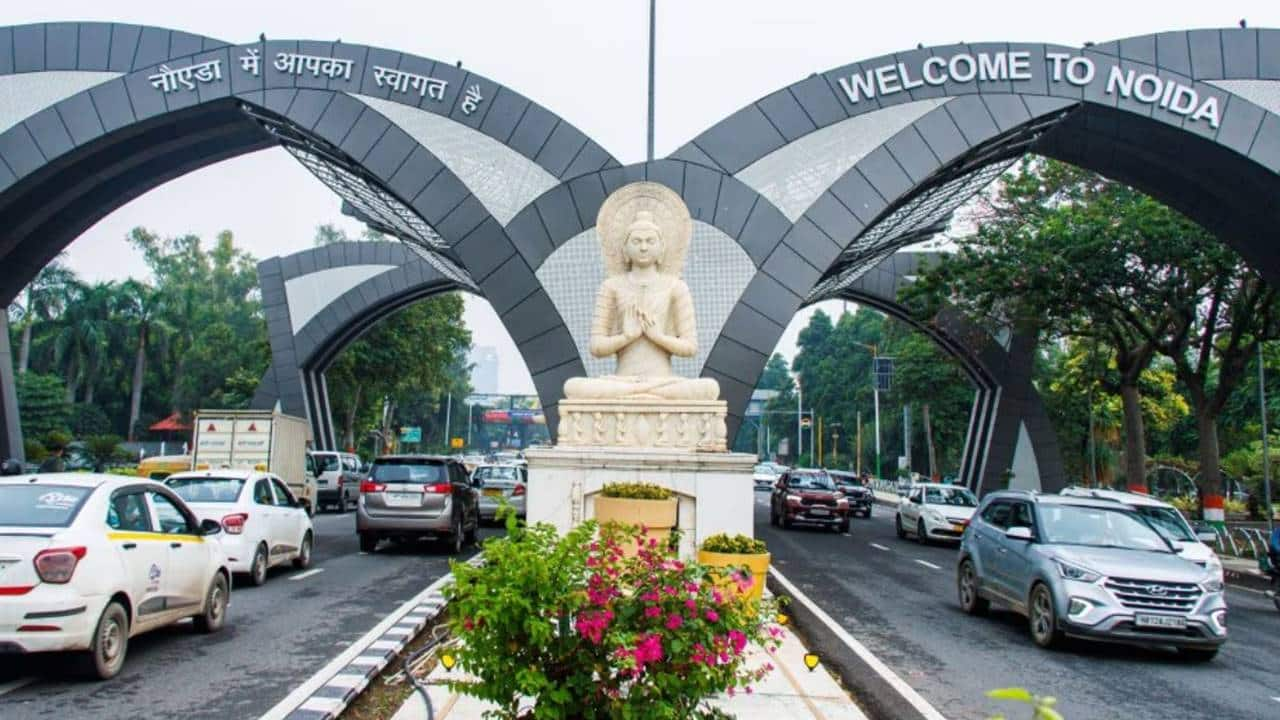
Gautam Buddha Nagar serves as the primary economic engine for Uttar Pradesh, contributing nearly 10 per cent of the state's domestic product. Chief Minister Yogi Adityanath defied the long-standing Noida jinx by visiting the district many times since March 2017. He said, "administrative and development priorities would guide his visits."
Assembly polls are due in about three months in Uttar Pradesh, India's most populous, and arguably the country's most politically significant state. The map of the 75 districts across which 403 Assembly constituencies are spread makes for an interesting visual. It broadly resembles a bull ready to charge. Lalitpur in the south-central region and Sonbhadra in the southeast jut into neighbouring states like hooves braced for a leap. But the real financial muscle lies in Gautam Buddha Nagar. This district on Uttar Pradesh's western edge flanking Delhi stands out as the most formidable engine in powering Uttar Pradesh's economic ambitions.
Chief minister Yogi Adityanath has defied the three-decade-old "Noida jinx" -- the belief that a serving Uttar Pradesh chief minister who visits the district will lose power. Since taking office in March 2017, he has made dozens of visits for inspections, launches and rallies. The district has three Assembly constituencies: Noida, Dadri and Jewar. Jewar is home to the new international airport, with a "Singapore City" development also taking shape. The superstition dates to June 1988, when then Chief Minister Veer Bahadur Singh of the Indian National Congress (INC) was asked to step down by the central leadership shortly after visiting Noida.
His successors, including Kalyan Singh, Rajnath Singh, Mayawati, Mulayam Singh Yadav and Akhilesh Yadav, largely avoided visiting Noida. Yogi Adityanath first visited Noida in December 2017, ahead of Narendra Modi's inauguration of the Magenta Line metro. He dismissed the jinx, insisting that administrative and development priorities would guide his visits. He was last in Noida on November 5, 2026 to inaugurate a 6-lane underpass. By showing up, he walked the talk, and, in effect, became Noida's brand ambassador. His presence was a sales pitch in itself: the district was not a political liability to avoid, but an economic engine to champion.
Economic Engine The macro data appear to reflect what the urban landscape suggests: a concentration of wealth and business activity. Gleaming corporate towers signal commercial strength, while busy cafés, malls and shopping arcades point to robust retail activity and household spending. Sample this. While many districts in eastern and central UP generate GDDP figures in modest billions, Gautam Buddha Nagar alone accounts for nearly 10 per cent of the entire state's domestic product. It operates on a scale that rivals entire smaller state economies in India. Gautam Buddha Nagar's GDDP at current prices during 2024-25 (the latest for which data is available) stood at Rs 3,34,270.47 crore nearly double that of Lucknow's (the state's capital city district) at Rs 1,68,022.55 crore.
Shravasti, located in the state's north-eastern region, stood at the bottom of the table recording a GDDP of Rs 10,150.52 crore. Gautam Buddha Nagar rivals the economies of entire smaller Indian states and the district alone accounts for nearly 10 per cent of the state's domestic product, which stood at Rs 30,24,620.98 crore at current prices during 2024-25. The divergence becomes even starker when examining income levels, underscoring the Noida-Greater Noida belt's significance as one of the strongest edifices of UP's economy. Gautam Buddha Nagar's per capita net domestic product at current prices during 2024-25 stood at Rs 12,82,251, which is more than 11 times higher than the state's per capita GDP of Rs 1,09,844 during the year.
During the same year, India's national per capita GDP stood at 2,05,324. Gautam Buddha Nagar's per capita GDP was 6.2 times more than the national average. While per capita incomes across much of the agrarian hinterland hover around Rs 60,000 to Rs 90,000, Gautam Buddha Nagar stands in a tier of its own, standing shoulder-to-shoulder with India's premier wealth-generation zones and industrial hubs such as Gurugram and Bengaluru Urban. Manufacturing, Real Estate and Consumption spending Gautam Buddha Nagar's Gross Value Added (GVA) breakdown is overwhelmingly driven by real estate and professional services, and manufacturing, with both segments together accounting for nearly 70 per cent of the district's GDP.
Manufacturing accounted for 33.68 per cent of the district's total GVA during 2024-25, powered by giant facilities for Samsung, Dixon, and a sprawling ecosystem of component suppliers. Real estate, ownership of dwellings, and professional services, which include IT/ITeS and now increasingly global capability centres (GCCs) accounted for 35.15 per cent of Gautam Buddha Nagar's GVA during 2024-25. The ripple effects of this economic activity may be visible beyond factory floors and office towers: in rising property costs and the bustle of cafés, malls and shopping arcades across Noida and Greater Noida.
Together, these signs suggest that the district's industrial and services activity is spilling into its property market, everyday consumer spending, and importantly for the state government, on revenues. Gautam Buddha Nagar's high consumption and commercial activity suggest it could lead Uttar Pradesh in GST collections. That remains an inference, not a verified ranking though, given that the state commercial tax department does not publish open-access financial ledgers broken down by revenue per district. The route to UP's economic ambitions undeniably passes through the hinterland because that is where the state's human capital and land volume reside.
But the fuel for that journey comes directly from Gautam Buddha Nagar, which is why it remains of very high political consequence, too.